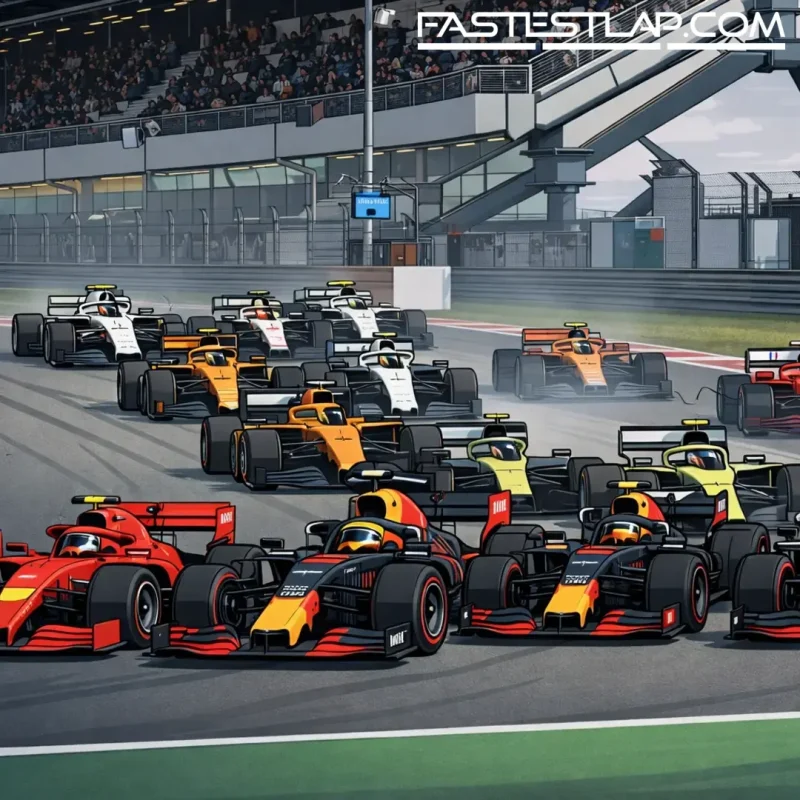
Formula 1 machinery is about to make some noise in Germany again — not for a grand prix, but for something that arguably matters just as much in 2026: tyres.
McLaren and Mercedes will run a two-day Pirelli test at the Nürburgring on April 14-15, using the current Grand Prix layout rather than the Nordschleife. It’s a small line on the calendar during the championship’s unofficial spring pause, but it’s a telling one. This is the first time contemporary F1 cars will turn laps on German soil since the Nürburgring hosted the Eifel Grand Prix in 2020, and it underlines how aggressively Pirelli’s development programme has had to move with the sport’s latest technical reset.
The Nürburgring outing is a dry-tyre test, part of Pirelli’s ongoing work to refine its 2026 range. With the new-generation cars and the narrower 18-inch tyre dimensions compared to 2025 — on both axles — Pirelli’s been asked to deliver a rubber package that behaves in a familiar window for drivers while tolerating a different cocktail of loads and energy. The construction and compound philosophy hasn’t been torn up, but “largely the same” in tyre terms never means simple. If anything, this year’s challenge is in the nuance: keeping a broad operating window, managing degradation characteristics across the range, and making sure the tyres don’t become the weak link as teams push the new cars harder through development.
That’s why in-season testing like this exists at all. Teams aren’t allowed to run current cars for performance development, but Pirelli is permitted its own programme — up to 40 test days — to gather the data it needs. Teams rotate through supplying cars and drivers so Pirelli can compare like-for-like information across different platforms. It’s one of the few areas where everyone in the paddock, rivals included, has to accept that the bigger picture matters.
There’s also a bit of context to the timing. McLaren and Mercedes had been slated to help with a wet-weather test in Bahrain at the end of February, but that plan was shelved when military conflict broke out in the region. The Nürburgring run isn’t a straight swap for that lost session; it’s not designated as a wet test and can be run in whatever conditions April in the Eifel decides to throw at the teams. In other words, Pirelli still has specific wet work to do elsewhere.
That part of the programme will be handled at Fiorano on April 9-10, where Ferrari will provide the car for a dedicated wet-weather test. And it comes after wet compounds were put through their paces in Suzuka recently, with Racing Bulls running Isack Hadjar and Arvid Lindblad across intermediate and full wet options. Even by modern standards, that’s a decent amount of wet tyre focus in a short window — which tells you Pirelli is taking no chances on a topic the paddock never stops arguing about.
The Nürburgring itself is an evocative choice for a test like this. Germany used to be a fixed point in F1’s identity, with the series bouncing between the Nürburgring and Hockenheim for decades (with that brief AVUS chapter in the early era). Aside from 1955, the country held a world championship grand prix every year until 2015, but after Hockenheim’s final race in 2019 it fell off the calendar entirely. The 2020 Nürburgring return was a pandemic-era exception, not a revival. So while nobody’s pretending a tyre test equals a German Grand Prix, the sight of modern cars circulating there again will still land with a certain weight.
Behind the scenes, the Nürburgring running also sits in a bigger commercial and political picture for Pirelli. Its deal as F1’s sole supplier runs through 2027, with an option for 2028. Paddock chatter has already pointed to Pirelli considering taking up that option, and the short-term goal is understood to be extending the relationship into 2028.
That matters because the wider tyre landscape is shifting. Pirelli is due to enter MotoGP in 2027, and in the background there’s been speculation that other manufacturers could look at F1’s next tender cycle. Names like Bridgestone and Hankook have been mentioned in that context, though neither has formally declared interest in taking over the F1 supply deal. Still, the mere possibility of a more competitive tender tends to sharpen everyone’s thinking — and it’s hard not to view a busy, visible test schedule in 2026 as part of Pirelli’s case for continuity. F1 remains a rolling laboratory with genuine technical value beyond the branding, and the company won’t want to give that up lightly.
For McLaren and Mercedes, the Nürburgring days won’t be about lap times, headline numbers or flexing form. They’ll be procedural, repetitive, sometimes dull — the kind of work engineers love and drivers tolerate. But they’re also the sort of sessions that quietly shape the racing we end up judging on Sundays.
And for Germany, it’s a reminder that while the calendar has moved on, the sport hasn’t forgotten the places that used to anchor it. Even if, for now, it’s only tyres that bring F1 back.