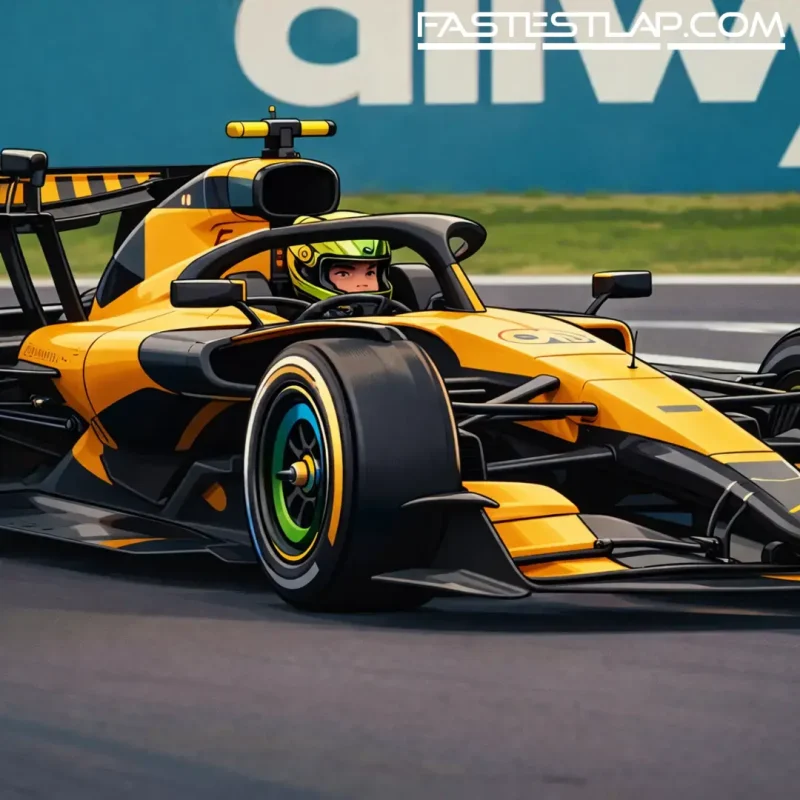
Lando Norris isn’t putting 2026’s shakier, livelier racing down to some grand philosophical reset from Formula 1. He likes plenty of what the new cars are asking of drivers. It’s the bit bolted in behind his seat that’s leaving him uneasy.
After Suzuka, Norris was keen to separate the chassis package — which he says he’s enjoying — from the new power unit behaviour that’s begun to intrude on decision-making in wheel-to-wheel fights. In his telling, the Japanese Grand Prix served up a perfect, slightly maddening example: battling Lewis Hamilton, Norris found himself committed to an overtake not because it was the moment he’d chosen, but because the battery deployment essentially chose it for him.
“I had a scenario in Japan where the battery deployment triggered, even though I didn’t really want it to,” Norris explained via McLaren’s official channels. “And I had to overtake Lewis as a result.”
The punchline, for a driver thinking two straights ahead, was immediate. Using the energy there and then meant he didn’t have it where he actually wanted it. “That meant I was then a sitting duck on the next straight,” Norris said, “where I had actually wanted to use the battery.”
It’s a small anecdote that lands with a larger thud, because it goes to the heart of what the 2026 regulations are trying to do — and the risk of where they might overreach. The new formula’s near 50-50 split between internal combustion and electric power, with the battery deploying and recharging multiple times per lap, inevitably drags energy management into the foreground. But Norris’ irritation isn’t with energy management as a concept; it’s with the sense that the system is sometimes managing him.
“For me, that’s taking too much control away from the driver,” he said.
It’s not a purely theoretical concern, either. Suzuka has already provided a more alarming illustration of how quickly the new dynamics can bite. Oliver Bearman’s high-speed crash while chasing Franco Colapinto into Spoon was linked to a hefty closing speed — around 30mph — that made the approach treacherous. Different incident, same underlying theme: if the cars are arriving at corners and battles with larger speed differentials because of how and when energy comes and goes, then the sport has to be absolutely sure the drivers are not passengers to an algorithm.
That’s why Norris’ tone is less rant than warning flare. He’s clearly not trying to torch the rules in April; he’s trying to influence how they’re interpreted and refined while there’s still time to smooth out the worst edges. Norris says there has been “good dialogue” with the FIA and that he expects changes to be in place by the time F1 returns to racing in Miami.
What makes the whole thing more interesting is that Norris isn’t delivering this critique from a place of misery. Quite the opposite: he sounds like a driver who’s rediscovered a type of car he missed.
“These cars are certainly very different to the cars from last year,” he said. “Some of which I enjoy, some of which I’ve found a bit more difficult so far.”
Last year’s machines, he argued, were monsters for downforce — spectacular when hooked up, punishing when they weren’t. “Loads of downforce… on rails when we got them dialled in,” was his summary, followed by the familiar warning that once grip went, it really went.
This season’s lower-downforce 2026 cars have moved the limit closer to the driver and made that limit more negotiable. Norris likes that he can catch slides more readily, that the reduced grip is “very exciting” to lean on, and that the whole thing feels closer to what he drove on the way up the ladder — meant as a compliment, not nostalgia bait. There’s a telling line in there too: “you really feel like you can make a difference.”
That’s the crux. The chassis is giving more agency back. The power unit, in his view, is at risk of taking it away again — not because drivers can’t handle the complexity, but because the complexity is being handled for them in moments when instinct and judgement ought to be decisive.
Norris also struck a pragmatic note that will resonate with the people actually writing the sporting directives. The racing has been entertaining, and drivers aren’t blind to the show. “We’re glad the fans are enjoying the racing,” he said, pointing out that F1 is “an entertainment sport at the end of the day.”
Still, he drew a clear line between genuine on-track jeopardy and what he called “artificial elements” — the sort that can make an overtake feel preordained, or a defence feel hopeless, depending on what the battery decides to do when. His optimism is that the sport is close to the right balance, but not quite there yet.
The tricky part for the FIA and the stakeholders Norris referenced is that there’s no free lunch. Give the driver full manual control and you risk turning races into complicated energy games that only a couple of brains can truly optimise in real time. Automate too much and you get what Norris experienced at Suzuka: a driver making a move because the car has effectively nudged him into it, then paying for it a straight later.
Suzuka has a habit of exposing anything that doesn’t quite add up. Norris’ point is that 2026’s cars, as pure driving tools, are already delivering the sort of edgy, workable grip that racers tend to love. Now the power unit logic needs to catch up — before the sport normalises a world where the most important decisions in a fight are being taken out of the cockpit.