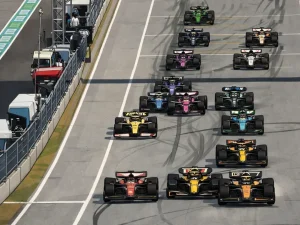
Max Verstappen hasn’t been subtle about what’s bothering him in Formula 1’s 2026 reset. It isn’t the look of the cars, or the broader direction of the rules. It’s the way the new power units are forcing drivers to manage energy in places they previously made their reputations.
Franz Tost, watching this season with the detached eye of a team boss who’s seen several technical revolutions come and go, thinks he understands why Verstappen has been the loudest critic. In short: the regulations have diluted one of the sharpest weapons in the very best drivers’ arsenal — that last, brutal slice of braking performance that used to create separation.
The new units run on a 50/50 split between electrical and combustion power, and the knock-on effect has been felt most at the end of straights. Battery harvesting and the much-discussed “superclipping” mean drivers are sometimes arriving at braking zones having already lifted earlier than instinct dictates, not because they’re defending, saving tyres or setting up a move, but because the car needs to recover energy. The spectacle might not always suffer — overtaking numbers have been healthy — but the craft has undeniably changed.
Tost, speaking to *Krone*, argued that the complaint coming from Verstappen and others isn’t nostalgia, it’s frustration at having a proven skill neutralised.
“I haven’t seen a single boring race this season,” Tost said. “Sure, there have been a lot of discussions about the new regulations. I can also understand the frustration of the top drivers.
“Drivers like Max Verstappen, Lando Norris, or Fernando Alonso used to be able to exploit their strengths under braking. But if you have to lift off the throttle 10 or 20 metres before the braking point to recharge, that advantage is lost.”
That’s the key detail often missed when fans reduce the debate to simple “drivers don’t like change” grumbling. For years, Verstappen’s edge has been his ability to arrive at the corner on the limit — later, harder, more committed — and still rotate the car without overstepping. If the rules force everyone to back out early to meet an energy target, the braking contest becomes less about nerve and technique and more about compliance. It’s not that there’s no skill involved; it’s that the skill is being asked to live in different places, and some of the most decisive moments are being artificially sanded down.
Verstappen has made that point in his own, less diplomatic language across the opening chunk of the season, likening the current generation to “Mario Kart” and “Formula E on steroids”, and describing it as simply not “fun” to drive. And the timing of his discontent is hardly ideal for Red Bull: after dominating the ground-effect era — including that extraordinary 2023 season of 19 wins from 22 races — he’s started 2026 on the back foot.
Seven race weekends in, Verstappen sits on 55 points while championship leader Kimi Antonelli has surged to 156. Those numbers don’t just underline a performance swing; they intensify every quote, every radio message, every sigh in the media pen. When a driver is winning, complaints can sound like background noise. When he isn’t, they sound like a warning siren.
Tost, though, is pushing back on the idea that the sport is in trouble. From his perspective, the racing product has been strong and the audience isn’t obsessing over state-of-charge graphs the way engineers and drivers do.
“The development is heading in a very positive direction,” he said. “There are many overtaking manoeuvres, which are exactly what the spectators want to see, in my opinion. Whether the battery is full or empty is of no concern to most fans.”
That line will resonate in the rule-making corridors, because it’s the fundamental tension of 2026: the championship can be entertaining while still leaving the drivers feeling like passengers to energy management. F1 has always balanced performance and show, but rarely has the trade-off been so obvious on the straights, with cars visibly hitting an invisible ceiling as they approach the braking zone.
The sport has, however, listened — at least partially. The FIA’s World Motor Sport Council has now officially ratified power unit ratio changes for 2027 and 2028, shifting the split back towards the internal combustion engine.
In 2027 the plan moves to a 58-42 split in favour of the ICE, followed by 60-40 in 2028. The details matter: next season, combustion power rises by around 20kW (25bhp) while ERS is reduced by 50kW (67bhp). Maximum harvesting increases by 25kW per lap, a move aimed directly at reducing superclipping, and fuel flow is permitted to rise by up to five per cent.
Then in 2028, fuel flow increases by 13 per cent overall, the ICE climbs to 450kW (roughly 600bhp), and maximum harvesting power increases by a further 25kW per lap — the final step toward that 60-40 balance.
None of this is a magic wand. Drivers will still manage energy. Engineers will still chase the optimal deployment curves. But it’s an admission that the pendulum may have swung too far in 2026, turning too many flat-out moments into negotiated compromises.
And for Verstappen — whose style has always thrived on decisive, old-school aggression — it’s also a reminder that the sport is prepared to bend when enough people inside it agree something doesn’t feel quite right. Whether the timeline helps him is another question entirely. In a season already slipping away on points, the broader regulation fix arriving in 2027 and 2028 may offer validation more than relief.