
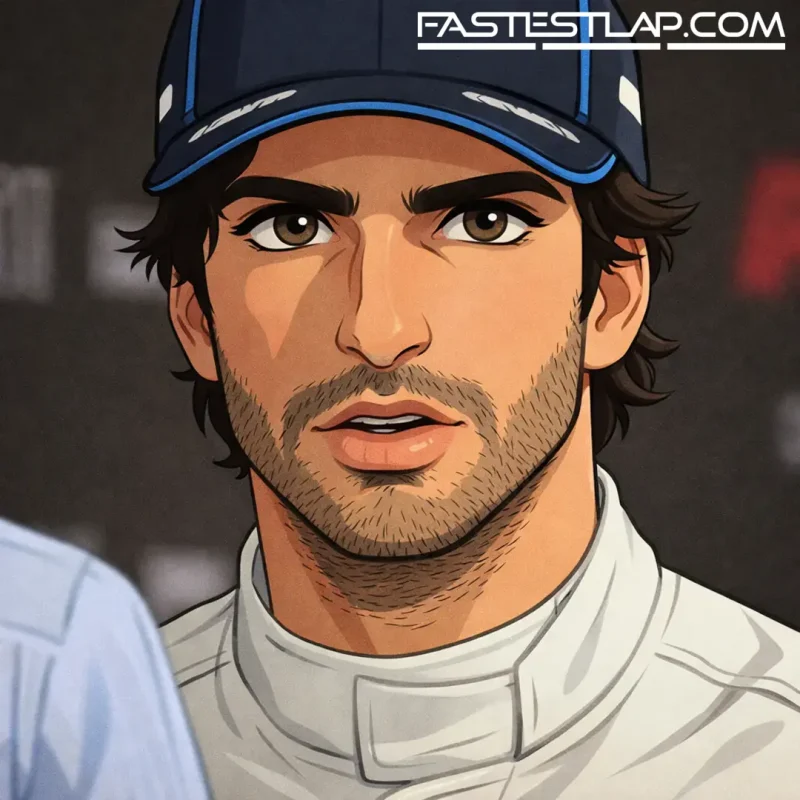
Carlos Sainz doesn’t sound like a driver nitpicking around the margins. At Spa-Francorchamps, he was talking like someone who thinks Formula 1 has walked itself into a corner — and that the much-hyped 2026 reset isn’t going to be the clean escape route fans have been promised.
The irony is that Spa is the sort of place F1 usually uses to sell itself: long straights that reward commitment, iconic high-speed sequences that separate the brave from the merely quick, and enough flow to remind you why drivers still talk about “feel” in an era of models and maps. This year, though, it exposed the ugliest side of the current energy-management reality — superclipping, harvesting, and that unmistakable sensation that the cars are being asked to run a version of the lap that isn’t quite flat-out.
Ten races into a season defined by driver grumbling on the radio and technical briefings about energy deployment, Spa gave them a public stage. The figures being thrown around in the paddock were stark: around 50km/h down at the end of Blanchimont, roughly 40km/h down through Pouhon compared to last year in qualifying trim. At a circuit where speed has always been the point, that’s not a small aesthetic problem — it changes the character of the lap.
Sainz’s own weekend hardly offered the comfort of distraction. He finished 16th, only three places better than where he started across 44 laps, and his post-race tone reflected a driver who didn’t feel the racing itself was the main story.
“In the race, obviously you are more grip limited, so you fight the car a bit more through there,” Sainz said when asked about Pouhon’s shifting identity — a corner that, in previous seasons, was a proper commitment test and now risks becoming something you simply get through. “But yeah, I think we all missed the qualifying of last year, especially at a track like this or Silverstone.
“I think everyone knows this is not good enough for Formula One and needs to be changed.”
That’s the crux. This isn’t just about one circuit “not suiting” a particular regulations cycle. Sainz’s frustration is aimed at the sport’s direction of travel: the way power delivery and energy recovery are currently dictating the spectacle at exactly the venues where F1 most wants the cars to look alive. He accepts it will be “evolved” — there’s an implicit acknowledgement that the governing bodies and manufacturers know it isn’t landing — but his patience for incremental tweaks is clearly limited.
“It’s clear that none of us are enjoying the cars as much as last year to drive,” he added.
Spa, in other words, wasn’t an outlier in Sainz’s mind. It was a warning flare.
When pressed on whether the circuit had simply brought the worst of harvesting and superclipping into focus, Sainz didn’t hesitate. “Probably,” he said — and then pointed to an even less forgiving test that’s still to come: Monza.
“Monza, there’s no high speed where you play with the throttle and the brakes a bit,” Sainz explained. “So we will just super clip and cut the energy a lot in the straights.
“But the corners should be not that different [to Spa]. And then, yeah, this and Silverstone are probably the worst in terms of missing and high-speed performance.”
There’s a subtle but important detail in that assessment. Spa at least offers sequences where the driver can still lean on the chassis, still work the car, still create a little theatre through commitment and rhythm — even if the top-end figures have been blunted. Monza is far more binary. If the energy deployment picture is as limiting as Sainz suggests, the risk isn’t merely that the cars look slower; it’s that the lap starts to feel like it’s being dictated by constraint rather than bravery.
That context matters when the conversation turns to 2026, because the sport’s next big regulations overhaul is being marketed as a clean-sheet solution: new cars with active aerodynamics and a new engine formula with a 50/50 split between combustion and electrical power. Sainz, though, doesn’t sound convinced that changing the packaging will fix the sensation drivers currently hate.
He was asked specifically about an anticipated tweak that would tilt the balance towards the combustion side in a 58/42 split. Would that be enough to make a noticeable difference?
“Probably not,” Sainz replied. And then came the line that will resonate inside a paddock that’s spent the season trying to square sustainability messaging with a product that, at times, looks visibly constrained. “That’s why they are already planning a change because they know this is not the best.
“So even though they will try and improve it, and it will improve, I think everyone knows enough of too much electric and just go back to what was always working.”
It’s not hard to hear the broader frustration behind that. F1 doesn’t have a credibility problem with innovation — it’s built on it — but it does have a credibility problem if the cars at Spa and Silverstone stop looking and feeling like the fastest, most aggressive circuit racers on Earth. When a driver as measured as Sainz is essentially saying the sport has overcooked the electrical element, he’s not arguing for nostalgia; he’s arguing for the basic sensory promise of F1.
Spa has a habit of clarifying debates that might otherwise stay abstract. This weekend, Sainz used it to put a very direct question back to the rule-makers: if the pinnacle can’t look like the pinnacle at the circuits that define it, what exactly are we optimising for?









