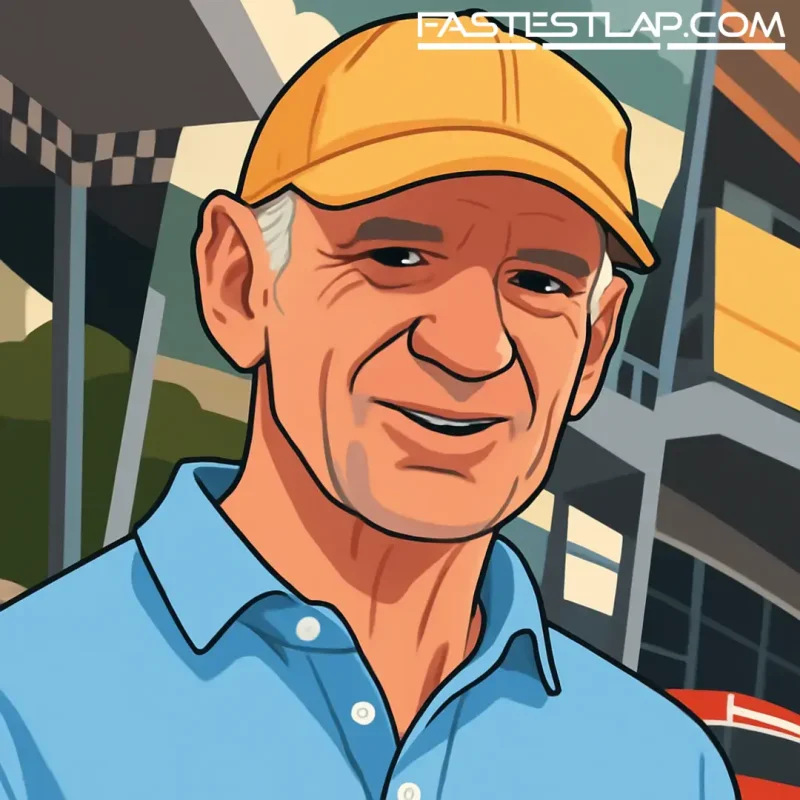
Adrian Newey has never been one to romanticise the grind. Ask him about the golden years and he’ll talk instead about the season that went wrong — the one that stripped the ego, shook the confidence, and taught him how to build something better.
Before he was the most decorated designer in Formula 1 history, Newey was the prodigy who shot up through March and Leyton House with dizzying speed, winning in sports cars and IndyCar before turning his hand to F1. His first Formula 1 chassis for March in 1988 punched well above its weight; the paddock took notice. Then came 1989, and a car that simply didn’t work. Week after week. Publicly.
On the James Allen on F1 podcast, Newey didn’t sugar-coat the impact. People remember the wins, he said, but it’s the “duff” seasons that test your bearings. The Leyton House misfire proved a brutal education: engineering doesn’t care for hubris, and even the cleverest ideas can fall flat if you stop being ruthlessly objective. When the fixes don’t arrive and the stopwatch won’t lie for you, self-belief gets noisy. So do colleagues, and critics.
Newey’s point wasn’t nostalgia. It was the through line. He’d been fast-tracked early — chief designer in his mid-20s, technical director before 30 — and admitted he might’ve bought into the hype after 1988. The failure that followed was the reset. The lesson wasn’t poetic, it was practical: ditch the ego, double down on fundamentals, keep listening.
He traces some of that resolve even further back. Coming into Southampton University by way of an Ordinary National Diploma rather than traditional A‑levels left him short on maths and nearly out the door in year one. That didn’t happen by accident; it took a kind of stubbornness that would later prove useful when a Formula 1 season went sideways. Setbacks arrive, in life and in racing. What matters is what you do after the debrief ends.
All of which lands differently now that Newey is Aston Martin’s team principal and a shareholder, steering the project into 2026. He’s already at work on the first car of the new rules cycle, the one that will coincide with Aston Martin’s Honda works era and a reset of the aero and power unit landscape. The job isn’t to sprinkle star power on a green car. It’s to build a culture that doesn’t flinch when the numbers don’t flatter, to make sure the first answer isn’t always the final one, to turn bruises into upgrades.
If you’ve watched Newey teams over the decades, you’ll recognise the pattern: the quiet confidence that the right path might look odd until it’s fast; the willingness to live with uncomfortable truths until they’re understood; and the calm acceptance that Formula 1 is the most public place on earth to be wrong. That outlook is worth as much as any sketch on a drawing board, particularly with wholesale regulation change looming.
He put it simply: there’s no flat line of happiness in this sport. There’s no perfect curve. Success is a jagged graph, and sometimes it dips for a while. The trick is keeping your head when the graph looks ugly, and trusting the work when it says you’re heading in the right direction.
Aston Martin, as a project, has never lacked ambition. What it has needed — what every team needs when the horizon keeps moving — is a steady hand that’s seen both sides of the sport and understands which scars to lean on. Newey’s got plenty, and he wears them lightly.
The next chapter, then, isn’t about the mythology of a genius arriving to save the day. It’s about a veteran who remembers exactly how it felt when a car wouldn’t respond and a season wouldn’t turn, and who knows how to keep a group together until it does. If Aston Martin are going to hit the ground running in 2026, it’ll be because they’ve learned — and kept learning — the same lesson that once blindsided their team boss: there’s no room for ego in engineering, but there’s endless room for resilience.