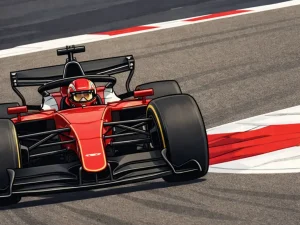
Fred Vasseur didn’t so much question the FIA’s process as its calendar.
Ferrari’s team boss has branded it “a shame” that Formula 1’s looming decision on the 2026 power unit compression ratio debate won’t translate into any on-track regulatory change until 1 August — even though the vote itself is expected to be wrapped up before the season-opening Australian Grand Prix.
That timing is the part Vasseur can’t quite swallow. Teams are about to ship equipment to Melbourne, and yet the sport is still living in a holding pattern: a rule clarification (or effectively a rule change, depending on your point of view) may be approved, but any enforcement is scheduled only after race 13, the Hungarian Grand Prix.
“First, we don’t have a clear decision today,” Vasseur said in Bahrain. “It’s quite difficult, because we have to send the engine to Melbourne in two days’ time.
“Now that it’s [a] challenge, but overall, we have to trust the system. We are convinced that we will find a solution between us, and then we have to follow the process of the governance of Formula One. But yeah, it’s a shame. It’s more on the delay and the timing than something else.”
At the heart of the saga is the wording of the new engine regulations around compression ratio, set at 16:1. The relevant clause, C5.4.3, states: “No cylinder of the engine may have a geometric compression ratio higher than 16:1. The procedure to measure this value will be detailed by each PU Manufacturer and executed at ambient temperature.”
The dispute, as it has been discussed in the paddock through the winter, is whether an interpretation exists that allows a manufacturer to satisfy the ambient-temperature test while effectively achieving a higher ratio in running conditions. Mercedes has been widely linked with that interpretation — framed by rivals as exploiting a loophole to reach an 18:1 equivalent when the unit is operating.
After weeks of back-and-forth and Power Unit Advisory Committee discussions, the FIA has now pushed the question to a formal e-vote among the power unit manufacturers. In its statement, the governing body said the vote is “primarily centred on a proposed change to the assessment of the power unit compression ratio in running condition”.
The FIA’s compromise is to keep the 16:1 limit, but alter how compliance is proven. The proposal would require manufacturers, from 1 August 2026, to demonstrate the compression ratio limit not only at ambient conditions but also at a “representative operating temperature” of 130°C. The FIA expects the vote result within 10 days.
That delay — effectively granting half a season of running under the current measurement method — is the political reality of modern F1 governance. This isn’t being treated as a case of illegality, and the FIA is wary of detonating competitive balance by springing a redefinition on engines that are already built and signed off.
FIA single-seater director Nikolas Tombazis made the rationale explicit: “We felt it was feasible, because we felt there wasn’t any discussion of anything illegal. We think people have spent time designing their engines and solutions.
“We didn’t feel it was fair to do something for the start of the season. We felt it was wrong, but we also didn’t feel it was something as it was beyond what we felt was the intention of the rules.
“We felt it was correct to also not let it go on too much… we felt it was a balanced approach.”
In other words, the FIA is trying to land in the narrow strip between “we’re not accusing anyone” and “we can’t let this become the de facto rulebook”. The 1 August date is a line in the sand that acknowledges development investment, but stops short of letting the debate drag into 2027.
The voting mechanism also tells you this is bigger than one team’s gripe. It requires a supermajority: four of the engine manufacturers, plus Formula 1 and the FIA, must agree for the change to be adopted. That sets a high bar and all but guarantees heavy behind-the-scenes lobbying, because the consequences aren’t just philosophical — they’re performance-related, and in a new engine era, the first few months can set the competitive narrative for years.
Tombazis also pointed out the immediate practical impact if the change is approved: cars running from August onward would need to meet the new operating-temperature compliance check. What teams do in Melbourne is their own business, but if anyone is “beyond that level” early in the year, they would eventually have to make adjustments for the second half of the campaign.
And yet, even as the noise around the topic has grown, Tombazis insisted it’s being inflated. “I do also stress that I think this matter isn’t really something that is anywhere near as important as people make out,” he said.
That may be so in pure lap-time terms — or it may be the sort of thing that only looks “small” until someone turns up with a meaningful advantage. Either way, the bigger issue for Vasseur is the uncertainty. Teams are expected to plan, commit and ship with the regulatory ground still shifting beneath them, even if the quake doesn’t officially hit until midsummer.
The irony is that the vote itself could, in theory, put the controversy to bed before a wheel even turns in anger in Australia. But the delayed enforcement means the paddock will spend the first half of 2026 racing with one eye on Budapest — and on what, precisely, everyone has built into their 2026 power units while the rule was still being read one way rather than the other.