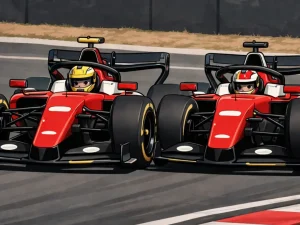
Ferrari will lift the curtain on its 2026 colours on Friday morning at Fiorano, before sending the SF-26 out for its first public miles on the team’s private test track.
It’s the familiar Maranello routine — the low-key launch on home soil, the drivers in attendance, the first shakedown laps in front of the tifosi and the cameras — but the subtext this time is harder to ignore. Ferrari isn’t just unveiling a new paint job; it’s cashing in the chips it pushed to the middle of the table last year.
The Scuderia ended 2025 a disappointing fourth in the Constructors’ Championship, and that slump didn’t come out of nowhere. Ferrari had already made its call: stop spending time and resource on the SF-25 and pivot early to the all-new 2026 package. That’s an aggressive trade-off in any season, and an even bolder one when you’re Ferrari and “fourth” lands like a small scandal.
Friday’s reveal is the first tangible proof of what that sacrifice bought them.
Both Charles Leclerc and Lewis Hamilton will be at Fiorano for the launch, and they’ll also handle the initial running. Those early laps are rarely representative in performance terms — nobody’s pretending otherwise — but they matter internally. For a team that can feel mood swings more sharply than most, there’s a psychological value in simply getting the new car out cleanly, ticking through the systems, and letting the drivers start building a relationship with it before the paddock circus rolls into Barcelona.
The timing is no accident either. Ferrari’s Fiorano day comes three days before the first pre-season test begins in Barcelona on Monday, giving the team a small window to iron out any immediate gremlins before it joins everyone else in the more exposed environment of collective testing. In modern F1, where a single reliability hiccup can trigger a week of noise, that breathing space is useful.
For Hamilton in particular, it’s another early milestone in what is already the most scrutinised move on the grid. He doesn’t need a theatrical first impression — he needs a functional one. The best launches Ferrari have done in recent years have been the ones that felt almost boring: car runs, drivers smile, engineers go to work. If the SF-26 starts, stops, and does what it’s told, that’s a win on day one.
Leclerc, meanwhile, will be keen to get a first sense of whether Ferrari’s 2026 direction gives him a platform he can trust across a season, not just on the occasional weekend when everything aligns. He’s been the reference point through the team’s recent peaks and dips; now he shares that centre of gravity with a seven-time world champion. That changes the internal temperature, and it changes the pressure on the car to meet two sets of demands.
What we won’t get on Friday is anything definitive about where Ferrari sits relative to the rest. The real judgment begins in Barcelona, and even then the paddock will spend most of the week trying to work out who’s sandbagging, who’s in trouble, and who’s quietly nailed the basics. But there’s still something revealing about Fiorano: Ferrari’s confidence is often visible in the way it carries itself, not in lap times. If the team looks organised, if the running looks smooth, if the drivers climb out talking about balance rather than “a few small things”, you can usually tell the winter has been at least competent.
And competence has been the elusive currency at Maranello for too long — not speed in flashes, not brilliance in single-lap moments, but the calm, repeatable execution that turns a good concept into a season.
Ferrari chose to pay for 2026 with 2025 points. Friday is where we start to see whether it bought them something meaningful.