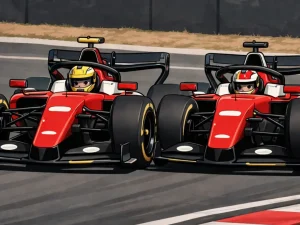
Ferrari will sit out the opening day of pre-season running in Barcelona, with Fred Vasseur confirming the Scuderia won’t take to the Circuit de Barcelona-Catalunya until Tuesday.
It’s the latest example of teams treating this five-day test like a chessboard rather than a mileage free-for-all. With the 2026 regulations resetting the sport’s technical landscape and the rules limiting each team to running on just three of the five days, the traditional “everyone turns up Monday and goes flat-out” rhythm has vanished. McLaren has already said it won’t run on Monday either, and Ferrari is now taking the same view: pick your days, protect your programme, and don’t waste a token if the plan isn’t there to use it properly.
The timing matters because Ferrari has already ticked off the first public-facing milestone. On Friday it unveiled the SF-26 and immediately put the car through its paces on a Fiorano filming day, capped at 200 kilometres. Lewis Hamilton and Charles Leclerc both got their first laps in red, enough to shake the systems down and do the obvious checks without pretending it’s anything like a representative test.
That Fiorano running also helps explain the Barcelona call. Ferrari isn’t arriving cold; it’s arriving having already validated the basics. In a winter where teams are juggling brand-new technical rules and compressed track opportunities, that small head start can be worth more than another half-day of low-grip Monday running in Barcelona if your priority is controlled correlation rather than headline lap times.
Vasseur, speaking after the launch, framed Ferrari’s approach in the language you’d expect from a team thinking about the long game rather than the first timing screen of the year.
“It’s the beginning of the season, the beginning of the test of the preparation of the season, and we know that the season will be quite long,” he said. “Now we have to be focused on Barcelona.
“We will start the test on Tuesday, and then, with the regulations, we decide which dates we have to run – Thursday, we will also be on track.”
That leaves Ferrari with a clear programme: Tuesday and Thursday are locked in, with one further day to be chosen from what remains. The wider paddock expectation has been that many would opt for a Monday-Wednesday-Friday pattern, but the early confirmations already show there won’t be a single “standard” schedule this year. Some teams will want the bookend days to chase improved track conditions and clear air; others will prioritise spacing to allow overnight changes and analysis. Ferrari, at least publicly, is leaning into the idea that understanding comes before performance.
That message ran right through Vasseur’s comments about the SF-26 appearing in an initial, baseline specification. The early emphasis is on building an accurate picture of the car’s behaviour and systems, then deciding where the development effort bites first. It’s a very modern way of saying what teams have always known: the fastest development plan starts with the best data, not the best-looking lap time.
“I think the most important thing at the beginning is the reliability,” Vasseur added. “The most important [thing] is to be able to do mileage. That’s why we are quite happy today, because we didn’t have an issue.
“It’s a good step that in Barcelona, the target will be to get a maximum of information on the car, maximum of data, and then we start the development from Bahrain onwards.”
Loic Serra, Ferrari’s chassis technical director, offered a useful insight into how Ferrari has tried to set itself up for the kind of season 2026 is expected to be: one where nobody lands on perfection immediately, and the ability to evolve quickly matters as much as the first iteration.
“We tried to extend the conceptual phase because, effectively, when you have brand new regulations, you need to be able to go through the loops of development several times, as many as you can,” Serra explained. “At one stage, you have to settle down the solution and then make it happen.”
The key line, though, was less about what Ferrari has chosen and more about what it has deliberately avoided: painting itself into a corner.
“We also had in mind to make sure that we know that with these developments, with these new regulations, car development will be a big topic during the season,” he said. “So we need to make sure we’re not cornering ourselves in the design and that we have enough potential for the car development.”
Pressed on how quickly the SF-26 might change even before the first race, Serra didn’t try to play it down.
“There will be evolution of the car, for sure,” he said. “The development doesn’t just start with the beginning of the season. It will be there as well in winter testing; there will be some evolution, for sure.”
All of which makes Ferrari’s Barcelona decision feel less like a team ducking early attention and more like a team trying to put its limited track days where they’ll yield the cleanest answers. In 2026, a “missed” day isn’t a crisis — it’s just a different bet on when the most useful running will happen.
And for Ferrari, with a new car, a new technical era, and Hamilton still at the very start of his real integration into the operation, there’s a certain logic to ensuring the laps it does take in Barcelona are the ones that count.