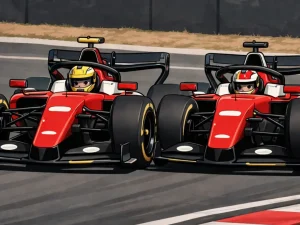
Ferrari lights the fuse: SF-26 engine fires up as Cadillac turns first laps
Ferrari gave Maranello something to clap about this week, sparking its 2026 power unit into life with Charles Leclerc and Lewis Hamilton watching on from the dyno room. The factory floor applauded when the hybrid V6 fired and settled, the seven-time champion catching it on his phone like everyone else who knows noises still matter in a future that’s half-electric.
The timing wasn’t accidental. The clip landed the same day Cadillac logged its first laps with Ferrari’s customer engine package during a shakedown at Silverstone, making the American outfit the second to taste-track a 2026 car after Audi’s early run in Barcelona a week ago. For a sport staring down the barrel of sweeping new rules, it was a neat bit of choreography: Ferrari shows the heartbeat, its new partner gets it moving.
F1’s 2026 reset is a big one, an unusually synchronized chassis-and-engine reboot that blends 50% electrification with fully sustainable fuels and active aero. Power unit supply has consolidated into five names for the new era: Ferrari, Mercedes, Honda, and newcomers Audi and Red Bull Powertrains-Ford. In that group, Ferrari’s the constant, juggling works ambitions with customer duties — and in Cadillac’s case, a critical bridge. Cadillac will run Ferrari power to start its F1 programme while its in-house unit continues in development, with the American PU not expected to arrive until 2029.
Back in Maranello, the short video said plenty without revealing much. Leclerc and Hamilton shared a few words with team boss Fred Vasseur and deputy Jerome d’Ambrosio after the run, a small moment that still carries weight. If you’ve ever been in the room for a fire-up, you know the drill: months of spreadsheets and sleepless nights condense into a single button press, and if the room claps, it’s not for show.
As for what’s under the covers, Ferrari’s 2026 design has been the subject of familiar paddock whispers. Multiple reports in recent months have pointed to a “different” approach from Maranello, notably the use of steel alloy cylinder heads in pursuit of higher pressures and temperatures at ignition. In an era where aluminum has been the staple for its weight advantage, going steel sounds counterintuitive — until your combustion is cleaner and more efficient. Reliability was the sticking point, with Ferrari thought to be keeping an aluminum fallback live as a hedge last year. The word now is that durability breakthroughs have nudged the Scuderia toward committing to the steel solution for 2026.
We’ll see the rest soon enough. Ferrari’s SF-26 is scheduled for a January 23 launch, just ahead of the first pre-season running in Barcelona. Expect the usual blend of tight bodywork and carefully curated angles, plus plenty of intrigue about how teams intend to exploit active aero in tandem with the more potent hybrid systems. And expect a lot of ears straining through headphones on pit wall: with the MGU-K contribution cranked up and sustainable fuel in the tank, the soundscape will be different — not worse, just different.
On the customer front, Cadillac’s shakedown was an important first lap in a long game. New entrants don’t get many quiet days in modern F1, and having Ferrari power buys time, data, and a yardstick. It’s hard to overstate the value of those first installation miles at Silverstone. Audi’s earlier run in Spain showed the same intent: be early, learn fast, and build from something other than a white sheet of paper.
There’s already been fan art doing the rounds — concept liveries of a scarlet SF-26 imagined by talented designers online — but the only colours that truly count are the ones you can see reflected on the dyno, on the garage floor, and, soon, against the timing screens. In that sense, Ferrari’s week was useful. One car sang. Another, wearing its badge on a different nose, turned wheels. For a team that wants to be the benchmark in the next era, that’s exactly the sort of two-step that sets a tone.
Leclerc and Hamilton will be the ones judging the real thing when it hits the track. For now, the message out of Maranello is simple and loud enough: the 2026 Ferrari is alive, and the heartbeat sounds healthy.