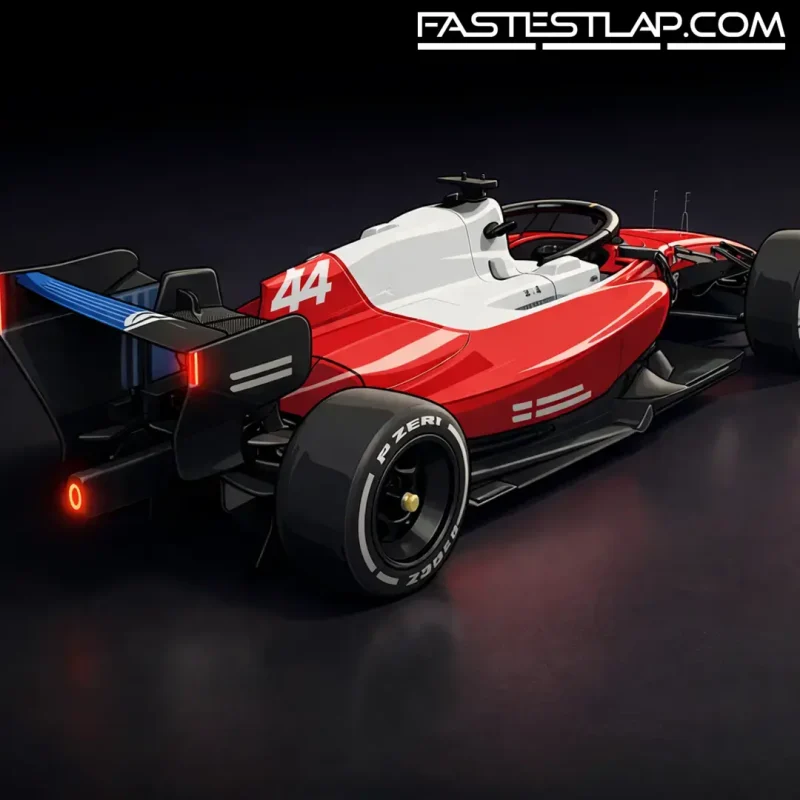
Ferrari didn’t waste time easing itself into Formula 1’s new era. With the SF-26’s “new-concept” livery unveiled in a short video, Lewis Hamilton rolled the car out of the Shell garage at Fiorano and put the first kilometres on Maranello’s 2026 challenger in front of a predictably devoted crowd.
It was a cold, overcast morning, but that rarely dampens the appetite around Fiorano when there’s a brand-new Ferrari to see — especially one carrying so much symbolic weight. Fans reportedly started turning up around 5am, with Hamilton finally heading out closer to 11. The scene was familiar: phones raised, cameras chattering, cheers echoing off the trees. The context, though, is anything but.
Because this isn’t just another shakedown. The SF-26 is Ferrari’s first real-world step into a rules reset that changes the personality of the cars as much as their look: the 2026 machinery is shorter and lighter than last year’s, it runs active aerodynamics, and it’s driven by a power unit concept built around a 50/50 split between electrical and combustion power.
Ferrari’s new engine was, inevitably, part of the intrigue. But the early laps at Fiorano were never about lighting up the timing screens or making a statement about pace. They were about proving the thing works — and doing it early.
That point has been made repeatedly inside the team, most clearly by Fred Vasseur, who has framed the start of 2026 as a season in which competence and reliability could be worth more than any shiny early performance headline. Ferrari’s approach, he’s said, is to run a “Spec A” car first: establish that the fundamental concept is sound, bank mileage, and only then push hard on development.
It’s a mindset shaped by the reality of modern F1 testing. Teams aren’t sitting on a cushion of endless track time anymore, and while 2026 brings more running than recent winters, it still won’t feel generous when you’re trying to validate an entirely new set of technical choices. Vasseur’s point last year was blunt: the first target is mileage, not lap time. Reliability first, performance second — because if you discover a big problem late in testing, you can easily find yourself arriving at the season opener without time to properly respond.
That’s why today’s laps matter, even if nobody outside Maranello knows what fuel loads were in it, what modes it ran, or what Ferrari learned. The value is in the boring bits: systems behaving, cooling doing its job, hydraulics and electronics surviving, and a car that can be run through a sensible programme rather than spending the morning parked up behind the garage with bodywork off.
For Hamilton, it was also the first proper public glimpse of him doing what Ferrari hired him to do: lead from the cockpit in a season where driver feedback is going to be heavily leaned on. New cars, new tyres, active aero, a different power delivery profile — everyone will be learning, but the teams that learn cleanly and quickly will get to spend their winter chasing speed rather than chasing fixes.
Ferrari’s day also underlined the scale of the attention that follows it, regardless of whether it’s a filming-style shakedown or a full test. There was plenty of fan-shot footage circulating within minutes, and the official clips did the rounds just as quickly.
Next comes the more serious work. After Fiorano, Ferrari heads to Spain early next week for a five-day behind-closed-doors test, with each team permitted to run on three of those days. Then the sport switches into its usual pre-season rhythm with two official Bahrain tests: 11–13 February and 18–20 February.
The clock is already visible in the distance. The 2026 season begins with the Australian Grand Prix on 8 March, and in a regulation change year the opening flyaways can punish hesitation. It’s why Vasseur has been so insistent about the “Spec A” philosophy: arrive at the first races knowing what you’ve built, not still diagnosing what you thought you built.
For now, Ferrari’s first message of 2026 is simple. The SF-26 is alive, it’s rolling, and the team has started the hard part — turning a concept into a car that can actually go racing.