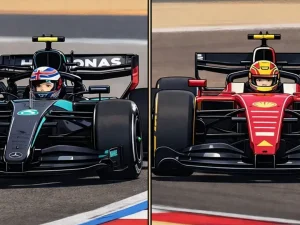
Ferrari is keeping its powder dry as the first proper flashpoint of 2026 approaches.
With the paddock still swirling around the new power-unit compression ratio and the suspicion that Mercedes has found a neat way to benefit from how it’s measured, Fred Vasseur has made Ferrari’s position plain: the Scuderia wants a ruling, not a courtroom drama. And it won’t be turning up in Melbourne with a protest document ready to slide across the stewards’ desk.
“My point of view on this is… for sure we are going into the direction they have to have grey area,” Vasseur said at Bahrain testing, outlining what most teams privately accept about sweeping regulation resets: ambiguity is not a bug, it’s a feature — at least at the start. “The most important for me is to get clarity… what we need is to have a clear cut, it’s okay now, it’s like this.”
That framing matters. Ferrari isn’t pretending the issue doesn’t have competitive consequences, but it’s consciously trying to steer the conversation away from legality-by-protest and towards governance-by-decision — an important distinction at a point in the cycle when nobody wants the opening races coloured by appeals, politics and the whiff of “gotcha” tactics.
The dispute itself has a familiar shape: a rule written with one intention, a measurement process that creates an interpretation gap, and a couple of manufacturers allegedly being clever in the bit in between.
For 2026, the FIA has moved Formula 1 to new 50/50 electric and biofuel power units and, in that broader rewrite, reduced the engine compression ratio from 18.0 to 16.0. The compromise was presented as part of a package designed to broaden manufacturer interest — a list that includes Audi, Ford and Honda’s return as a works player.
But the detail that’s set the whole thing humming is how the compression ratio is checked: at ambient temperatures. The rumour — and it has done the rounds loudly enough that it’s become a formal talking point — is that Mercedes and Red Bull Powertrains have found a way to run effectively higher compression at track temperatures while still satisfying the letter of an ambient-only test.
This is where the politics get prickly. Because even rivals who suspect Mercedes of gaining an edge also know the uncomfortable truth: if the regulation and test procedure allow it, then calling it “illegal” is a stretch. The fight, then, isn’t about catching someone cheating. It’s about changing the framework before the competitive landscape hardens.
That’s why the pressure is on the FIA and FOM to decide whether to add a hot-temperature test to remove the grey area. The Power Unit Advisory Committee has already been discussing the matter in a series of meetings, and the timetable is tight: power unit homologation is due on 1 March. There’s also a meeting of the F1 Commission expected next week involving all 11 teams, the FIA and FOM, with this prospective change on the agenda.
The subtext is obvious. Once the ink dries on homologation, you’re no longer simply “clarifying” — you’re potentially forcing redesigns or freezing in an advantage, depending on which way the ruling falls. That’s why Vasseur is pushing for a clean, authoritative answer now, while the sport still has room to act without detonating months of work.
Ferrari’s refusal to talk protest is also a nod to how ugly this can get when left to fester. If you turn Melbourne into a legal battlefield, you risk weeks of speculation over what was “allowed”, what was “intended”, and whether the championship is being shaped in stewards’ rooms rather than on track. That’s corrosive for everyone — including the teams that feel wronged.
“We are not there to make a protest,” Vasseur said when pressed on whether Ferrari would challenge Mercedes at the season-opening Australian Grand Prix if no change is agreed. “We are there to have a clear regulation and to have everybody with the same understanding of the regulation.”
There’s also a colder, more strategic read: protests are blunt instruments. They can backfire, they rarely build alliances, and they can leave you isolated when you need votes. In a situation where a supermajority could theoretically force through a change — requiring four of the five manufacturers plus FIA and F1 agreement — Ferrari gains more by being seen as the team asking for order, not blood.
And the alliances are fluid anyway. One of the more intriguing twists here is that Red Bull, initially linked to the supposed loophole, is now said to be aligned with the push against it. That creates a very different dynamic, because it leaves Mercedes potentially exposed in any vote-based mechanism. Whether that alignment is born of principle, paranoia, or a belief that Mercedes has executed this particular trick better than anyone else is something the paddock will keep debating long after the meetings finish.
For now, the immediate focus returns to Bahrain, where teams still have three more days of running between 18-20 February. But the real deadline sits off-track. If next week produces the “clear cut” decision Vasseur is asking for, F1 avoids starting its new era with a regulation dispute hanging over every straight-line speed trace.
If it doesn’t, the sport might still escape a Melbourne protest — Ferrari has effectively promised as much — but it won’t escape the noise. The first year of a new formula is always about who interpreted the rules best. The question is whether the governing body lets that play out, or decides this particular interpretation has gone a step too far.