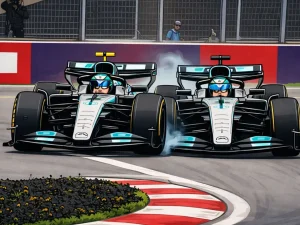
Charles Leclerc isn’t expecting a regulatory lifeline to suddenly drag Ferrari onto Mercedes’ power unit level — even if the Scuderia ends up qualifying for extra development concessions after the first FIA assessment window closes following the Canadian Grand Prix.
The mechanism in question is ADUO — Additional Development and Upgrade Opportunities — the new 2026-to-2030 tool designed to stop the engine field from ossifying under the homologation framework. The FIA is tracking Internal Combustion Engine performance through an ‘ICE Performance Index’, and if a manufacturer sits at least two per cent behind the best-performing unit, it becomes eligible for additional upgrade scope within the season. Two-to-four per cent down earns one extra homologation upgrade; four per cent or more down earns two.
Ferrari is widely expected to be in the conversation when the numbers come back, but Leclerc’s read from the cockpit is that even a favourable ADUO verdict won’t be transformative.
“I think it’s going to be very difficult [to catch Mercedes],” Leclerc said in Montreal. “I think they have a very big advantage.
“And ADUO, I mean I obviously don’t know yet if we are in – I’ll be surprised if not because I can see sometimes on the straight that we are lacking a little bit compared to the Mercedes or even Ford power unit – I think it will definitely be a help to try and get closer. Whether it will be enough to close the gap, I don’t know.
“It also depends which level we get, if we get it at all, but surely if we get it, it will be a help to get closer.”
That’s the key nuance. ADUO isn’t a free-for-all development spree; it’s a tightly rationed opportunity, triggered by a percentage deficit that may or may not correlate neatly with what drivers feel at the end of a long straight. Leclerc’s mention of “which level we get” is doing a lot of work there — the difference between one and two extra homologation upgrades is enormous in an era where every major step has to be planned, validated, and timed around the calendar.
And even in the best-case scenario, Ferrari is up against a simple reality: you can’t legislate away a head start. Mercedes’ advantage, as Leclerc describes it, looks substantial enough that the first ADUO window may only shift the conversation from “how far behind are we?” to “can we make it uncomfortable by mid-season?”
Ferrari’s Friday in Canada offered little immediate reassurance. In sprint qualifying, Lewis Hamilton put his Ferrari fifth, 0.361s off the leading Mercedes benchmark, with Leclerc a further tenth back in sixth. Montreal is a venue where power deployment and efficiency tend to show up in unflattering ways, so the straight-line references Leclerc alluded to weren’t hard to understand.
Team principal Fred Vasseur, speaking earlier in the season, has been careful to frame ADUO as a process that needs trust more than theatre. He said Ferrari was waiting on the FIA’s figures and expected the scheme to be applied consistently.
“Now we have to trust the FIA. They will come back to us with numbers soon and we have to rely on this,” Vasseur said. “But at the end of the day, we are speaking about per cent and I know perfectly that it’s not easy to assess…
“On the mechanism, what you can do, the dyno hours and so this is crystal clear. The parameters to consider the performance are also clear from day one and I don’t see any issue on the current situation.”
It’s a pointed message, even if delivered softly: Ferrari doesn’t want a political brawl about methodology; it wants the entitlement (if it qualifies) and the freedom to use it efficiently. In the paddock, there’s already an underlying tension baked into ADUO — front-runners tend to view concessions as a reward for falling short, while those on the back foot see it as the bare minimum required to prevent an early-cycle lockout.
For Ferrari, the real test won’t be whether the FIA grants ADUO, but how quickly Maranello can translate any extra room into tangible lap time. The 2026 regulations are unforgiving in that sense: development isn’t just about finding a number on the dyno, it’s about integrating it into an overall package without destabilising reliability or compromising the rest of the car’s operating window.
Leclerc, at least, isn’t selling false hope. ADUO might help Ferrari “get closer”. Closing the gap outright — especially to a Mercedes unit that appears strong enough to be name-checked unprompted — is another matter entirely. The first FIA assessment after Canada will tell Ferrari what it’s allowed to do next. It won’t tell it how long it’ll take to do it.