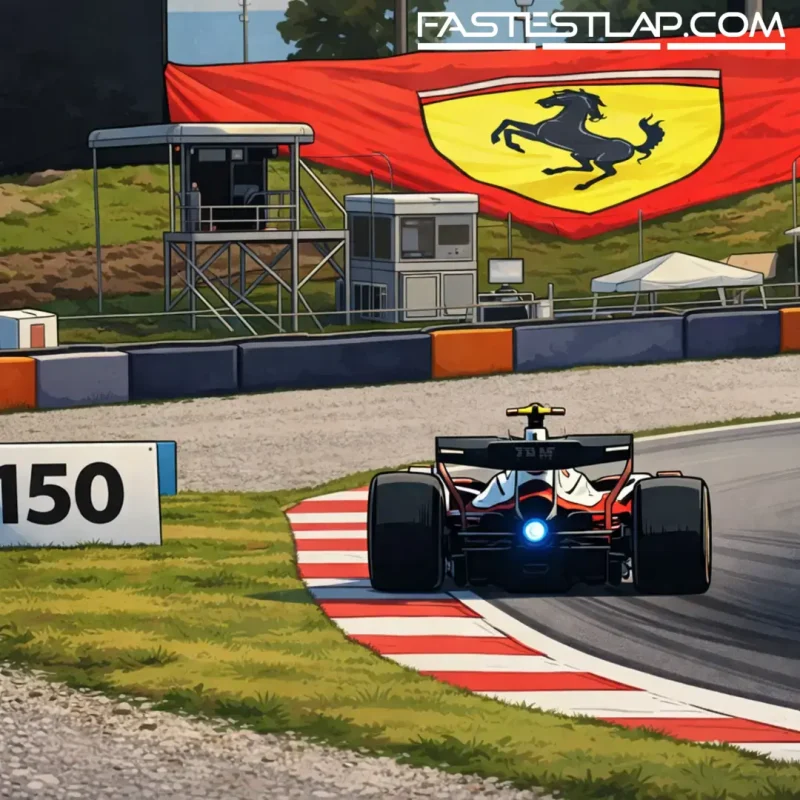
Ferrari will roll out its first Additional Development and Upgrade Opportunity (ADUO) power unit update at the Austrian Grand Prix, but if anyone’s expecting Spielberg to be the weekend the red cars suddenly look like they’ve found 20 horsepower down the back straight, Maranello is already trying to kill that story.
Enrico Gualtieri, Ferrari’s power unit technical director, was notably careful in framing what’s coming to the Red Bull Ring: a step forward, yes, but not a competitive earthquake. That tone matters because ADUO has quickly become one of the most misunderstood bits of 2026’s regulatory landscape — a “catch-up” lever that sounds dramatic until you remember what it actually covers.
ADUO exists to help close gaps between manufacturers on the internal combustion engine component specifically, not the entire hybrid package. In other words, it’s not a golden ticket to rewrite the whole power unit. It’s a constrained opportunity to claw back on one slice of the performance pie, under a set of homologation and development restrictions designed to stop this turning into an arms race in disguise.
The first ADUO reference point this season painted a pretty clear picture of where everyone stands on ICE performance. Red Bull’s unit emerged as the benchmark, with Mercedes next in line, more than two per cent adrift — enough for Mercedes to be granted one upgrade opportunity. Ferrari, Audi and Honda were further back still, each more than four per cent down, which earned them two opportunities apiece.
Ferrari has now confirmed it’s using the first of those two chances in Austria. But Gualtieri wasn’t selling it as the moment the Scuderia flips the competitive order on its head.
“This update is not a major step, and it will not on its own change the competitive order,” he said.
That’s not a throwaway line. It’s Ferrari trying to set expectations in a season where every marginal gain gets inflated into a narrative about momentum, pressure, and who’s “falling behind” in the new era. And in fairness, Gualtieri’s logic is hard to argue with: the current rules don’t reward one-shot hero upgrades. Performance now arrives in layers — and, crucially, through how cleanly teams exploit what they already have from weekend to weekend.
“What it does show is the attitude of the team and our technical partners, to push continuously and to make the most of every opportunity to improve our package,” he added. “In a championship as competitive as this one, it is unrealistic to expect a single update to transform the overall picture.”
Read another way, Ferrari is pitching ADUO as a mindset test as much as a technical one. The mechanism is there; how quickly you convert the allowance into trackside performance says something about the health of the operation. That subtext will land in a garage that now carries the extra weight of Lewis Hamilton in red, and all the scrutiny that comes with it. If you’re Ferrari, you don’t just need upgrades — you need proof you can deliver them reliably, integrate them cleanly, and keep iterating without tripping over your own processes.
Gualtieri leaned into that broader message, stressing that Spielberg’s update fits into an “intended development roadmap” rather than being a bolt-from-the-blue attempt to patch a glaring weakness.
“The update we are bringing to Spielberg is a relatively minor one, and it’s the result of the work completed in recent weeks to transfer improvements from our development program to the track,” he said. “It epitomises key principles of our sport: continuous improvement, reacting quickly, and deploying gains at the earliest opportunity.”
He didn’t go into technical detail on what exactly has changed for Austria — standard practice in 2026 when everyone is protective about the smallest edges — but the direction of travel across Ferrari’s two ADUO slots is already the paddock’s open secret. The second opportunity, due later in the season, is widely expected to focus on the turbocharger.
That matters because Ferrari’s 2026 power unit is believed to run a smaller turbocharger than its rivals. Early on, that characteristic was linked to strong launches — one of those niche strengths that looks huge when it’s unique, and then rapidly stops being news once everybody else adapts. Rivals, in this case, were helped along by the FIA’s five-second blue light warning ahead of the start procedure, which blunted some of the advantage Ferrari appeared to enjoy when the new rules first bit.
If Ferrari’s second ADUO step does indeed bring a newly designed turbocharger, the team is effectively sequencing its catch-up: first addressing ICE performance now, then shifting attention to a component that shapes how the whole unit behaves in the real world — driveability, deployment characteristics, and the kind of lap-time that doesn’t show up neatly as “engine power” on a graph.
For Austria, though, the message is simple: expect a nudge, not a leap. The interesting part isn’t whether Ferrari arrives at Spielberg suddenly “fixed”. It’s whether the team can turn these ADUO windows into a steady rhythm of progress, because that’s how 2026 is going to be won — not with one magical update, but with a season-long grind where the best organisations keep finding small gains while everyone else argues about why their big one didn’t land.