Ferrari’s been talking up Miami for weeks, but the more you listen, the clearer it becomes that this isn’t just another upgrade drop. It’s a pivot point — politically, technically, and maybe psychologically too — because the sport’s new power unit “catch-up” mechanism could start to bite just as the first proper development wave arrives.
The SF-26 is already showing enough promise to keep Maranello in the conversation early on, but it’s also exposed the familiar pain point: Ferrari still believes it’s giving away too much to Mercedes on the power unit side. That’s where the FIA’s Additional Development and Upgrade Opportunities programme (ADUO) comes in, a regulation designed to stop the new 2026 landscape calcifying into a one-engine championship.
Under ADUO, the FIA will take an average performance readout of each power unit manufacturer every five to six races. As Nikolas Tombazis, the FIA’s single-seater technical director, explained, those that fall below a defined threshold can receive additional development opportunities, with the benefit accumulating over the season depending on how far behind they are.
In theory, it’s neat: a controlled release valve to keep the racing honest. In practice, it immediately raises the kind of question F1 loves to argue about — when, exactly, does the first measurement window land?
Miami has suddenly become the focal point because the calendar has been scrambled. With the cancellations of Bahrain and Saudi Arabia, the season reaches Florida as round four rather than the round six slot it originally held. That matters because Miami could now be either the first meaningful ADUO checkpoint or simply the first race where teams are ready to unload the upgrades they were building towards earlier.
And the FIA and Formula 1 are still discussing how that should be handled.
For Ferrari, the timing is everything. If Miami is treated as the first ADUO round, any engine-side deficit to Mercedes could be partially offset sooner than expected. If not, Miami still remains critical, because it’s the first race after a rare month-long break — the kind that lets teams stop firefighting, dig into the first three races’ data, and properly manufacture a coherent update rather than dribbling parts on in ones and twos.
Fred Vasseur has been unusually forthright about how he sees the next phase of the season. “From Miami onwards, there will probably be another championship,” he said in Japan. It wasn’t presented as a threat or a promise — more an acknowledgement of how 2026 will play out once the early homologation-era cars start evolving at speed.
Vasseur’s point is that the opening flyaways were about establishing a baseline. Now comes the bit where you find out who understood the rules, who merely survived them, and who can develop fastest without losing their way.
Ferrari, for its part, sounds like it intends to arrive in Miami with more than a standard revision. Vasseur had already indicated that a “good package” originally earmarked for Bahrain will now be pushed to Miami, with the team exploring whether it can bring forward components that were scheduled later.
“We might be able to do a package and a half for Miami,” he said.
That line is classic Vasseur: half joke, half warning. But it also hints at a bigger internal reality. With a new-era car, the first serious upgrade batch isn’t just about downforce; it’s about correlation — proving the tunnel, the tools, and the philosophy are pointed in the right direction before you commit to a season-long development path.
Ferrari’s SF-26 has already shown enough consistency to bank points without looking spectacular. Three straight P3 finishes in the opening grands prix has kept it second in the Constructors’ Championship behind Mercedes, but the gap is sobering: Ferrari sits on 90 points, already 45 adrift of Brackley.
In the Drivers’ standings, Charles Leclerc is third behind Mercedes pair Kimi Antonelli and George Russell. That’s a perfectly respectable place to be after three races in a new regulation cycle — yet it also explains why Miami is being treated inside Ferrari as a line in the sand. If the Scuderia is going to turn this into a real title fight rather than a season of “nearly” moments, it needs a step change, not a tidy improvement.
That’s where the month off becomes an opportunity and a risk. Vasseur described it as the “beginning of the homologation of the car”, and he’s right in the sense that teams now have enough race data to understand what’s genuinely weak versus what merely looks weak under certain track characteristics.
“We have good data after three races to understand the competitiveness of the car, where we are okay-ish and where we are not,” he said, before stressing the key reality of this development race: “Performance is coming from everywhere.”
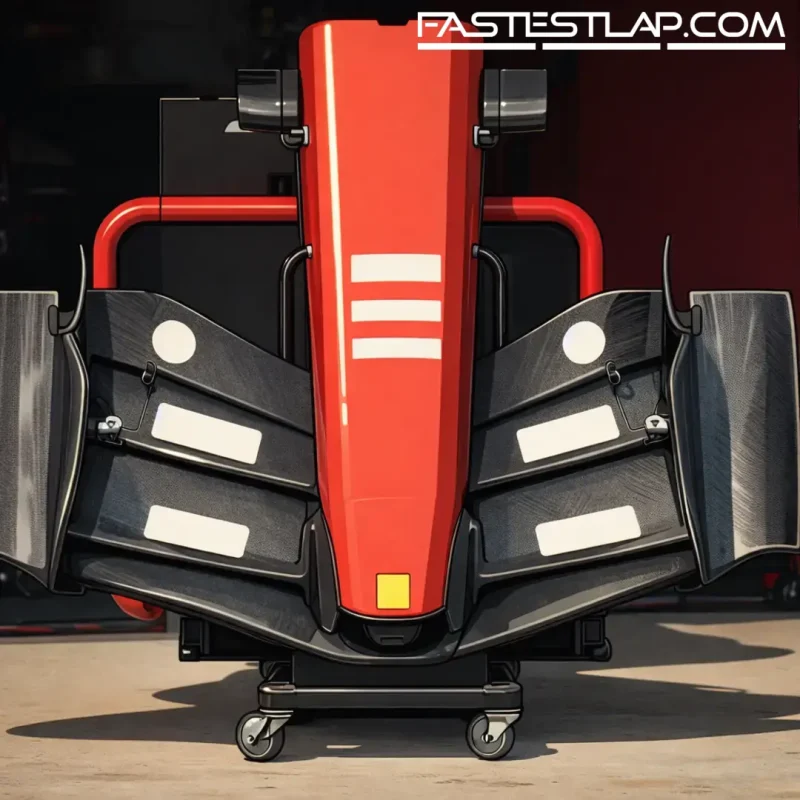
That matters because Miami won’t only be about a potential ADUO inflection point. It’s where the development war properly starts — the moment when everyone arrives with new floors, new wings, revised cooling, tidied bodywork, and all the quiet structural tweaks that never make for glamorous photos but decide whether a car’s platform is stable enough to exploit.
Ferrari’s challenge is twofold: make the upgrade deliver, and make sure it delivers in a way that can be built on. Miami is littered with the wreckage of teams chasing a lap time headline and discovering, three races later, that they’ve cornered themselves into a concept they can’t refine.
Vasseur, though, is framing it as an execution contest rather than a philosophical crisis. “It’s more a matter to do a better job than the others, than to do a step,” he said. That’s a quietly pointed remark in a paddock where everyone is trying to convince you their next update is transformational.
Miami will tell us how much of Ferrari’s early deficit is baked into the car and how much is simply the timing of its development curve. It may also tell us whether ADUO becomes the great leveller it was designed to be, or just another lever teams will spend the season arguing about in technical working groups.
Either way, Ferrari’s “package and a half” isn’t just about going faster in Florida. It’s about proving that the SF-26 — and the people shaping it — can dictate the next phase of 2026, rather than react to it.