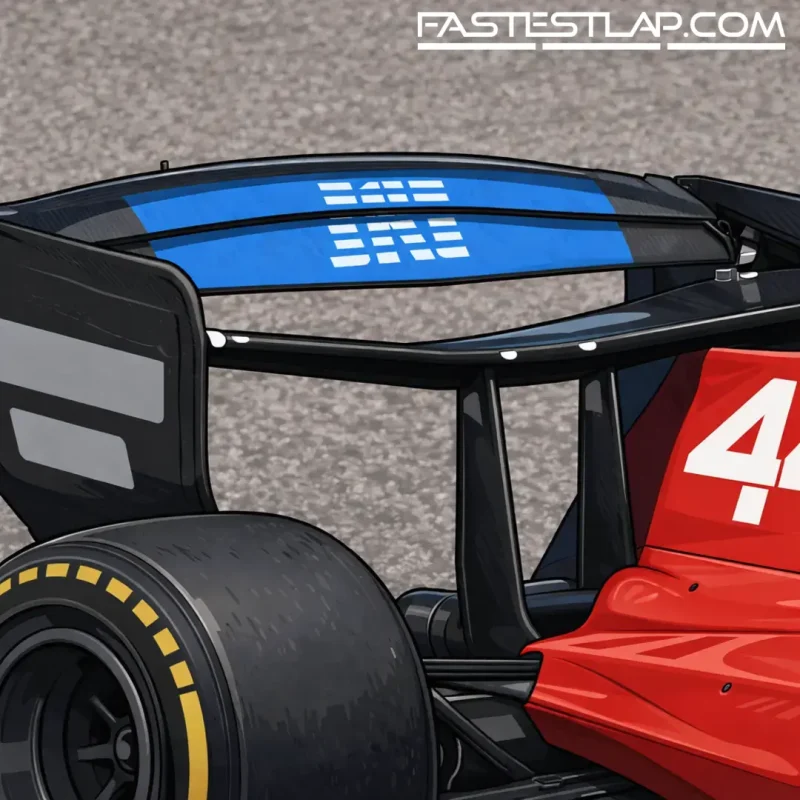
Ferrari didn’t just roll into the final day of Bahrain testing with a new rear wing. It rolled in with a philosophical question for the rest of the pitlane: how much mass are you willing to carry for a clever aerodynamic trick?
The SF-26 had already been turning heads earlier in the week with a small winglet positioned close to the exhaust area — a detail understood to be aimed at helping the car generate usable downforce — but Thursday’s talking point was far more obvious. Ferrari bolted on a new active rear wing concept that looks nothing like the familiar “open-the-flap” approach most teams have defaulted to under 2026’s active aero rules.
With straight-line mode activated, Ferrari’s upper rear-wing elements rotate rather than simply separating like the old DRS-style solutions that have become the grid’s visual baseline. Audi and Alpine have also diverged from the mainstream with their own interpretations, but Ferrari’s execution stands apart — the kind of mechanism that makes engineers lean forward and drivers glance in the mirrors to check something hasn’t failed.
Lewis Hamilton was the one tasked with putting laps on it. The seven-time world champion ran the new wing briefly — just five laps — before Ferrari reverted to its previous specification for the rest of the session and the final day of the test. That limited mileage only added to the intrigue: was it a quick correlation check, an installation run, or simply a case of Ferrari not wanting to spend precious test time on a configuration it isn’t convinced it’ll race?
Team boss Fred Vasseur, speaking in Bahrain, kept the door firmly open on what Ferrari will actually turn up with at the season-opening Australian Grand Prix.
“I think everybody is doing innovation. Sometimes it’s visible, sometimes it’s not,” Vasseur said. “I’m sure that our competitors and everybody on the grid is doing exactly the same.
“It’s true that the last two bits that we bought on track were visible from outside, but it’s not a big difference with the others. I don’t know if it will be for Melbourne or for the next one [in China].”
That’s the public-facing line, and it’s not wrong — everyone’s searching. But Ferrari has very deliberately chosen a solution that invites a second question: if it’s so good, why isn’t everyone doing it?
Oliver Bearman may have supplied the most revealing clue. Haas, Ferrari’s customer-team partner, has looked at the same sort of idea and decided against it. Not because it’s illegal, or because it’s overly complex — but because it’s heavy.
“Yeah, I saw it, and it looks cool, but it is heavy as well,” Bearman said in Bahrain. “I think everyone has considered it, including ourselves, but there is always a compromise to be made on these things.
“I was actually behind Lewis, and I saw it, and I was like: ‘What happened?’ I thought it was broken, but honestly, it is super innovative, and it looks pretty slick as well. So if it works on track, then they’ve done something right, that’s for sure.”
Bearman’s reaction is telling on two levels. First, it confirms what plenty in the paddock were already muttering: this isn’t some impulsive sketch Ferrari threw together overnight — it’s the sort of concept every aero group will have at least evaluated in some form. Second, it puts the spotlight on a core theme of the 2026 regulations that’s already shaping design choices: weight is back to being a weapon, and not everyone can afford to spend it in the same places.
This year’s cars have a minimum weight of 768kg, 32kg lighter than last season, even with the sizable battery required by the new 50/50 split between internal combustion power and electrical energy. The cars are smaller, shorter, and trimmed in wheelbase, but the battery mass has clawed back plenty of what those dimensional reductions might have offered. In the background, there’s been persistent paddock speculation that some teams are struggling to hit that minimum at all, never mind build in margin for clever but weighty mechanisms.
Against that context, Ferrari’s choice starts to look less like showmanship and more like a bet that it can either (a) meet the weight target with enough headroom to carry an ambitious active aero assembly, or (b) find lap time in straight-line efficiency that more than pays back any mass penalty. Either way, it’s a confident move — because if you’re heavy *and* draggy in 2026, you’re just heavy and draggy.
For Haas, the calculation is different. Customer teams don’t always get the same freedom to chase the most exotic solutions, and even if they did, the performance gain has to be huge to justify spending precious kilograms on a single component when you’re still trying to optimise the whole platform. Bearman’s “compromise” comment lands right on the pressure point: when the grid is fighting both the clock and the scales, the smartest idea isn’t automatically the fastest one.
The unanswered part is whether Ferrari’s rotating wing is a genuine performance lever or simply an interesting route to the same end-state. The fact Hamilton only ran it for a handful of laps — and Ferrari didn’t persist with it across the final day — suggests the team is still in evaluation mode rather than committing to it as an opening-round pillar.
But the broader consequence is already here. Ferrari has forced rivals into a familiar early-season posture: do you stick with the safe interpretation you know you can package and weight-manage, or do you revisit the more ambitious concept you filed away as “too heavy” and see whether there’s a way to make it viable?
In a 2026 landscape where the margins are likely to be defined by integration as much as outright aero load, Ferrari’s rear wing might not be the first innovation everyone copies. It might be the one that makes the rest of the paddock re-check its assumptions — and, quietly, its weight spreadsheets.