George Russell has offered an early hint at where the 2026 pecking order might first be felt — not in long-run pace, not in headline lap times, but in the messy, underappreciated business of simply getting off the line.
With Melbourne looming as the opening act of Formula 1’s new rules era, paddock chatter has drifted towards starts for good reason. The new power units have changed the feel of low-speed torque delivery and turbo behaviour enough that drivers and engineers are still arguing with the machinery rather than operating it. And in that environment, even a small procedural advantage can look like gold dust.
Russell, speaking after Bahrain testing, didn’t dress it up: the current situation is awkward, and the technical compromises baked into the 2026 package are making life harder than anyone would like.
“We have been making progress, but it is challenging,” he said. “There’s a lot of things fighting against one another. They make one improvement here, but then another part of the system is fighting against that. They’re really trying to balance all of these different limitations.
“It is like an engineering nightmare for the guys working, so they’re sort of really getting their money’s worth.”
That last line was delivered with the sort of dry amusement you hear when a driver knows his engineers have been living on bad coffee and worse sleep. But the underlying point is serious: the launch phase is currently too dependent on hitting a narrow operating window — and race starts don’t wait for your turbo to feel ready.
Russell explained the new reality with an example from Bahrain. What used to be a straightforward third-gear first corner has become something else entirely, because teams are chasing revs to keep the turbo alive.
“Here in Bahrain, usually the first corner is a third gear corner in the previous generation,” he said. “Now, we’re having to use first gear to keep the engine, the revs very high, to keep the turbo spinning. This is probably the one thing that is quite annoying and isn’t that intuitive.”
It’s a telling detail, because it points to the knock-on effects drivers are feeling everywhere — not just on the grid. If you’re having to alter gear choices in normal corner sequences to protect turbo response, then a standing start becomes even more of a tightrope walk.
And that’s where Ferrari enters the conversation.
Russell suggested the Scuderia may have found a way to make the launch procedure less punishing than it is for others. His observation was simple but potentially significant: Ferrari appears able to run higher gears in situations where rivals are forced down the box to keep the turbo lit.
“I think Ferrari seem to be able to run higher gears than other manufacturers,” Russell said, adding that this “probably suggests they’ve got a smaller turbo than other manufacturers.” The implication is clear — if Ferrari’s turbo response is more forgiving, its drivers may not need to contort their launch process quite as much to avoid falling off the boost cliff.
In an era where margins are razor-thin and the first 200 metres can decide whether your carefully planned Sunday becomes a damage-limitation exercise, that could translate into a very real competitive lever. It’s not just about reaction time or clutch bite point anymore; it’s about whether the engine is in the right mood at the exact moment the lights go out.
Russell also touched on the core problem facing everyone: teams can perfect a procedure in practice, but the race start is dictated by the signal, not the spreadsheet.
“At the moment, we’re just sort of going through our procedure, and I’m only doing my launch when I’m in a given window,” he said. “But we are very conscious that for a race start, you go when the lights are out, you don’t go when your specific turbo is in the right window.”
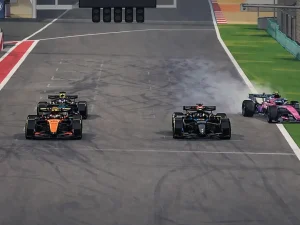
That pressure point is what prompted Oscar Piastri to raise concerns after a chaotic practice start on the final day of the Bahrain test. Piastri insisted his own delayed launch wasn’t caused by his power unit, but by the actions of others around him, and he called for discussions before the Australian Grand Prix on what he viewed as a safety issue. McLaren team principal Andrea Stella echoed the concern, pointing to how difficult it has been to get everyone comfortable with the new system.
Russell, for his part, believes the sport is moving in the right direction. He referenced earlier unease — including an episode in Barcelona — but insisted progress has been made since then. His message was essentially: yes, it’s tricky, but it’s becoming manageable. The caveat is obvious, though. Manageable for whom?
If Ferrari really has a power unit characteristic that widens the usable window — allowing higher gears without falling into turbo lag — it may start the season with a small but repeatable advantage at the most chaotic moment of a Grand Prix. Not enough to win a title on its own, but enough to turn a borderline first lap into clean air, or to keep a rival boxed in through Turn 1.
And in a brand-new regulation cycle, those small, repeatable wins have a habit of snowballing. Melbourne will be the first proper stress test — the first time everyone has to launch not when it’s comfortable, but when it counts.