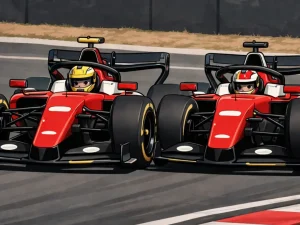
Ferrari’s first public miles with the SF-26 were never going to be a clean-room lab exercise. Put a brand-new car on track at Fiorano, hang a couple of cameras over the fence, and the internet will do what it does: freeze-frame every pause, zoom into every mechanic’s hand gesture, and declare a crisis before the engine’s even cooled.
So when clips began circulating of both Charles Leclerc and Lewis Hamilton stopping on the short Fiorano run and being pushed back towards the garage, the familiar alarm bells started ringing online. In reality, it was far less dramatic — and, if anything, pretty typical of how these tightly managed shakedown days now work.
Ferrari’s own demonstration running is capped at 15 kilometres, which turns every lap into a budgeting exercise. On days like this, teams aren’t chasing lap time; they’re ticking boxes. If part of the plan involves halting the car at a specific point — and then having mechanics push it back rather than burning precious metres under its own power — that’s not a failure mode. It’s mileage management.
Leclerc, about to start his eighth full season as a Ferrari driver, was relaxed about the whole thing afterwards. The key message from the cockpit: the basics checked out.
“You’re definitely looking forward to this day every year,” he said, reflecting on the first taste of the new machine. “However, it’s the kind of day where the main target is to check that everything is working properly and that there are no big problems, which was the case today, so that is a positive.
“But in terms of performance, in terms of feeling, it’s too early to say.”
That last line matters. Fiorano shakedowns can be deceptive at the best of times, and Leclerc didn’t pretend otherwise. Fog hung around the track and there was dampness under the tyres — the sort of conditions that make any first impressions about balance or grip more noise than signal.
“The conditions weren’t that great either,” he said. “There’s a lot of fog, a little bit of a wet track as well, so it’s not the best conditions to test a car for the first time.”
What Leclerc did underline, though, is the point of days like these: not the stopwatch, but correlation — the first chance to see “the real sensors on the car” and check the car is behaving as expected after months of design work and simulation. That first proper readout, even over a handful of kilometres, is when the abstract becomes real.
And because this is Ferrari at Fiorano, there’s always the human element pressing right up against the engineering brief. Leclerc spoke about the Tifosi lining the track and how that lifts the moment, even when the run plan is conservative and the programme is clinical.
“It’s been a very exciting moment,” he said, “especially because being in Fiorano there’s a lot of Tifosi all around the track and that adds to that very special feeling.”
Hamilton, meanwhile, was the one who logged the SF-26’s first miles before handing over to Leclerc — a small procedural detail, perhaps, but one that inevitably feeds the wider fascination around how Ferrari will present itself with two marquee drivers on the same side of the garage in 2026.
The bigger story now is how quickly the paddock can get into a rhythm. The SF-26’s shakedown was the prelude; the first proper chapter begins in Barcelona, where Formula 1’s initial pre-season test for 2026 starts on Monday. The schedule is five days at the Circuit de Barcelona-Catalunya across January 26–30, with each team limited to a maximum of three days of running.
Even there, it won’t be the full grid straight away. Ferrari and McLaren have already confirmed they won’t run on the opening day, and Aston Martin is also expected to sit out Monday. Williams, too, won’t be in Barcelona at all, choosing instead to focus on the two Bahrain tests next month.
It all adds up to a slightly staggered start to the new era’s on-track learning — which only increases the temptation for fans to overread early clips from places like Fiorano. For Ferrari, the only headline they needed from Friday was the simplest one: the car ran, the plan was executed, and, in Leclerc’s words, there were “no big problems”.
In late January, that’s not the kind of reassurance that wins championships. But it’s the kind that prevents you losing one before it starts.