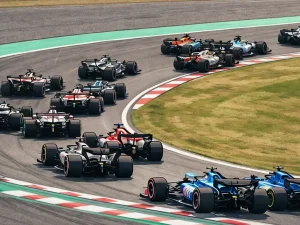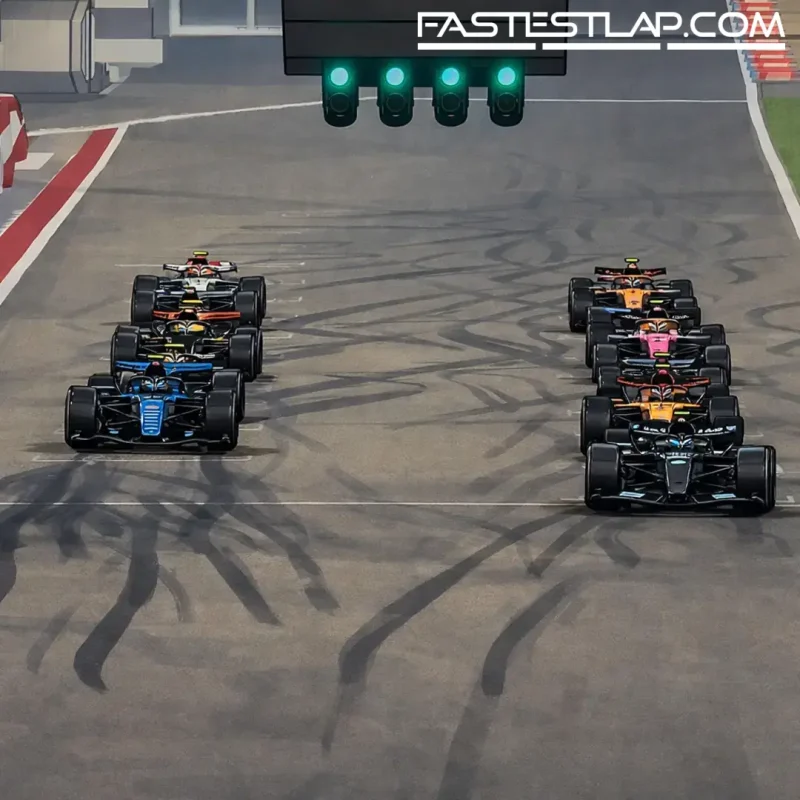
If you want a neat snapshot of what 2026 is going to feel like from the cockpit, don’t overthink the lap times from testing. Watch the practice starts.
They’ve been messy enough in Bahrain to spark the usual pre-season chatter, but Alex Albon’s read is that the “chaos” is partly a testing artefact rather than a reliable preview of what we’ll see once the lights go out in Melbourne. Engineers are still cycling through launch maps, energy deployment assumptions and clutch behaviours in conditions that don’t always resemble a real grand prix start. In other words: plenty of the drama is self-inflicted, and some of it will get engineered out.
The bigger point, though, isn’t whether the field will look tidier on race day. It’s what those starts — and the laps that follow — are revealing about how drivers are being asked to drive these cars.
Jean Alesi has cut to the heart of it with a complaint that’s increasingly common among old-school racers watching a regulation set built around a 50/50 split between combustion and electrical power. In his view, the sport’s sharpest qualifiers are being asked to operate with one hand tied behind their back, not because they’ve forgotten how to carry speed, but because the lap is now a negotiation with battery state as much as it is a pursuit of grip.
Alesi’s example is telling: Max Verstappen and Charles Leclerc, two drivers who make their living by being savage in the corners, can look electric through the technical sections and then watch the stopwatch bleed away by the end of the lap. It’s not that they’re suddenly poor at finishing straights — it’s that the current systems encourage compromises that don’t flatter that style. “They have been faster in every corner, but slower at the end of the lap time,” Alesi said, pointing to qualifying in Japan as the clearest illustration of the trade-off.
This is the part that will irritate purists: the idea that a driver can be told — even in qualifying — to lift, harvest, and protect the electrical side of the power unit, because the car needs it later in the lap. Battery management has always existed in modern F1, but 2026 is pushing it closer to the centre of the performance window. When you hear talk about “super clipping” and harvesting becoming routine, it’s essentially the admission that “flat-out” is no longer a default setting, even over one lap.
Verstappen, never one to pretend he’s enjoying something he isn’t, has already been vocal about where he thinks this trend leads. His “anti-racing” label for the new formula and the “Mario Kart” jibe — complete with “mushrooms” boosts — aren’t subtle. They’re also not really aimed at Red Bull as a team so much as the direction of travel: a sport where the driver’s instinct is increasingly overruled by the car’s energy needs.
Alesi, interestingly, doesn’t frame that bluntness as corrosive. He sees it as a necessary internal pressure point — a driver doing what elite drivers have always done, which is refuse to normalise a weakness. From his perspective, Verstappen’s job now is less about fixing it himself and more about forcing the right response from the factory. “It’s just more on the engineers’ side,” Alesi argued, adding that Verstappen’s maximum contribution is to keep the message clear and let the technical group chase the solution.
That may sound like a tidy division of labour, but it’s also a subtle acknowledgement of what the new era is doing to driver agency. When the limiting factor is energy flow rather than bravery, the gap between “I can change this with my right foot” and “we need a different system” grows wider. Drivers can still mask shortcomings with feel and judgement — they always will — but the levers they’re pulling are more strategic and less visceral.
The early competitive picture adds another wrinkle. Leclerc, Alesi notes, has still been able to fight at the front in grands prix thanks in part to Ferrari’s “epic starts”. Meanwhile, Verstappen and new team-mate Isack Hadjar have been dealing with launch issues on the Red Bull-Ford package, giving away positions when it matters most. That’s a painful way to begin any season, particularly one where track position is still king and where managing the car’s energy state can complicate overtaking rhythms.
It also explains why the start conversation refuses to die. If Ferrari can reliably convert its launch performance into clean air, it can paper over deficits elsewhere. If Red Bull-Ford is losing places off the line, it’s forcing Verstappen into the worst possible version of 2026: stuck in traffic, burning tyres, and spending precious energy just to get back to where he started.
Albon’s point about Melbourne may well hold true — teams will tidy up procedures, refine clutch bites, and reduce the headline-grabbing failures. But the underlying tension won’t disappear. This season is going to reward the outfits that can turn battery management from a restriction into a weapon, and punish those whose fastest drivers are left feeling like they’re driving to a spreadsheet.
And if Verstappen is already comparing the experience to a game, that’s not just a throwaway line. It’s a warning shot — to the engineers, to the rulemakers, and to anyone who thinks the best way to showcase the world’s best drivers is to give them less freedom to be brilliant.