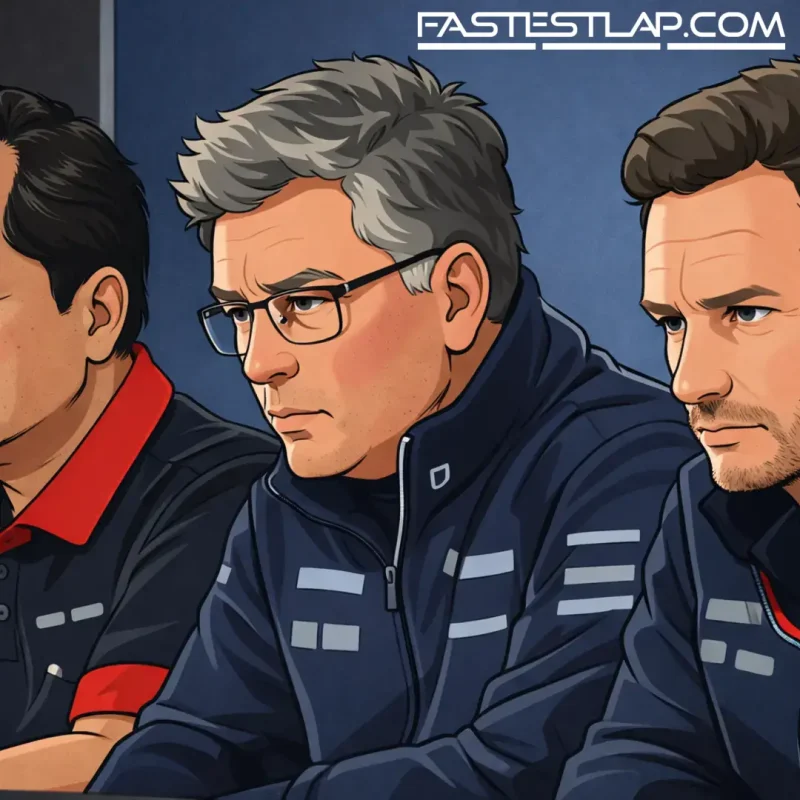
Otmar Szafnauer is back in the paddock — just not the one he left.
Ahead of the 2026 Formula 2 season opener in Melbourne, Van Amersfoort Racing has confirmed the former Aston Martin and Alpine team principal has joined the Dutch outfit as chief executive officer and managing partner. It’s a move that lands a heavyweight of modern F1 management in the heart of the feeder series, at precisely the moment the grid is filling up and the pathway to the top level is getting more political, not less.
Szafnauer hasn’t held an active Formula 1 role since Alpine dismissed him over the Belgian Grand Prix weekend in 2023, bringing a blunt end to a tenure that had begun only in early 2022. Before that, he’d been a mainstay on the pitwall through multiple identities of the Silverstone team, joining the operation in 2009 when it raced as Force India and eventually becoming one of the most recognisable faces of its Racing Point and Aston Martin eras. Long before he was a team boss, Szafnauer also worked on Ford and Honda’s F1 programmes — a CV that, for all the noise that surrounds him, is built on proper mileage.
Van Amersfoort, meanwhile, isn’t shopping for a figurehead. The team’s reputation in junior single-seaters has been built over decades of doing what plenty of outfits talk about: developing drivers and winning races across categories. For a squad that already lives and dies by detail — recruitment, preparation, marginal gains in operations — adding someone who’s spent years in the hardest end of the sport is a statement about intent as much as it is about day-to-day running.
“Van Amersfoort Racing has a strong reputation for developing talent and competing at a high level across multiple categories,” Szafnauer said. “I look forward to working closely with the leadership team and the wider organisation to guide the next phase of the team’s development.”
VAR team principal Brad Joyce made it clear this is as much about perspective as it is about a job title. “Otmar’s experience and leadership add valuable perspective to the organisation,” Joyce said. “His appointment significantly strengthens VAR as we continue to evolve and pursue our long-term vision.”
There’s a neat logic to Szafnauer surfacing in Formula 2 now. F1’s 2026 landscape is shifting — new rules, new dynamics, and a season that begins this weekend at Albert Park with F2 running alongside the Australian Grand Prix. The feeder series is where the next class of prospects starts to get shaped not only by lap time, but by the kind of professional structures that top teams increasingly expect young drivers to have around them. An F2 team that runs like an F1 organisation can become a magnet — for talent, sponsors, and relationships — and Szafnauer knows exactly what that looks like in practice.
VAR’s 2026 F2 line-up will be Argentina’s Nicolas Varrone and Mexico’s Rafael Villagomez, with the team hoping Szafnauer’s arrival translates into sharper execution behind the scenes as much as any headline-grabbing “big name” value. In Formula 2, where weekends are brutally compressed and momentum swings can be violent, operational strength is often the difference between being in the mix and being lost in traffic.
It’s also hard to ignore the longer shadow this casts. Szafnauer has been open about wanting another crack at Formula 1, and last year spoke about working with American funding and a car manufacturer on a potential future entry — initially framed as an 11th team idea before Cadillac secured that slot, shifting the target to a possible 12th place should the process open again.
That matters here because F2 isn’t just a driver shop window; it’s a networking layer of the sport. Senior figures drift through garages all weekend, sponsors want access, and manufacturer interest in the ladder is never far away. A role inside a prominent junior team keeps Szafnauer in circulation — visible, current, and involved in performance, not just theory.
For Van Amersfoort, it’s a chance to accelerate its own evolution with someone who understands the machinery of F1-level decision-making: the cadence of upgrades, the politics of personnel, the commercial realities that can make or break a project. For Szafnauer, it’s a return to the competitive beat without the theatre and knife-fights of the F1 pitlane — at least for now.
One thing VAR doesn’t lack is history. Jos Verstappen won the Formula Opel Lotus Benelux title with the team in 1992, and Max Verstappen spent his only full season in junior single-seaters with Van Amersfoort in Formula 3 in 2014 before being fast-tracked into F1 with Toro Rosso — now Racing Bulls — in 2015, becoming the youngest driver the sport had seen.
In that context, Szafnauer’s appointment feels less like a detour and more like a recalibration. The feeder series is where futures get built, and in 2026, having an ex-F1 team principal pulling the levers in a Formula 2 operation is the kind of competitive edge rivals will notice — even if it doesn’t show up on a timing screen until the points are already gone.