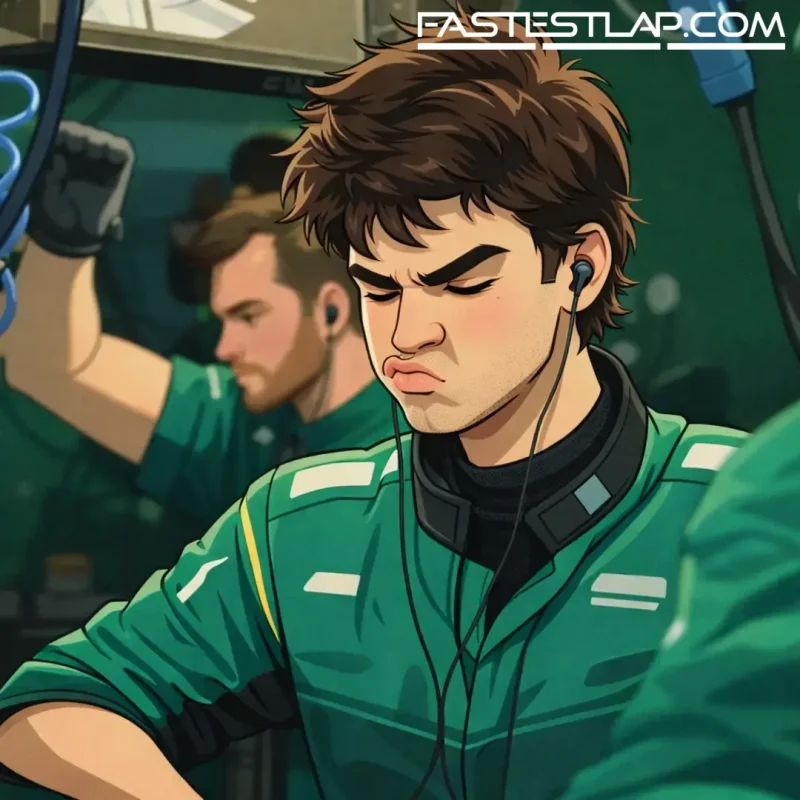
Aston Martin’s new Honda era hasn’t even made it out of winter testing without a little pain, and that’s probably the most honest sign yet of just how disruptive 2026 is going to be.
Lance Stroll didn’t bother dressing it up in Bahrain. In the garage and in front of the microphones, he painted a bleak early picture of the AMR26’s form, suggesting the car is more than “four seconds” per lap off where it needs to be. It’s an eye-catching number in any pre-season, but especially in this one — a year where power unit behaviour and energy deployment can make a lap time look either respectable or catastrophic depending on how you’re running the car.
Honda, now Aston Martin’s works partner, has effectively backed up the sense that the programme is still finding its feet. Shintaro Orihara, Honda’s trackside general manager and chief engineer, admitted the group is “playing catch-up” after the second pre-season test in Bahrain, even as he stressed the value of the running completed.
The headline number from Sakhir is hard to ignore: 206 laps across the three days, the lowest tally of any team. That follows an already scrappy build-up, with Aston Martin arriving late to last month’s Barcelona shakedown and managing only two of its permitted three days.
Orihara’s message, though, was clear: if you can’t have volume, you’d better make sure what you do collect is useful. Honda says it left Bahrain with “a significant amount of data” and “key learnings”, particularly around how the new package behaves once it’s bolted into Aston Martin’s chassis.
“Testing in Bahrain over the last three days was really beneficial for us and for our partnership with Aston Martin Aramco Formula One Team as we ran 206 laps overall,” Orihara said. “It was a good opportunity to learn a lot from the power unit package itself and its integration in the chassis.
“New regulations are a big change, not only for the way you drive the car, but also how you charge and deploy your energy over one lap. We worked on new ways of how to deal with energy management together with the team and drivers.
“Of course, we would have wanted to run more laps, but we have to remember this is our first official test together with the team, so we all had lots to learn from our new on-track collaboration.”
This is the part that’s easy to miss if you’re only looking at the lap count and the lap time. Under the 2026 ruleset, the job isn’t simply to make a fast engine and a fast chassis — it’s to make a single system that behaves predictably when the driver asks for a certain response at a certain phase of the lap, and to build that response into a raceable, repeatable deployment plan. When a programme is new, that’s where the hours go: calibration, integration, correlation, then iteration.
Honda’s also being unusually candid about the workload still ahead.
“It is certain that we have more work to do back at our F1 R&D centre in HRC Sakura and here at the track,” Orihara added. “We know where to improve together with the team and, believe me, we are pushing!
“For sure, we are playing catch-up on overall test programme, but we have just acquired a significant amount of data and key learnings from the last week. Looking forward, we have three more days of testing next week and we will be prepared to make the most out of it.”
That mention of “playing catch-up” matters because it aligns with what Honda has been saying for months. Koji Watanabe, president of Honda Racing Corporation, had already told media at the 2025 Daytona 24 Hours that Honda was “struggling” with its 2026 engine development. As recently as last month, he was still conceding that “not everything is going well”, while insisting there was “nothing fatal” that couldn’t be overcome. Watanabe also talked up Honda doing “whatever it takes” to meet the demands of Aston Martin team principal Adrian Newey.
Newey, for his part, hasn’t been pretending Aston Martin is starting this cycle from a position of comfort. He has openly described the team as effectively four months behind, pointing to the knock-on effects of the AMR Technology Campus still bedding in, the CoreWeave wind tunnel not being fully productive until April, and his own arrival last March.
“The reality is that we didn’t get a model of the ’26 car into the wind tunnel until mid-April, whereas most, if not all of our rivals would have had a model in the wind tunnel from the moment the 2026 aero testing ban ended at the beginning of January last year,” Newey said recently. “That put us on the back foot by about four months… The car only came together at the last minute, which is why we were fighting to make it to the Barcelona Shakedown.”
Put all that together and Bahrain starts to look less like a freak wobble and more like the visible consequence of a compressed development cycle meeting a brand-new technical partnership. The uncomfortable bit for Aston Martin is that the early deficits appear to be coming from both ends of the car: the team’s own delayed chassis programme, and a Honda power unit project that has acknowledged it hasn’t been smooth sailing.
But there’s also a nuance here that’s worth keeping in mind before anyone reaches for the doom stamp. Testing mileage is precious, yet one good test day late in the programme can sometimes be worth more than three messy ones early, particularly if a team has identified exactly what it needs to validate next. Honda believes it now knows where the weak points are — and, crucially, says it’s coming into the final three days of running ready to “make the most out of it”.
Stroll’s frustration in Bahrain felt real, and it’s hard to blame him when the ask is being framed in seconds rather than tenths. Still, if Aston Martin and Honda can turn these “key learnings” into usable performance quickly, the story of this partnership doesn’t have to be defined by a bleak February.
Right now, though, the picture is simple: the Newey-Honda-Aston project has started 2026 doing exactly what its own senior figures warned it would be doing — chasing time, chasing mileage, and trying to make a complex new ruleset behave before the season starts asking questions for points.