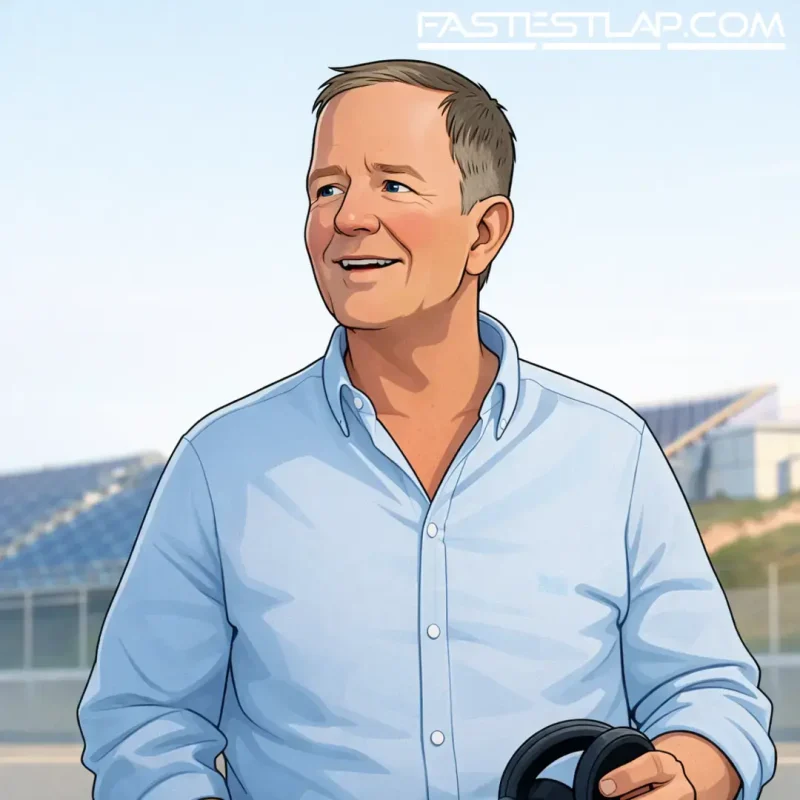
Martin Brundle has had movie stars, world champions, politicians and the occasional PR minder try to steer him away on a grid walk. He’s been ignored, interrupted, and politely stonewalled more times than he’d care to count. What he hadn’t ticked off the list, even after three decades of doing this, was a late-afternoon snack courtesy of American late-night TV.
Yet that’s exactly what happened in Miami, in one of those perfectly odd little moments that F1’s modern circus produces without even trying. Jimmy Fallon, making his first trip to a grand prix, got caught up in the pre-race chaos and — in the middle of Brundle’s Sky F1 grid walk — leaned in and bit the foam windscreen on Brundle’s microphone.
It was surreal, juvenile, and instantly viral. Brundle, to his credit, treated it with the kind of dry amusement you only develop after years of being surrounded by grid-walk mayhem. Posting after the race, he wrote: “In 30 years of broadcasting I’ve never wondered what a branded microphone sock tastes like. There’s some very funny people around.”
Fallon didn’t exactly back away from it once he was back under studio lights. Returning to *The Tonight Show* this week, he retold the story of his first F1 weekend with the wide-eyed enthusiasm of someone who’d just discovered that the sport doesn’t really do “normal”.
“It was so exciting,” Fallon said, explaining the grid walk concept to his audience in his own way: a last-minute rush onto the track, a scrum of reporters, and endless “What do you think of the race?” questions fired at anyone famous enough to stop.
Then he went straight to the point. “Martin Brundle, by the way… your microphone tastes delicious!”
Silly as it was, the episode landed because it sat right on the intersection F1 now lives in: the hardcore sporting machine rolling along at 200mph, and the celebrity sideshow swirling around it. Miami, more than most races, leans into that collision — a paddock packed with A-listers, cameras everywhere, and a grid that feels like it has as many publicists as engineers.
And Brundle, whether he likes it or not, remains the unwilling ringmaster of that particular act. The whole appeal of his grid walk is that it’s slightly unruly, occasionally awkward, and never fully under control. That’s the point. It’s live television with enough uncertainty to feel real — which is exactly why a gag like Fallon’s can catch fire so quickly.
The timing was especially apt because, while Fallon’s bite was doing the rounds online, Sky and Formula 1 were finalising something far more consequential than a foam windscreen: the broadcaster’s long-term future with the championship.
Sky Sports confirmed on Wednesday it has extended its deal to retain live Formula 1 broadcast rights in the United Kingdom and Ireland until 2034. Sky will also remain the home of live F1 in Italy until 2032.
F1 president and CEO Stefano Domenicali said Sky has been a “dedicated, trusted, and passionate partner” and credited its “world leading approach to live broadcasting, content creation, and behind-the-scenes analysis” — and, pointedly, its on-screen talent — with helping drive the sport’s growth in those markets.
Sky Group CEO Dana Strong framed the extension as part of F1’s next phase, talking up “world-class storytelling, innovation and long-term investment” as the series enters what she called an “exciting era”, referencing “more British talent on the grid” and name-checking rising stars like Kimi Antonelli.
There’s a neat symmetry to all of it. Brundle’s microphone moment was harmless nonsense, but it underlined the thing Sky and F1 are buying into for the long haul: a version of the sport that’s equal parts elite competition and cultural event, sold through personalities as much as lap times.
The renewed agreement also keeps one important compromise in place. Highlights of each race, plus live coverage of the British Grand Prix, will remain free to air. In the UK and Ireland, the highlights package is currently held by Channel 4, with that deal set to expire at the end of 2026.
In other words, the business end of F1’s media landscape is being locked down deep into the next decade — while the viral end will continue to do what it does, probably at Brundle’s expense.
Because the real takeaway from Miami isn’t that a celebrity tasted a microphone sock. It’s that, in 2026, this is simply what Formula 1 looks like now: a sport polished enough to sign decade-long TV deals and chaotic enough that, on any given Sunday, the most talked-about moment before lights out might involve a comedian and a piece of foam.