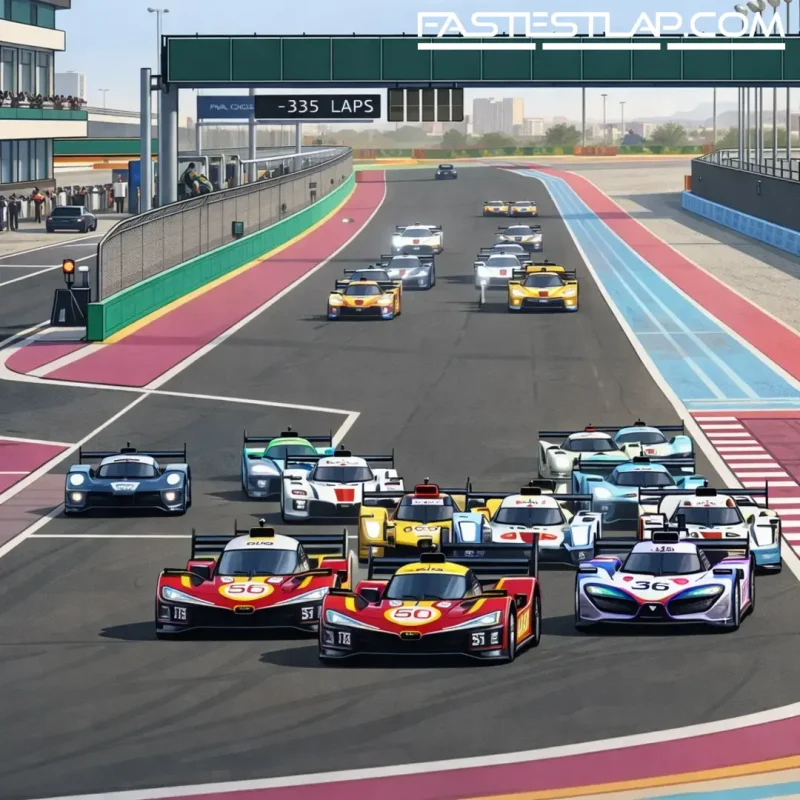
The FIA has postponed the Qatar 1812km, the scheduled season-opener of the 2026 World Endurance Championship, in a move that underlines just how quickly the sport’s carefully balanced global calendar can be knocked off axis when the real world intervenes.
The race at Lusail International Circuit had been set for 26–28 March, but the governing body confirmed it will now be moved to a later date, with the intention of slotting it into the second half of the season. For now, that leaves Imola’s 6 Hours (17–19 April) as the new opening round of the campaign.
The decision comes against the backdrop of escalating military conflict and geopolitical tension in the Gulf region. In the past few days, Qatar and neighbouring countries including Kuwait, Bahrain, Saudi Arabia and the United Arab Emirates have been hit by missile strikes from Iran. With that context, the FIA’s language was blunt by motorsport standards: safety and security for competitors, staff and fans would be “of utmost importance”, and the event would be delayed.
“FIA WEC management has been in constant dialogue with the Qatar Motor & Motorcycle Federation (QMMF) in light of the current and evolving geopolitical situation in the Middle East,” the statement read. “With the safety and security of competitors, personnel and fans of the utmost importance, the decision has been taken to delay the event that had been due to take place on 26-28 March.”
The FIA added that talks with Lusail are ongoing, and that a replacement date will be “finalised and communicated in due course”, with the clear expectation it will be staged later in 2026 rather than dropped altogether.
FIA president Mohammed Ben Sulayem, who earlier in the week had said “safety and well-being will guide our decisions” as the organisation assesses upcoming events in the region, reiterated that stance after the postponement was confirmed.
“The safety and well-being of our community will always be the FIA’s first priority,” Ben Sulayem said. He also thanked the QMMF, Lusail, the ACO and WEC stakeholders for what he described as a measured, collaborative response, while stressing the championship will work to find space for the race later in the year.
WEC CEO Frédéric Lequien struck a similar tone, framing the postponement as a delay rather than a retreat.
“The Qatar 1812km is an integral part of the FIA WEC calendar,” Lequien said. “We have all been working hand-in-hand since Saturday morning to find the best solution for staging the event, and while we still need a few more days to finalise the exact revised date, I can confirm it will be during the second half of the 2026 season.”
It’s not difficult to see the strategic logic behind that timing. Beyond the obvious safety picture, major endurance events don’t simply “move” in the way a meeting room booking might; teams are operating on tightly planned freight cycles, staff rotations, and homologation and spares schedules that don’t appreciate sudden detours. A late-season Qatar date would at least allow WEC and its competitors to rebuild a coherent logistics chain rather than force a hurried reshuffle right at the start of the year.
The postponement also lands with an unavoidable knock-on relevance for Formula 1. Qatar was one of three major FIA-sanctioned events scheduled in the region across the coming weeks, alongside F1’s Bahrain Grand Prix on 12 April and the Saudi Arabian Grand Prix on 19 April. Those races remain on the calendar as things stand, but both F1 and the FIA have acknowledged they are monitoring the situation closely.
Even leaving the direct security concerns to one side, the practicalities are awkward. The current environment has already led to heavily restricted logistics and air travel in the region. If that continues into April, it doesn’t take much imagination to see how it could start to compromise preparations—especially given how little slack there is in modern F1’s set-up windows, freight movements and staffing.
There are also specific concerns in Bahrain. Authorities there have confirmed missile attacks remain ongoing, including strikes targeting the naval base at Juffair—around a 30-minute drive north of Bahrain International Circuit—while drone attacks have targeted the motorway bridge connecting Bahrain to Saudi Arabia.
For now, though, the key detail is unchanged: at the time of the FIA’s announcement, both the Bahrain and Saudi Arabian Grands Prix are still scheduled to run.
What WEC’s Qatar decision does is quietly reset the baseline for what “monitoring the situation” can mean in practice. It’s one thing for series and teams to issue carefully worded statements while hoping the schedule holds; it’s another to take a flagship opener off the board entirely. If you’re in the F1 paddock looking at April’s Middle East double-header, you won’t be able to pretend the option of postponement doesn’t exist.
None of this is comfortable territory for motorsport, which prefers problems that can be solved with lap time, strategy, or engineering. But the sport has also learned—sometimes the hard way—that credibility depends on acting before a situation becomes unmanageable, not after. WEC has made its call. F1’s next few weeks will tell us whether it needs to make one of its own.