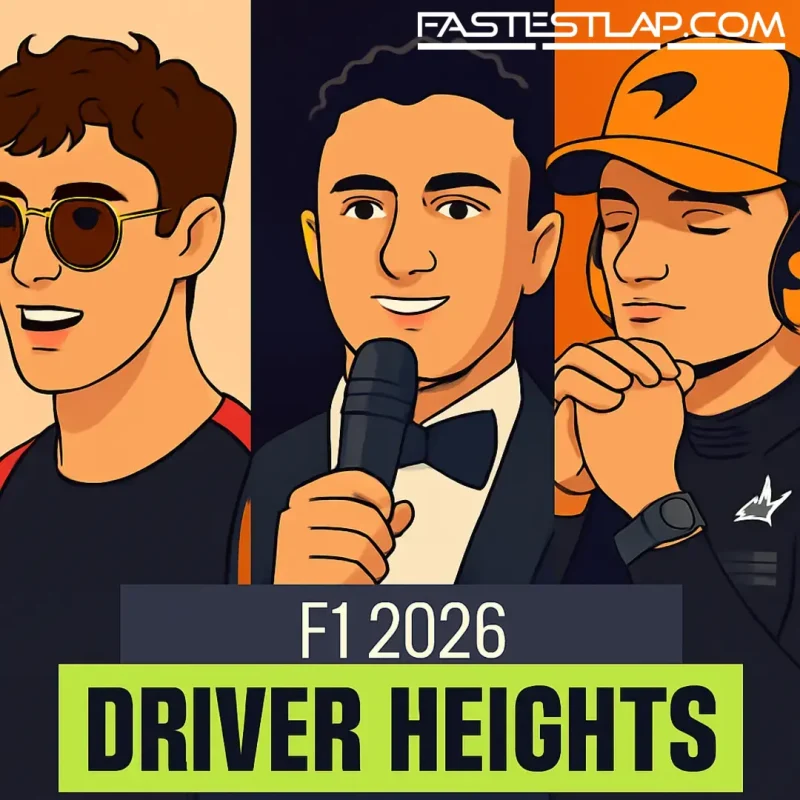
Sizing up F1’s 2026 grid: who’s tallest, who’s tiniest, and why it still matters
A new set of regs, fresh badges on the nosecones, and a grid that stretches from the very tall to the very not. As F1 heads toward 2026, height chatter is back on the paddock agenda — not because it wins you lap time, but because it used to cost you some.
The top line: Haas rookie Oliver Bearman is set to be the tallest driver on the 2026 grid at 1.88m. At the other end, Red Bull’s Isack Hadjar checks in at 1.67m, becoming the shortest driver on the roster with Yuki Tsunoda moving into a reserve role.
Why height ever mattered — and why it matters less now
Once upon a time, taller drivers paid a tax in carbon and compromise. Tight cockpits and strict weight limits meant headroom, legroom and ballast were all headaches. That’s eased. F1 introduced a minimum cockpit weight (driver plus helmet, suit and boots) of 80kg in 2019; it stepped up to 82kg in 2025 to protect driver welfare. If a driver-plus-kit weighs under the limit, teams add ballast. The upshot: engineers don’t have to starve taller drivers or carve out their ankles to make the numbers work.
Even so, packaging is still packaging. Taller drivers can make pedal box design and seat fit more finicky, and every engineer loves the ballast freedom a smaller driver provides. But you’re not losing tenths simply for being lanky anymore.
Who’s towering over 2026?
Bearman leads the tape at 1.88m, with Williams’ Alex Albon and Haas’ Esteban Ocon next at 1.86m. As a pairing, Haas are skyscrapers. Audi’s line-up of Gabriel Bortoleto and Nico Hülkenberg both clear the six‑foot mark at 1.84m, too — plenty of reach for those mini switch pods on the new wheels.
And the shortest?
Hadjar comes in at 1.67m. Then it’s Fernando Alonso at 1.71m, Mercedes’ Kimi Antonelli at 1.72m, and a trio at 1.73m in Valtteri Bottas, Arvid Lindblad and Sergio Pérez. If ballast is a playground, that’s a fun set.
Is there a minimum height for F1?
No. The FIA’s rules don’t stipulate a minimum height — only that the cockpit must be a volume that safely accommodates the driver. Simpler said than done when you’re chasing millimetres of aero gain, but the intent is clear.
A little history for context
Hans-Joachim Stuck is widely regarded as the tallest F1 driver on record at 1.94m, with the late Justin Wilson the tallest of the 21st century at 1.93m. At the other extreme, Andrea Montermini is reported as the shortest at 1.57m. The sport’s never been one-size-fits-all — it’s just learned to fit all sizes better.
F1 2026 driver heights (in height order)
– Oliver Bearman — Haas — 1.88m
– Alex Albon — Williams — 1.86m
– Esteban Ocon — Haas — 1.86m
– George Russell — Mercedes — 1.85m
– Gabriel Bortoleto — Audi — 1.84m
– Nico Hülkenberg — Audi — 1.84m
– Lance Stroll — Aston Martin — 1.82m
– Max Verstappen — Red Bull — 1.81m
– Charles Leclerc — Ferrari — 1.80m
– Oscar Piastri — McLaren — 1.78m
– Carlos Sainz — Williams — 1.78m
– Pierre Gasly — Alpine — 1.77m
– Lando Norris — McLaren — 1.77m
– Franco Colapinto — Alpine — 1.74m
– Lewis Hamilton — Ferrari — 1.74m
– Liam Lawson — Racing Bulls — 1.74m
– Valtteri Bottas — Cadillac — 1.73m
– Arvid Lindblad — Racing Bulls — 1.73m
– Sergio Pérez — Cadillac — 1.73m
– Kimi Antonelli — Mercedes — 1.72m
– Fernando Alonso — Aston Martin — 1.71m
– Isack Hadjar — Red Bull — 1.67m
What it means in practice
– Ergonomics: Teams will tailor seats, pedal trays and steering columns more than ever. Expect a few extra late‑night fit sessions for Haas and Audi.
– Weight and balance: With the 82kg cockpit minimum now in place, height is unlikely to dictate competitive ceilings. Ballast distribution remains a lever, not a lottery.
– Reliability and comfort: The newer cars’ packaging is kinder to longer limbs, which helps with consistency over a season — and with drivers not feeling like sardines after 305km.
The 2026 grid brings new names and new badges, but the sport’s evolution around driver welfare means height is a footnote, not a fate. It’s still a fun stat, though — and if you’re lining up next to Bearman, you’ll know it the moment you look left on the grid.