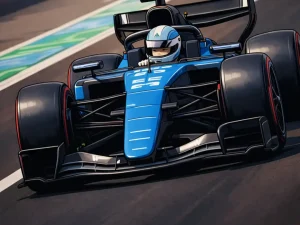
Lewis Hamilton was back in Ferrari’s SF-26 on Thursday, and not for the sort of mileage that makes for glamorous Instagram content.
Pirelli confirmed the seven-time world champion set a 1:01.031 on the opening day of a two-day wet-tyre development test at Fiorano, Ferrari’s private track, as the tyre supplier continues shaping its wet-weather compounds for the 2026 rules era. The lap time itself is largely trivia — the track was artificially soaked via Fiorano’s sprinkler system to keep conditions repeatable — but the scale of the work isn’t. Hamilton logged 142 laps, 423 kilometres, cycling through multiple full-wet constructions before spending the latter part of the day on a range of intermediate variants.
For Ferrari, this is the sort of unshowy, iterative programme that can quietly pay dividends when the championship gets messy. With the 2026 cars putting a renewed premium on managing energy and driveability over a stint, a predictable wet tyre is worth its weight in points. Most weekends, the wet stuff feels like a lottery; Pirelli’s approach here is the opposite, turning it into controlled data-gathering.
The conditions were kept stable by design. Pirelli said the circuit’s irrigation system created consistent wet running, with ambient temperatures reaching 21°C. That matters because it removes a lot of the noise engineers usually fight when they’re trying to separate tyre behaviour from track evolution or shifting weather. In that environment, the driver’s feedback becomes more useful — and Hamilton, whatever you think of his age or his adaptation curve at Ferrari, remains one of the grid’s more exacting barometers when the grip isn’t coming easily.
He’ll be back out again for Friday’s second and final day of the test, continuing the same wet-weather programme.
This Fiorano running sits in the middle of a carefully packed April for Ferrari. During the break before the Miami Grand Prix on May 3, the team has scheduled three distinct sessions: a TPC outing at Mugello last week, this Pirelli wet test at Fiorano across Thursday and Friday, and then a filming day at Monza on April 22 using its current car.
That Monza choice is telling, not because anyone expects a filming day to unlock a miracle — the running is limited, and teams treat it accordingly — but because it aligns neatly with what Ferrari is trying to fix. Monza is one of the harsher tests of energy management on the 2026 calendar, and Ferrari’s own camp has already framed straight-line performance as an area where it’s chasing Mercedes. Hamilton has previously pointed to Mercedes’ straight-line speed as a defining element of the W17’s advantage, and if Ferrari is serious about closing that gap, gathering clean, repeatable data at a track that punishes inefficiency makes sense.
Ferrari also still has both of its permitted filming days available for 2026, and there’s an obvious commercial incentive to cash one in during the April lull. The team’s promotional output this season has been relatively light beyond the post-launch material from January, and the reality is partners don’t pay for “we’ll get round to it later”.
From a competitive standpoint, though, the more interesting thread is what comes next in pure performance terms. Team principal Fred Vasseur has hinted that Miami will bring a significant upgrade package. Ferrari had originally aimed to introduce a major step at Bahrain — an event that would have taken place this weekend — but with the Sakhir round cancelled, Vasseur suggested the Scuderia could roll its extra development time into what he called “a package and a half” for Miami.
That adds context to why Ferrari’s April looks so functional. You don’t rack up 142 wet laps at Fiorano for headlines; you do it because the engineering group is trying to reduce the number of unknowns before the next big push. When upgrades arrive, teams want as many variables nailed down as possible — tyre behaviour, baseline balance, correlation — so that any improvement (or any new problem) is traceable.
Ferrari isn’t the only team feeding Pirelli’s 2026 work. Mercedes and McLaren are set to run a Pirelli test at the Nürburgring next week, which will mark the first time since the one-off Eifel Grand Prix in 2020 that current F1 machinery has been on the German circuit. Elsewhere, Red Bull and Racing Bulls completed tyre testing at Suzuka after last month’s Japanese Grand Prix, a session that ended with rookie Arvid Lindblad aquaplaning and crashing in wet conditions — a sharp reminder of why wet tyre development remains such a high-stakes corner of the sport, even in a world of simulations and controlled tests.
For Hamilton, Thursday’s mileage won’t be judged by the stopwatch anyway. It’s another brick in the wall of his first season at Ferrari: learning how this car talks to him, how it behaves on the limit when grip is inconsistent, and how effectively he can translate feel into direction for the engineers. Tests like this are rarely glamorous, but they’re the kind of work that tends to show up later — on a Sunday when the sky turns grey, strategy goes sideways, and someone wins because their car simply makes more sense on the tyres than everyone else’s.