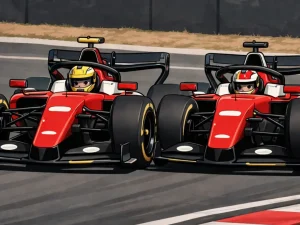
Lewis Hamilton didn’t need a grand stage to make Ferrari’s 2026 car feel real. A grey, damp morning at Fiorano did the job just fine.
Ferrari has published onboard footage of Hamilton’s first laps in the SF-26, the Scuderia’s new challenger for the 2026 season, after unveiling the car on Friday before rolling it out for an initial shakedown at its private test track. It’s a tightly edited clip — a few angles, a few corners, a wave to the ever-present fans pressed up against the fencing — but it’s still the first clean look at how Ferrari wants this new era to begin: Hamilton out first, setting the tone, with Charles Leclerc taking over afterwards.
The conditions were very much “testing season” weather rather than a glossy launch-day fantasy. Hamilton’s running was done on extreme-wet Pirellis, with low light and a sheen of water sitting on the Fiorano surface. In other words, nothing you’d use to draw conclusions about balance or performance — but plenty to underline what matters most right now: systems checks, driver procedures, and the early feel of a car built to a very different set of rules.
Ferrari’s own caption struck that note, calling it “our first look at the SF-26 in action” and pointing to the work “from everyone in the factory to Charles and Lewis on track.” It’s marketing language, sure, but the subtext is unmistakable. With 2026 bringing one of the sport’s biggest combined resets — chassis and power unit together — every team is desperate to project competence and momentum from day one. Ferrari, perhaps more than most, knows how quickly the mood around Maranello can flip.
One moment from the wider Fiorano content did catch the eye for reasons beyond the usual “first fire-up” theatre. Fan-shot footage from the track showed Hamilton repeatedly toggling the new active aerodynamics as he headed out of the garage — visibly busy on the controls, switching between configurations in quick succession.
That matters because active aero isn’t a side note in 2026; it’s central to how these cars are meant to work. Under the new regulations, drivers can switch between high- and low-downforce configurations on track. High downforce is intended for cornering performance and stability; low downforce trims the car out for straight-line speed. The theory is “maximum performance at all times over the course of a lap”. The reality, as ever in F1, will come down to how intuitive the system is to deploy, how seamlessly it integrates with everything else the driver is managing, and how quickly teams can make it second nature.
So while the clip itself is short, Hamilton’s “busy hands” moment is telling. The early weeks of a new rules cycle are often portrayed as pure engineering — windtunnels, simulators, correlation. But on the ground, it’s also about building a new kind of driver workflow. Different switches, different habits, different timing cues, and a very different sense of what “a good lap” looks like when you’re effectively managing aero state as part of your driving rhythm.
That’s why Ferrari putting Hamilton in the car first is more than symbolism. It’s practical. He’s not just learning Ferrari’s 2026 machine; he’s helping define the baseline procedures and language around it. In a year where the sport is also moving to 50 per cent electrification and fully sustainable fuels, there’s a lot changing at once, and teams will want their senior drivers shaping those early references: how the car is driven, how it’s talked about, and how problems are described before the engineers even plug in.
The footage itself shows Hamilton rolling out of the garage, building speed gently, and acknowledging the fans — the “hardcore” group that always seems to appear at Fiorano regardless of weather, time, or occasion. It’s a small human touch, but it plays into the sense Ferrari is keen to cultivate heading into Hamilton’s second season in red: settled, aligned, and ready to go to work.
None of this tells us whether the SF-26 is quick, of course. Fiorano shakedowns rarely do, and extreme wets on a murky day make it even less useful as a form guide. But it does give a first hint of what 2026 will demand from drivers: more active decision-making, more toggling between modes, and more emphasis on operational sharpness as performance becomes something you manage dynamically, not just extract.
For now, Ferrari’s message is simple: the car runs, the systems are alive, and Hamilton is in the middle of it from the first metre. The rest — the lap time, the development curve, the politics of expectation — can wait for a drier day.