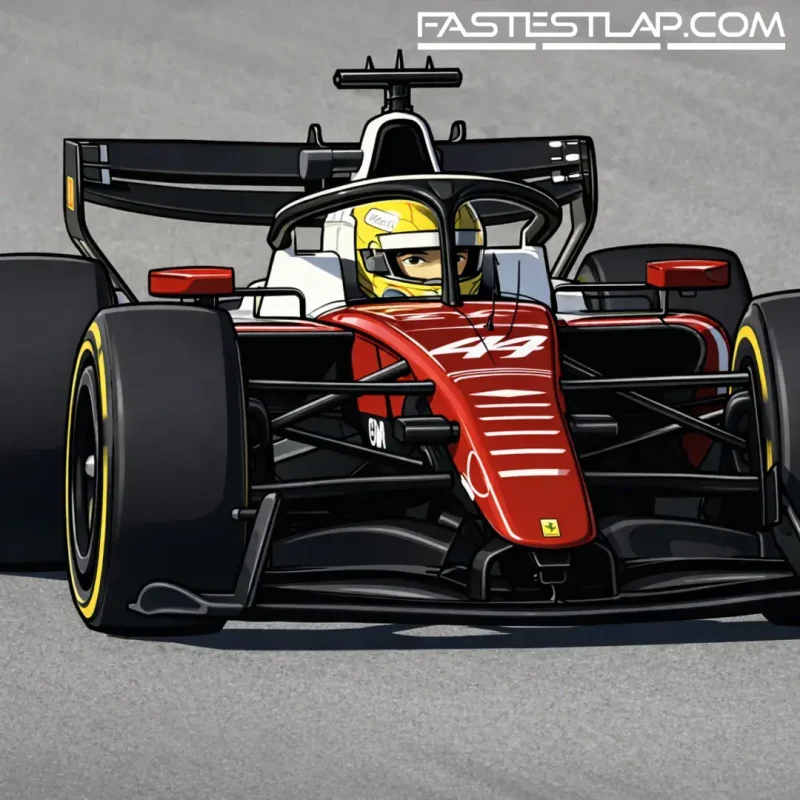
Lewis Hamilton walked out of Ferrari’s closed-door Barcelona shakedown with the sort of grin that tends to set off early-season alarms across the paddock. Behind the wheel of the SF-26, he’s understood to have ended the three-day run with the best time of the test — a 1:16.348 on soft tyres late on the final day — and he sounded, at least publicly, like a driver who’s found a new home that speaks his language.
But if there’s a single takeaway from the first proper mileage of F1’s new era, it’s that nobody should be handing out medals in January. Karun Chandhok, never one to get swept along by the first flash of headline pace, urged caution and pointed to the only moment that will actually settle anything: the first qualifying session of the year in Melbourne.
Hamilton’s pace advantage, as it’s understood, was slender but attention-grabbing. He finished around a tenth clear of George Russell and roughly a quarter of a second ahead of Lando Norris. Ferrari also logged solid distance: the SF-26 racked up 442 laps, second only to Mercedes on 500. In a winter where basic reliability is still a competitive weapon, that matters.
Hamilton, though, leaned less on lap times and more on mood. “We definitely have work to do to improve, of course, like everybody does,” he said on F1TV. “But I think we’ve had great debriefs. Everyone’s really on it. I really feel the winning mentality, like in every single person in the team, more than ever.”
That line will do the rounds, partly because it’s Hamilton and partly because Ferrari has been here before: quick in testing, sharp in the soundbites, then left explaining why it didn’t translate when the points started counting. The Scuderia hasn’t won a world title since Kimi Räikkönen’s 2007 drivers’ crown, and its last constructors’ championship came in 2008. In other words, “winning mentality” is a phrase Ferrari gets judged on more harshly than most.
Chandhok’s point was simple: don’t confuse a controlled shakedown with the sport’s first proper stress test. “The proof will only come when we get to the first qualifying session at the first grand prix in Melbourne,” he said. With the 2026 regulations turning both the engine philosophy and the on-track balance on their head, reading too much into early running is a trap.
That’s not just old-fashioned testing scepticism, either. The new power units change the game in a way that makes winter pecking orders unusually slippery. As Chandhok noted, hybrids have defined the last 12 seasons, but previously only about 20 per cent of the power was electric. For 2026, it’s effectively a 50-50 split. How teams deploy that, how comfortable drivers are with it, and how well the whole system talks to the chassis is going to swing weekend-to-weekend — especially early on.
And already, before a competitive lap has been turned “in anger”, as the saying goes, the engines have their first political storm brewing. Mercedes and Red Bull Powertrains are said to have found a loophole that allows them to run a higher compression ratio on track than the nominal 16:1 limit, because the FIA’s measurement is taken in “ambient” conditions — and the ratio rises once the engine is actually operating. The alleged gain being talked about is around 15bhp, which in lap time terms has been framed as potentially worth as much as four tenths.
Even if the numbers prove optimistic, the broader significance is obvious: in a new engine formula, any grey-area advantage becomes magnified, and any perceived head-start tends to drag the entire field into a regulatory tug-of-war. If that debate escalates, it could do as much to shape the first half of 2026 as anything we saw on track in Barcelona.
For Hamilton specifically, though, Chandhok flagged a different worry — and it’s the sort that doesn’t show up on a timing screen.
Ferrari has yet to publicly confirm who will be Hamilton’s race engineer after he and Riccardo Adami split following a first season that was, by Chandhok’s description, tension-fraught. The race engineer-driver relationship is one of the most intimate and consequential pairings in the whole operation, and leaving it unresolved this close to the season raises eyebrows.
Chandhok didn’t mince his words. “I find it honestly a little bit strange because why didn’t they make that decision in December?” he said. “The relationship between the driver and their race engineer is so important for success.”
Ferrari has been linked with a move for Cedric-Michel Grosjean, formerly Oscar Piastri’s engineer, but there’s been no official announcement beyond Adami’s departure. It leaves Hamilton in a slightly awkward place: new car, new regulations, new methods — and potentially still bedding in the person he’ll be talking to every lap when it matters.
Barcelona, then, reads less like a verdict and more like a trailer: Ferrari looks competent, Hamilton looks energised, and the SF-26 appears to be doing what it should over proper mileage. But the sport’s centre of gravity is moving. Between the 2026 power split, the early compression-ratio controversy, and the fact that nobody yet knows who has truly nailed the integration, any certainty right now is mostly theatre.
Hamilton will get more meaningful answers soon enough. Ferrari’s next run comes in Bahrain with a three-day test from 11-13 February, before returning to Sakhir later in the month ahead of the trip to Australia, where the first Friday practice of the season is scheduled for 6 March.
That’s the point Chandhok is circling — because until Melbourne qualifying arrives, winter form is just winter form. And Ferrari, perhaps more than anyone, knows how little that can be worth.