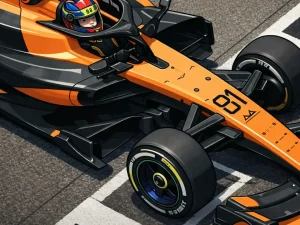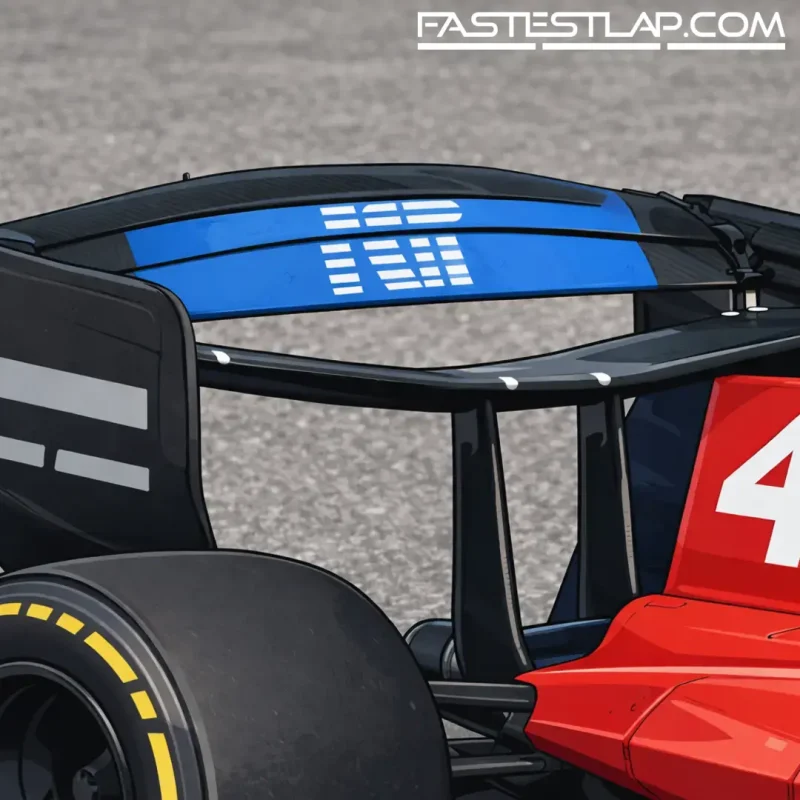
Ferrari arrived in Bahrain with the sort of new-season swagger that tends to make rival engineers drift a little closer to the pitwall than usual. Part of that was the SF-26 looking healthy across the test, part of it was the context — a winless 2025 has left Maranello needing a statement as Formula 1 turns the page to the 2026 rules era. But the real paddock-magnet was bolted to the back of Lewis Hamilton’s car: a rear wing concept that doesn’t just comply with the new active aero regulations, it tries to bend them to Ferrari’s will.
Most teams have taken the obvious route for the straight-line mode: an evolution of the old DRS idea, a flap that opens in a familiar way. Ferrari’s solution is different. When the driver triggers the low-drag setting, the upper elements of the rear wing rotate rather than simply hinging open. It’s a radical piece of interpretation, and in a year where everyone is searching for free efficiency, it’s the kind of visible innovation that instantly sparks the two questions that matter: does it work, and will the FIA be happy?
The second question isn’t being asked because anyone’s suggesting Ferrari is outside the rules — more because 2026’s active aerodynamics are new ground, and the sport has a habit of stress-testing grey areas in public before they’re litigated in private. Ferrari, for its part, is playing it cool.
Fred Vasseur, speaking in Bahrain, was notably non-committal about whether the rotating wing will even make it to the season opener in Melbourne on March 8. That, in itself, tells you plenty. When a team is absolutely convinced a new device is both robust and clearly beneficial, it tends not to dangle uncertainty in front of the media.
“I think everybody is doing innovation. Sometimes it’s visible, sometimes it’s not,” Vasseur said. “I’m sure that our competitors and everybody on the grid is doing exactly the same.
“It’s true that the last two bits that we bought on track were visible from outside, but it’s not a big difference with the others. I don’t know if it will be for Melbourne or for the next one [in China].”
That’s a classic Vasseur answer: deflate the hype, keep competitors guessing, and leave Ferrari maximum flexibility. But the subtext is hard to miss. Ferrari brought two conspicuous pieces to the Bahrain test — first a small wing element close to the exhaust on Wednesday, then the rotating rear wing on Thursday — and didn’t rush to sell them as silver bullets. In modern F1, teams don’t downplay breakthroughs because they’re modest. They do it because they’re managing risk.
And there are risks here. The concept has been described in the paddock as something others explored on paper before committing their resources elsewhere. The perceived drawbacks are tied to the transition: how quickly the wing can move from one state to another, and what happens aerodynamically in the moments between.
The concern is that a rotating mechanism could be slower to “open” and “close” than a more conventional approach — and in an era where straight-line mode is a tool to be deployed repeatedly and precisely, timing matters. There’s also an inherently awkward transient position where the elements are briefly closer to vertical during the rotation. In that split second, the wing could behave less like a downforce device and more like a sail, creating an undesirable aerodynamic effect just as the car is being asked to do something critical — accelerate cleanly, remain stable, and not trigger a knock-on compromise in balance.
That doesn’t mean it’s a dead end. It means it’s the kind of idea that can be brilliant if you nail the details, and painful if you don’t. Ferrari has form for being willing to take that bet, especially when it believes the regulation set rewards boldness.
It also explains why Vasseur isn’t guaranteeing an Australia debut. Bahrain testing is one thing; Melbourne is another. The first race weekend is when parc fermé pressure, scrutineering attention, and real-world corner cases arrive all at once. If Ferrari still has questions about reliability, actuation speed, calibration, or even how the wing behaves in dirty air and varying wind conditions, it may choose to bank a safer configuration early and introduce the rotating assembly once it’s fully satisfied.
Interestingly, not everyone in the pitlane had been losing sleep over a Ferrari-style mechanism. Williams team principal James Vowles said on Thursday that such a solution hadn’t “come across our radar” during Williams’ 2026 design phase. That could be read a few ways: either Williams assessed it and dismissed it early, or it simply prioritised other areas under the new rules. Either way, it underlines how divergent concepts can be at the start of a regulation cycle — and how quickly the competitive order can pivot once one interpretation starts delivering lap time.
Ferrari’s bigger challenge now is managing the noise. A winless season tends to amplify every promising sign in winter testing, and a visibly unconventional rear wing only adds fuel. But the team knows the real test isn’t whether it can draw a crowd in Bahrain; it’s whether it can turn that ingenuity into points — and do it without spending the opening flyaways firefighting correlation issues or scrambling through post-race technical clarifications.
For now, the message from Vasseur is deliberately restrained: Ferrari has ideas, so does everyone else, and nothing is guaranteed for Melbourne. That’s either the calm before a genuine early-season step, or the sound of a team keeping its options open while it decides whether a daring mechanism is worth the operational compromises.
Either way, the SF-26 has already done one job. It’s made sure Ferrari is being watched again — closely, and by the right people.