Guenther Steiner has never really done nostalgia. Even when he’s looking back at a career detour that effectively shaped the rest of his working life, he tells it with the same blunt, slightly amused pragmatism that made him such a magnet in the Haas pitlane years.
In his telling, leaving Red Bull’s Formula 1 operation wasn’t a setback, or a politics-driven exile, or some great “what if” moment. It was timing. It was space. And, crucially, it was opportunity.
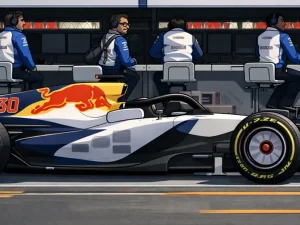
When Red Bull bought Jaguar in 2005 and rebranded the team, Steiner was installed as technical operations director. But by the following year Adrian Newey had arrived, and the structure around him inevitably tightened. Steiner describes it as the place becoming “crowded” — and for a guy who has always operated best with clear air and a clean runway, that mattered.
“For me, it worked out perfectly,” he said in an interview with FanAmp, reflecting on the move that took him away from the Red Bull F1 team and into the United States.
That’s the part that tends to get lost in the simplistic version of the story. Steiner didn’t just change jobs; he changed continents and career geometry. Red Bull’s American push in NASCAR became his pathway into the US, a country he says he’d wanted to live in when he was younger but couldn’t access without the right visa or corporate backing. The moment that door opened, he walked through it and never really looked back.
“Once I was here, now you cannot get rid of me anymore!” he joked.
Underneath the laugh, though, is a pretty sharp reading of how motorsport business actually works. Steiner argues that the move didn’t just suit him personally — it set him up professionally in a way Europe never would have. He built his own composite company in the States, growing it to around 300 employees, and he’s frank about what that environment gave him: proximity to the kind of capital he’d later need, and the cultural fluency required to persuade an American industrialist to fund a Formula 1 team.
That last point is classic Steiner: less romance, more reality.
“If I would have done the same in Europe, I wouldn’t have succeeded because I wouldn’t have found an investor,” he said. “And I needed to learn the American culture… because if I speak European culture to an American businessman, he’s not going to do business with me.”
That “business language” line is doing a lot of work. It’s also a neat summary of how Haas happened at all. When Steiner returned to the F1 orbit in the mid-2010s, he wasn’t pitching some airy passion project — he was selling a workable plan to Gene Haas, then building the operation with the sort of detail you only get from someone who’s spent years dealing with the less glamorous end of racing: hiring, facilities, suppliers, and partnerships.
He credits key early relationships too, notably with Dallara and Ferrari, deals that became foundational pieces of the team’s model.
Still, even with money and a plan, the biggest obstacle wasn’t technical, and it wasn’t sporting. It was political — and it had a name.
“The most difficult part was to get Bernie Ecclestone on board, to believe in it,” Steiner said.
At the time, Ecclestone was Formula 1’s commercial boss, and the grid had already seen enough shaky new-team pitches to make anyone cynical. Steiner paints Ecclestone as direct — no surprise there — and fundamentally tired of being asked to take a gamble on entrants who might not survive the first headwind.
The irony, as Steiner notes, is that Haas turned out to be the survivor: “the only team that was left from that era, which was new.”
What eventually shifted the needle wasn’t another spreadsheet. It was endorsement — the kind that mattered in that F1 ecosystem.
Steiner says Niki Lauda’s backing was pivotal, along with support from Stefano Domenicali and FIA president Jean Todt. In his version, there was a moment where the collective confidence of that group — plus the visible commitment of Gene Haas’s funding — made it “click” for Ecclestone. Steiner also points to the late Charlie Whiting as someone who strongly supported the effort, another reminder that in Formula 1, credibility isn’t just what you claim; it’s who’s willing to vouch for you when it counts.
Steiner’s own Haas chapter ended at the close of 2023 when his contract wasn’t renewed and Ayao Komatsu was appointed team principal. But he’s candid about the one thing he’d do differently, given how Formula 1’s financial landscape has changed since the boom years: he’d have tried to secure an ownership stake.
It’s not a complaint, more an acknowledgement of how fast the ground moved beneath everyone. As team values soared, the calculus of being “just” a team boss versus being a shareholder became obvious — in hindsight.
“If I would have known that the teams would be worth, within five years, billions of dollars, obviously you would make yourself more valuable,” Steiner said, before conceding he didn’t have the finances to do that at the time.
There’s an edge of rueful realism in that, but also consistency. Steiner isn’t rewriting his past into a fairy tale. He’s mapping the chain of cause and effect: Red Bull got crowded, America opened up, the business grew, Haas became possible — and a sport that was once allergic to new teams ended up in an era where simply having a slot on the grid became a wildly appreciating asset.
In 2026, as Formula 1 continues to evolve under new rules and new money, Steiner’s story reads less like a quirky career anecdote and more like a case study. Not in how to cling to a job in the paddock — but in how to use leaving one to build something bigger somewhere else.