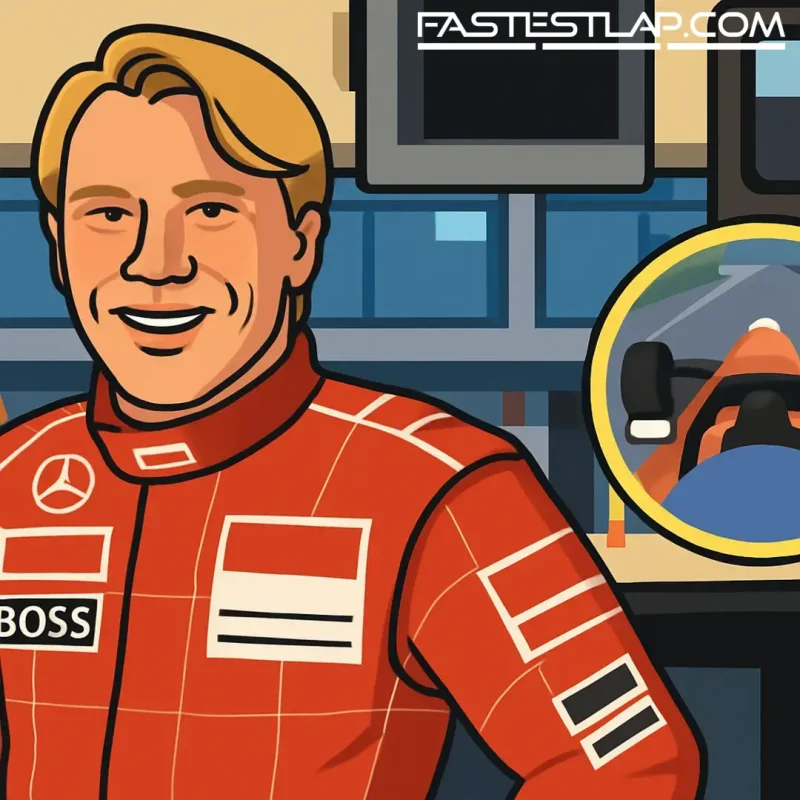
Thirty years on from the day F1 held its breath: Mika Häkkinen and the Adelaide miracle
There are crashes, and then there’s Adelaide ’95. Brewery Bend. First qualifying. A McLaren hops the kerb and “skips” the gravel at 120 mph, and Mika Häkkinen’s head whips forward with the kind of violence that still makes seasoned mechanics go quiet. Pre-HANS, pre-energy-absorbing everything. This wasn’t drama; this was a life teetering on a knife-edge.
Häkkinen remembers it all. The tyre failure at turn-in. The car slamming its plank into the tarmac, control vanishing. The launch off a brutal exit kerb. The spin. The sudden, unseen wall. Then nothing worked. Arms wouldn’t lift, legs wouldn’t move. Calm and conscious, but struggling to breathe.
Luck arrived wearing volunteer badges. Intensive care specialist Jerome Cockings and neurosurgeon Steve Lewis, in the right place at the right time, cut a hole in Häkkinen’s throat on the side of the circuit to get air to his brain. Professor Sid Watkins arrived and restarted his heart. Twice. It’s not melodrama, it’s the story. Without those three, there is no two-time world champion. There’s barely a tomorrow.
The pictures told one story; the morning papers in Finland told another. Häkkinen’s mother saw the front page and nearly collapsed. Inside the Royal Adelaide Hospital, the reality was uglier. A fractured skull. Internal bleeding. One side of his face not working. Eyelids taped shut. He couldn’t drink; his mouth refused to cooperate. He was alive, but “alive” did not yet feel like a victory.
Häkkinen spent weeks in hospital, first in Australia, then in England. Tests. Needles jabbed into his face to map nerve damage—like “Mike Tyson punching your head,” he’d recall later. Headaches that never clocked off. His hearing took a hit too; surgeons replaced tiny bones in his ears. When the medication ebbed, the pain moved in. And the doubts. Will I ever live normally again? Racing was a different galaxy away.
What he did have was a support system that refused to shrink. Ron and Lisa Dennis at the bedside. Mansour Ojjeh’s door always open. Keke Rosberg managing the logistics and the mood. A private plane to shepherd him between specialists. The space to heal, but also the expectation—gentle, firm—that the story didn’t have to end here.
Eighty-seven days after the crash, Häkkinen climbed back into a McLaren at Paul Ricard. The garage paused. He was gaunt. Half his hair had been shaved in surgery. He felt the stares and understood them. Then the engine lit. He rolled, braced himself for the first high-speed corner, and had the adult conversation every recovering driver must have with fear. You can sit in the passenger seat, but you’re not touching the wheel.
Sixty-three laps later, he was half a second quicker than Michael Schumacher’s Ferrari had managed the day before. Test times rarely rank as legacy moments. This one does. It was the day Häkkinen told McLaren—and himself—that he wasn’t finished.
The comeback season didn’t look heroic from the inside. In 1996 he took fifth in Melbourne and 31 points across the year, but the fog was real. David Coulthard arrived from Williams swinging. Häkkinen, by his own admission, wasn’t physically there. Every weekend took more from him than it gave. He didn’t talk about it. He pushed, went home, slept, repeated. Pride can be a hell of a painkiller.
By mid-’97, the haze burned off. Mercedes power grew meaner, McLaren smarter, Häkkinen harder. The speed everyone had seen in glimpses finally stuck. From there, the arc is familiar: titles in 1998 and ’99, sprinting past Ferrari and Michael Schumacher one year and holding off Eddie Irvine the next while Schumacher watched injured. If you love your sporting heroes with a little scar tissue, Häkkinen’s 2000—defeat in a season of towering drives—might be his purest work.
He stopped at the end of 2001. Officially a sabbatical. In reality, a quiet goodbye. He’d done the maths: after Adelaide, another big one might not end with an ICU and a second chance. He gave himself a few months to ponder a return and realised the obsession had melted. If you can’t give F1 100 percent, it will take the rest. He chose life outside the tunnel.
Did Adelaide change his risk tolerance? Not in the way you’d expect. The throttle stayed pinned. The man didn’t. He admits he calmed down, listened more, let the ego breathe a little. He kept talking about the crash, too. The openness wasn’t PR—it was therapy. Name the fear, shrink the shadow.
Häkkinen never forgot Adelaide. Literally. He still thinks about it every day, and not with darkness. Gratitude is the word he keeps circling back to: for family, for five children, for a career that reached the ceiling after trying to scrape him off it. He backed up the sentiment in a practical way, donating to build a helipad at the Royal Adelaide Hospital and returning in 1997 to open it and thank the people who saved him. It’s corny until you remember he arrived there by helicopter once, fighting the clock.
Thirty years on, the sport is safer, the kerbs are flatter, the cars are kinder. But the image of a McLaren hitting a wall at Brewery Bend is a postcard from a rawer era—and a reminder of how thin the margins were. Häkkinen’s legacy isn’t just the two titles, or the duels with Schumacher, or that antic flick through Eau Rouge when the car looked nervous but he didn’t. It’s the knowledge that he went to the edge, came back, and then chose, on his own terms, when to stop walking that line.