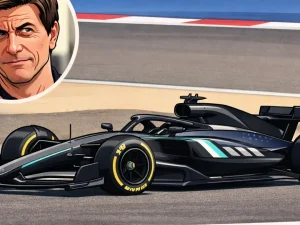
Toto Wolff isn’t interested in turning Mercedes’ 2026 engine dispute into a courtroom drama, even with the new power-unit homologation deadline looming and rival manufacturers pushing the FIA to close what they believe is a loophole.
Speaking during the Bahrain test, the Mercedes boss made it clear there’s “no such scenario” in which the team would take legal action if the governing body backs a late clarification — or even a change — around compression-ratio measurement. In Wolff’s view, whatever the politics, the sport’s governance has to be respected, even if it lands painfully for Mercedes and its customer teams.
The flashpoint is the compression-ratio limit written into the 2026 rules. The mandated figure has already shifted this year from 18:1 down to 16:1, and crucially it’s defined by a measurement taken at ambient temperature. Over the winter, concerns began circulating that more than one power-unit manufacturer had written to the FIA about an area of interpretation they believed was being exploited — and while Mercedes and Red Bull Powertrains were initially the names most often attached to the chatter, Red Bull is now understood to have aligned with Honda, Audi and Ferrari in pushing for the FIA to nail down a “hot” measurement method.
The allegation, in broad terms, is that Mercedes has found a way to run at a higher effective compression ratio once the power unit is up to operating temperature on track, while still satisfying the ambient test required by the regulations as written. That’s why this has become so combustible: it’s not a simple case of “legal vs illegal” in the traditional sense, but an argument about whether the regulation should be read as a strict operating limit at all times, or as a limit defined by the prescribed test conditions.
It’s also why the timing is so awkward. Power units are due to be homologated with the FIA on March 1, locking in designs for the season. Teams can’t magic up fundamental architecture changes in a fortnight because the paddock mood swings. And yet the Power Unit Advisory Committee — made up of the five manufacturers plus the FIA and Formula One Management — is now deep into meetings aimed at “alignment on the methodology of measurement” at hot running temperatures.
That matters because a new measurement method effectively becomes a new rule, at least in practice. For it to happen, a supermajority is required: four of the five manufacturers, plus the FIA and FOM, must agree. The manufacturer numbers are, by all indications, already there. What isn’t yet clear is where the FIA and FOM ultimately land — and Wolff didn’t hide how much that uncertainty changes the temperature of everything.
“The sport is full of surprises,” he said, explaining that Mercedes had kept the FIA close during its engine’s development and had been assured what it was doing complied with the rules. Wolff also played down the scale of any gain, putting the potential benefit at “two to three” horsepower — small in absolute terms, though nobody in F1 needs reminding how tight the margins are, particularly under a fresh set of regulations.
Still, Wolff’s most telling remarks weren’t about the engineering. They were about the ecosystem. He characterised the past few months as a lobbying effort that has “massively ramped up”, complete with “secret meetings” and “secret letters” — before adding, with a shrug that will feel familiar to anyone who’s dealt with the paddock’s version of confidentiality, that “there’s no such thing as secret in this sport”.
If the committee does vote through a revised test mechanism for hot compression-ratio checks, the repercussions could be immediate and messy. If Mercedes can’t comply with a tweaked requirement in time, you’re suddenly into scenarios nobody wants: cars potentially turning up in Australia under protest, or Mercedes-powered teams facing the prospect of running with compromised settings, or in the most extreme reading, not running at all until a solution is agreed. Wolff didn’t spell out a doomsday plan, but he didn’t pretend the risk was theoretical either.
“You develop an engine over a long time, and you have lead times,” he said. “If you were to be told you can’t operate the engine in the way you have developed it, that could be quite damaging for the performance.”
And yet, he insisted, lawyers aren’t part of the playbook. “If the governance of the sport decides to change the rules, against or for our position, we just have to get along with it,” Wolff said.
It’s a notably pragmatic public stance at a moment when Mercedes could easily adopt the opposite posture. Wolff even acknowledged the reality that in F1, assurances can have a short shelf life. “You’re being misled and you’re misleading all the time,” he said, pointing to how quickly opinions and alliances can shift once competitive fear enters the room.
That competitive fear may be doing more work here than anyone wants to admit. Wolff suggested recent excitement about the form of Mercedes-powered cars — including running in Barcelona — has helped turn a dormant technical detail into a full-blown political priority, with rivals worried about being made to look silly under the spotlight of a new engine era.
In an intriguing aside, Wolff also said FIA president Mohammed Ben Sulayem has been supportive of Mercedes’ reading of the regulation, describing him as someone “interested a lot” in engines and cars and therefore clear on what the wording means. But Wolff also made the key point: in the end, it’s the votes that matter, not private sympathy — and if the FIA and FOM align with the other manufacturers, Mercedes could find itself outflanked.
The next few days, then, are less about dyno curves and more about whether F1’s stakeholders want to legislate away a clever interpretation this late in the cycle, and what kind of precedent that sets for 2026 and beyond. Wolff, for his part, sounds like a man braced for the wind to change — and determined that if it does, Mercedes will “take it on the chin”, even if the bill is paid on track by eight cars rather than one.