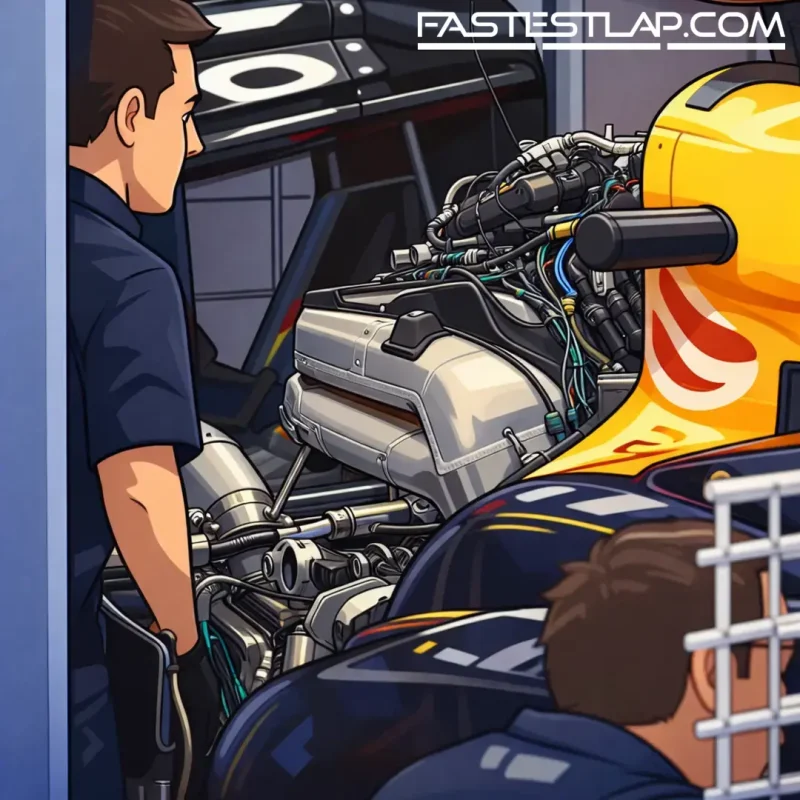
The FIA has moved to shut down one of the more awkward paddock conversations of the winter by rewriting how it polices compression ratio on the 2026 power units — and doing it on a timeline that all but guarantees someone will feel they’ve been leaned on.
After off-season noise about a potential loophole in the original wording, the governing body has confirmed it will now enforce compression ratio checks in both “cold” and “hot” conditions during 2026, with the hotter test pegged to an engine temperature of 130°C. The change has been approved unanimously by e-vote of the World Motor Sport Council, with elements also signed off unanimously by the power unit manufacturers.
In simple terms, Article C5.4.3 has been ripped up and replaced. The new rule states that no cylinder may have a geometric compression ratio higher than 16.0. Until 31 May 2026, that figure is measured with the engine at ambient temperature. From 1 June 2026 through the end of the year, it must comply both at ambient and at 130°C. Any component or mechanism “designed or functions to increase the compression ratio in operating conditions beyond 16.0” is explicitly prohibited.
The catch — and the part that will keep engine departments awake — is that compliance isn’t just a single FIA-issued test procedure. Each power unit manufacturer must define its own assessment process, following FIA-F1-DOC-042, then get it approved by the FIA Technical Department and baked into its homologation dossier. With homologation due by 1 March, that is a pretty clear signal that the FIA wanted this clarified before anyone could credibly claim they’d built an interpretation into the architecture and were now being asked to unpick it.
This didn’t come out of nowhere. Over the winter, rival engineers were openly chewing over the idea that the original “cold measurement” requirement could be satisfied in a way that still allowed a higher effective ratio when the engine was up to temperature on track. Mercedes was the name most often attached to those suspicions — not least because if there’s a rule with edges, the paddock assumes Mercedes has already run a ruler over it.
Nothing was ever proven publicly, and nobody was going to put their name to a formal accusation without something firmer than an educated hunch. But the politics of it were obvious: if one manufacturer could pass scrutineering at ambient, then operate at a higher ratio in race conditions, everyone else either had to live with the disadvantage or join the same game.
That’s how you end up with the other four power unit manufacturers meeting in Bahrain and pushing for clearer wording. The original proposal, per the FIA’s own summary, was for a 130°C test to come in from 1 August. The deadline for the vote was 28 February. Yet when the updated regulations appeared, the enforcement date had been pulled forward to 1 June — meaning the sport is only a handful of races into the new era before the “hot” yardstick arrives.
The FIA’s line is that it’s responding to what it learned through pre-season running in Barcelona and Bahrain and the feedback cycle from teams and drivers. It also framed compression ratio as one of the “key fundamental targets” of the 2026 rules, specifically in the context of making the formula attractive to new manufacturers. A hard cap is only a hard cap if it’s consistently measurable in the conditions that matter.
But F1 never closes a door without leaving a window cracked, and the amended text has its own odd twist. The FIA says that from 2027 the compression ratio will be controlled “only in the operating conditions (130deg C)”. Read strictly, that implies the ambient test disappears next year. So while 2026 will now require compliance both hot and cold, 2027 would only require compliance hot.
That doesn’t automatically mean anyone can game it — the regulation still bans any arrangement designed to increase the ratio beyond 16.0 “in operating conditions” — but it does shift the policing emphasis again. If you’re looking for why engineers keep asking for black-and-white definitions, it’s right there: the sport is effectively moving the goalposts twice in two seasons, and each move changes where the cleverness might live.
For the immediate start of the year, the change is more about calming the waters than handing out punishments. The expectation in the paddock is that Australia won’t turn into a protest-fest, and that when the revised “hot” measurement arrives in June — just before Monaco — the FIA isn’t lining up penalties as a headline act. The objective seems to be to remove doubt before it turns into an arms race that makes the regulation itself look naïve.
Longer term, it’s harder to pretend this is settled. If 2026 is the compromise year — cold checks for early-season continuity, then hot checks added once the championship is underway — the real fight may simply be deferred to the winter before 2027. Any manufacturer convinced it has found an interpretation that’s legal under a “hot-only” regime will argue it’s just doing its job. Any rival convinced that interpretation breaks the spirit of the limit will argue the FIA has invited the controversy back in.
That’s F1’s rhythm, especially when a new power unit formula arrives: the engineering is the story, but the governance is the sub-plot that can swing the competitive order. The FIA has made its move. The sport will now find out how much of the 2026 grid has built its hardware around a question the rulebook is only just getting around to answering.