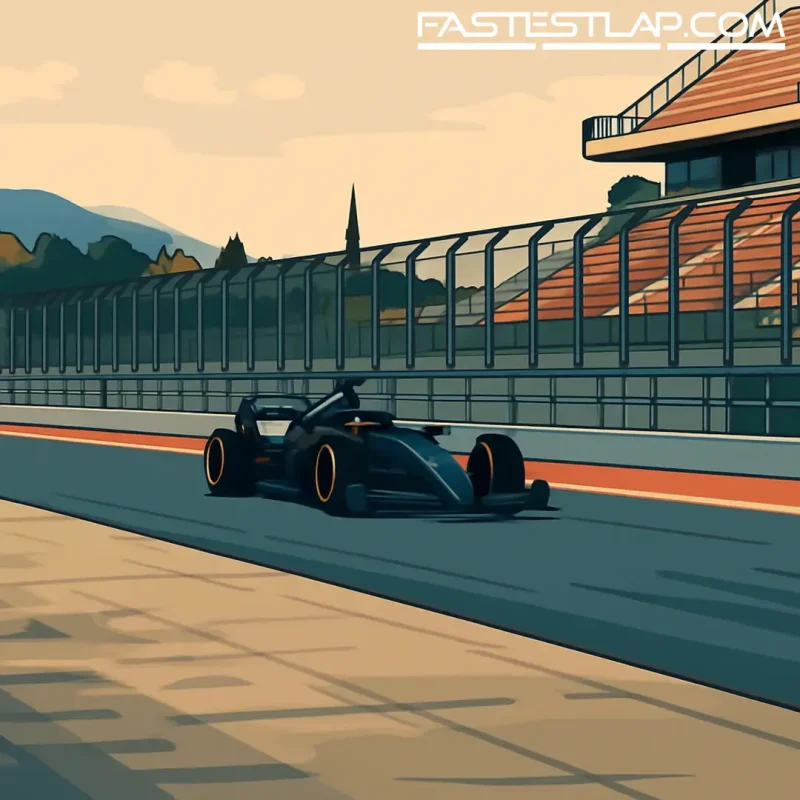
Audi’s 2026 F1 challenger has broken cover in Barcelona, and it’s already telling us plenty about where this new ruleset is heading.
The all-black R26 ran its first laps during a filming day at the Circuit de Barcelona-Catalunya, limited to 200 km but generous enough to reveal a key detail: Audi has gone double-pushrod. Front and rear.
That choice matters. With F1’s 2026 reset bringing active aerodynamics, a 50% split between electric and internal combustion power, and an entirely new packaging puzzle for the power unit, suspension geometry becomes more than a handling preference—it’s a control system. Teams need a car that stays predictable as the aero balance moves around and as the powertrain asks different things of the chassis at different points of the lap. Pushrod at both ends is fast becoming the paddock’s safe bet to manage those variables.
Audi appears to be first to show its hand on track, and it’s a very deliberate play. The R26’s stance hints at tight internals, with room carved out up high for cooling and the new energy store, and a clean lower volume—classic pushrod territory. Expect others to follow. Word in Maranello suggests Ferrari’s 2026 car will also run double-pushrod, which would mark the Scuderia’s first rear pushrod since the F10 of 2010. In Milton Keynes, the same whispers are circling around Red Bull’s next machine. None of that’s confirmed, but if you’re keeping score on trends, the grid is lining up behind this architecture.
Filming days are famously cagey affairs—single cameras, short mileage, lots of bodywork tape—but the R26 didn’t exactly hide. Fan-shot clips bouncing around social media show a neat, compact car in a stealth livery, turning laps with the tidy, unhurried feel you expect on day one. Nobody chases lap time on a shakedown. You chase systems checks, correlation and a quiet trip back to the garage.
Even with that limited running, Audi’s early start is notable. Teams have spent the past two seasons designing for 2026 in the background while racing under the final year of ground-effect regs. Now, with active aero flaps to choreograph, a hugely potent MGU-K to integrate, and sustainable fuels changing combustion behavior, you simply can’t leave integration work late. Suspension is the backbone of that integration—how the car rides the aero map, how it sits under braking with a heavier ERS contribution, how it preserves rear grip when the electric hit kicks in. If double-pushrod buys consistency and packaging headroom, it’s going to be popular.
The timing also underlines Audi’s intent. The German manufacturer takes over the current Sauber entry for 2026, and while 2025 is still very much its transition year in the paddock, the race team is already moving like a works operation. A formal launch for the R26 is scheduled in Berlin before the first pre-season running in Barcelona, but you get the sense they wanted a private dress rehearsal on a familiar stage.
There’s a bigger philosophical shift here too. The 2022–25 ground-effect era had plenty of pullrod evangelists up front, largely because of aero gains from lower wishbone placement and nose packaging. But 2026 is ripping up that logic sheet. Once you add active aero and the new power unit layout, the gains swing. Pushrod offers straightforward kinematics for ride control and frees up space where cooling and battery volume now live. It’s also a friendlier path for the heavy correlation work teams must do as the car’s aero states change mid-corner—something nobody wants to be debugging in Bahrain.
What we didn’t learn in Barcelona is just as interesting. The R26’s surfaces looked deliberately plain, with no obvious giveaways on the active flap architecture or the final cooling concept. Sensible. On day one, you keep the clever bits in the truck.
As for the competitive picture, it’s too early to read anything beyond intent. Audi’s job this winter is to build a baseline that’s stable under the new energy mix and aero logic, and to make sure the simulator and track data are speaking the same language. If they’ve got that right, everything else—performance runs, upgrade cadence, even race operations—becomes a lot easier to layer in.
File this one under “first punch thrown.” Audi’s opened 2026 with a decisive technical call and an early rollout. In a season where predictability will be worth tenths, double-pushrod looks like the smart play—and the rest of the grid seems to agree.