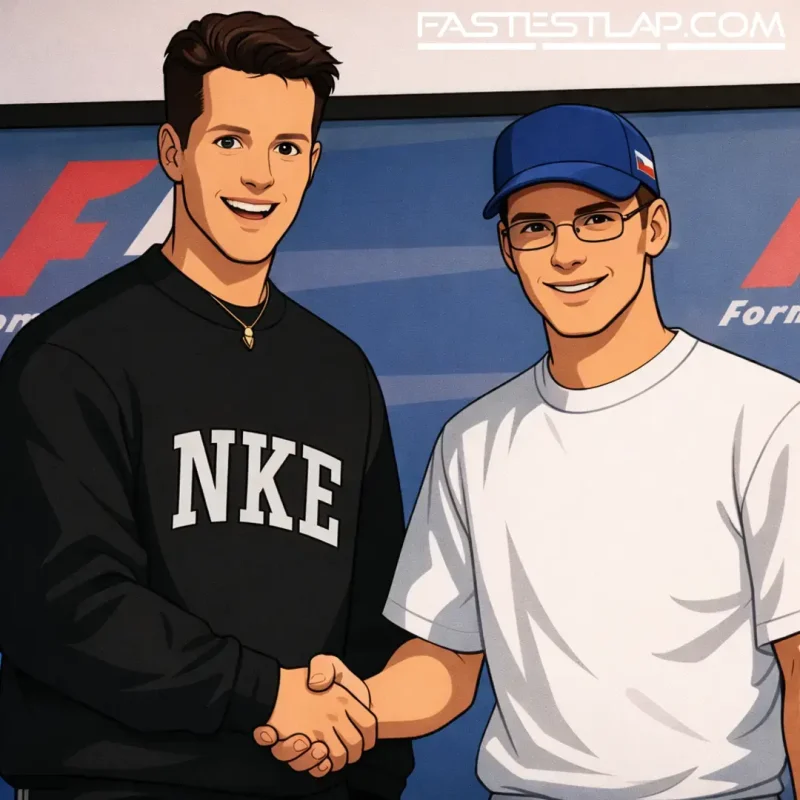
Jacques Villeneuve has never really bought into the mythology of Michael Schumacher — and he reckons Schumacher could tell.
Speaking on *Beyond the Grid*, the 1997 world champion offered a pretty revealing window into why one of F1’s most combustible rivalries never spilled into anything resembling warmth away from the circuit. The headline, in Villeneuve’s telling, isn’t so much hatred as distance: they simply didn’t mix.
“We never actually really socialised in all the years I was in F1,” Villeneuve said. “And he was my main competitor. So that’s really a strange one.”
That rivalry is etched into the sport’s lore, of course, culminating in the infamous clash at Jerez at the 1997 European Grand Prix — Villeneuve taking the title, Schumacher later disqualified from the championship standings. But Villeneuve’s explanation for the frostiness is less about that flashpoint and more about psychology: he didn’t arrive in F1 inclined to defer to Schumacher’s aura, and he suspects Schumacher wasn’t entirely comfortable with that.
“He knew that I didn’t care. That I wasn’t impressed or afraid of him, and he wasn’t used to that, I think,” Villeneuve said. “And that’s why in the battles I had with him, it didn’t always go good for him, because I just held strong against him.”
It’s a pointed claim, and not one you hear often about Schumacher — a driver who, even among his peers, was treated as a kind of inevitable force once he got his elbows out. Villeneuve’s contention is that he didn’t play the role of respectful understudy; he raced him like any other car that needed beating, which in turn changed the dynamic of their on-track encounters.
There’s also an intriguing layer of old Ferrari sentiment in his theory. Villeneuve wondered whether his surname carried weight in Italy that complicated things, given his father Gilles’ status as a Ferrari icon.
“Maybe because the Villeneuve name was still linked to Ferrari as well,” he said, suggesting it “unbalanced things a little bit” among fans — the sort of thing Schumacher, then leading Ferrari’s charge back to the top, would have been acutely aware of.
That tension — the famous name, the new challenger, the man Ferrari had built around — was already bubbling in Villeneuve’s rookie season at Williams in 1996. Asked about his first grand prix win, at the Nürburgring, Villeneuve recalled how Schumacher’s Ferrari sat in his mirrors for much of the race and how his own approach was shaped by IndyCar habits he hadn’t fully shaken.
“It was great, and he was in my mirrors the whole race,” he said. “Partly because I was still racing the IndyCar way, which is, don’t build a gap. I was controlling Michael there. I was just keeping him in my mirror, because that’s what I was used to.”
In modern F1 terms it sounds almost alien — choosing to manage the race by proximity rather than escape — but Villeneuve framed it as a mindset he had to unlearn. He also made the obvious point that any “chess match” like that is brutal when you’re the one being hunted.
“It’s always hard when you’re the prey,” he said. “Because you can only falter.”
The more vivid Villeneuve story, though, is still Estoril 1996 — the pass around the outside of the banked final corner that remains one of the defining overtakes of that era, not least because it was done on Schumacher.
Villeneuve said he’d spent winter testing staring at that corner and thinking of oval racing, of low banking and the way an outside line can actually be the fast way around if you commit. He even told Jock Clear, his race engineer at the time, that he planned to pull off an outside move in the race — a goal for the sheer fun of doing something others wouldn’t.
Clear, according to Villeneuve, tossed him a line before the start: *tell us which lap it’ll be, so we can come with a spoon to pick up the pieces*. Villeneuve insists that was the final little shove.
“We were coming onto a backmarker, so he backed off just a little bit to give himself some breathing space,” Villeneuve recalled of Schumacher. “And that’s when I saw my moment.”
He didn’t pretend it was neat. He was on the marbles in the second half of the corner, the car moving around beneath him, the kind of overtake where the only comfort is that you’ve already committed so you may as well see it through. Villeneuve believes it worked for one simple reason: Schumacher didn’t expect it.
“And that was the only way you could overtake Michael,” he said, “is by surprising him.”
That line, more than any retelling of Jerez, gets to the essence of how Villeneuve views Schumacher. Not unbeatable — but systematically difficult to fight if you played by the usual script. Villeneuve’s edge, at least in his own mind, was that he didn’t. He came from the States with a different sense of combat, a different calibration of risk, and — crucially — no instinct to treat the man in the other cockpit as untouchable.
Whether Schumacher truly “wasn’t used to” that is impossible to prove now. But if you’ve ever wondered why their rivalry always felt personal even when it wasn’t being loudly marketed as such, Villeneuve’s answer is compelling in its simplicity: they never built anything off-track, and on it, Villeneuve didn’t blink.