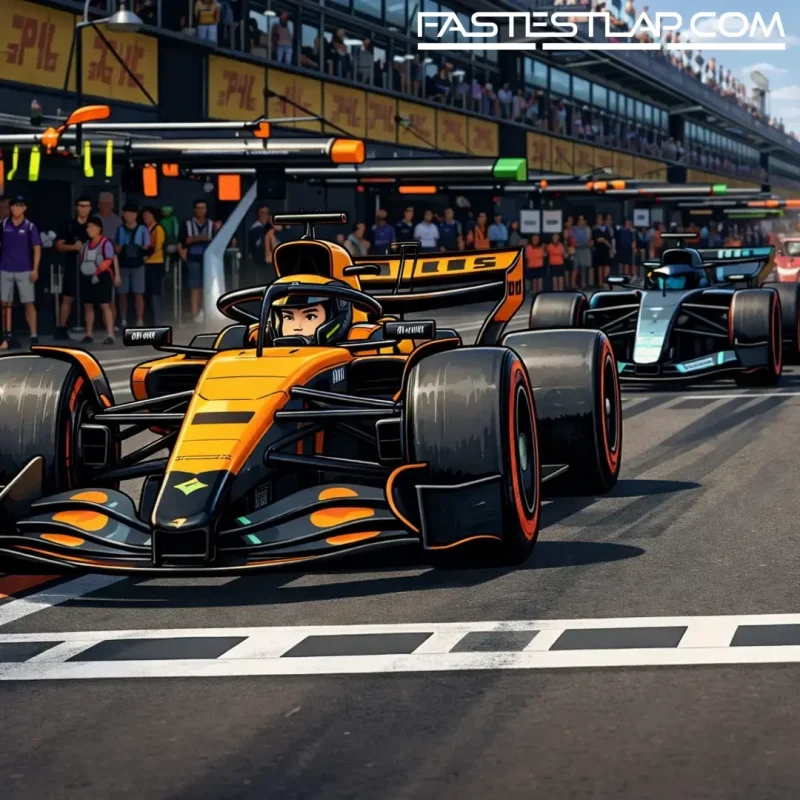
McLaren arrived in Melbourne as the reigning benchmark and left it sounding, for the first time in a long while, like a customer team that’s been caught out by its own supply chain.
Andrea Stella didn’t try to dress it up after the Australian Grand Prix. Yes, the MCL40’s corner grip needs work. But the bigger frustration, in his telling, is that McLaren isn’t currently extracting the Mercedes power unit the way Mercedes does — and, crucially, it doesn’t feel it has the predictability and tooling support to close that gap quickly.
In a weekend where Mercedes locked out the front row with George Russell ahead of Kimi Antonelli and then converted it into a comfortable one-two, the message from the paddock was blunt: the new 2026 power unit era isn’t just about having the same hardware. It’s about knowing how to make it sing, lap after lap, corner after corner, with energy deployment now baked into the driving style.
“What Mercedes are doing on a power unit is something that caught us off guard,” Williams boss James Vowles admitted, speaking after qualifying. Williams, like McLaren and Alpine, is also running the Mercedes HPP package, and Vowles’ comments were striking for their candour: he believes the capability exists in what Mercedes supplies, but he doesn’t yet know how to access it.
He was also clear-eyed about the political reality. The regulations require the same specification to be supplied, but that doesn’t create an “open door” where the works team hands over the methods that turn compliance into performance.
“It is not an open door, as you would imagine, because that’s where the performance is found,” Vowles said. “Mercedes are incredibly fair to customer teams… We have everything that they have access to. They have just been cleverer than we have, and it’s our job to get on top of it.”
That’s the key distinction: access versus understanding. In 2026, the power unit isn’t a black box you bolt in and then work around with aero and tyres. It’s a system you have to choreograph, and Stella’s argument is that McLaren is still learning the choreography.
The race result underlined the pain. Lando Norris was McLaren’s only finisher, bringing the car home 51 seconds behind Russell after Oscar Piastri crashed on his lap to the grid. Ferrari took third and fourth, Charles Leclerc ahead of Lewis Hamilton, while McLaren were left sifting through GPS traces and speed data that didn’t line up with what the team expected to see from identical power units.
Stella said the gap in the race broadly matched qualifying, placing the shortfall in the half-second to one-second range, depending on the phase of the lap. He broke the deficit down into two buckets: power unit “exploitation” and cornering grip. But even in that second area, the implication was uncomfortable — that Mercedes isn’t only quicker on the straights with the same engine family in the back of other cars; it’s also carrying more speed in certain corners, suggesting a whole-vehicle advantage built on energy strategy as much as mechanical or aerodynamic performance.
“We remain a little puzzled by the difference we see in the data between the speed of our car, and the speed of other cars using the same power unit,” Stella said. “It clearly indicates that we should be doing a better job in understanding how to utilise the power unit with the complexities that came with the 2026 regulations.”
That complexity is where this has teeth. Stella described talks with Mercedes High Performance Powertrains that have been running “for weeks” about getting more information and better integration. He painted a picture of McLaren’s pre-season running being more reactive than predictive — turning up, running the car, seeing what happened, and adjusting. In modern F1 terms, that’s basically swearing in church.
“Even in testing, we were pretty much going on track, run the car, look at the data… That’s not how you work in Formula 1,” Stella said. “Since we are a customer team, this is the first time that we feel we are on the back foot… Even when it comes to the ability to predict how the car will behave and the ability to anticipate how we can improve the car.”
It’s a revealing admission because it cuts across one of the quiet assumptions of the customer model: that while the works team will always have small advantages in integration and influence, the customers can still operate with enough certainty to develop the chassis effectively. Stella is essentially saying that, right now, the toolset and knowledge transfer aren’t where McLaren needs them to be to run the programme with its usual precision.
And then he got to the part every driver has been muttering about in private since the new rules landed: energy deployment is no longer a background optimisation problem. It’s the lap.
“Everything is very sensitive,” Stella said. Change lift-and-coast into Turn 1 and it can alter deployment for the rest of the lap. That sensitivity makes drivers feel like they’re “driving the battery” — and it makes simulation and predictive tools non-negotiable. If the team can’t model accurately what a small change will do three corners later, it’s already losing.
Stella insists McLaren sees “low-hanging fruit” in the collaboration with HPP, and he expects the relationship to intensify. But he also left the door open to the more awkward possibility: that part of Mercedes’ advantage may be systemic, rooted in the natural intimacy between works team and engine operation — a level of inherent knowledge customers can’t simply request in an email.
Round two in Shanghai, the first Sprint weekend of 2026, comes quickly. That’s both a problem and an opportunity. A problem because there’s less time to reset between sessions. An opportunity because the extra competitive mileage can accelerate learning — if McLaren can turn “puzzled by the data” into a repeatable plan.
In Melbourne, Mercedes didn’t just win the first race of a new era. It reminded everyone that in 2026, the power unit isn’t merely supplied — it’s interpreted. And right now, McLaren is still learning the language.