Formula 1’s 2026 picture snapped into sharper focus on Tuesday — not because anyone went racing, but because the paddock finally started putting tangible shapes, colours and intent on what’s been months of theory. One new entrant showed its hand on ambition, one team quietly revealed there’s more going on than the pretty launch renders, a manufacturer offered the first proper look at a next-generation power unit, and Mercedes signalled a significant internal shift just as the rule reset bites.
Audi’s first-ever F1 livery was always going to be scrutinised for what it said about the project’s identity. In Berlin, it delivered something that looks deliberately engineered rather than merely styled: a titanium-shaded front half, ‘Lava Red’ washing over the airbox and sidepods, then the red carried onto a black rear section for a hard, high-contrast finish. It’s an evolution of the R26 concept design it showed late last year, but the message is pretty clear — Audi isn’t arriving to blend in.
More revealing than the paint, though, was the framing. Audi set out an aggressive longer-term timeline: it wants to be fighting for titles by 2030. For 2026, the stated target is more modest — get into the points regularly. That’s a sensible first marker in a field that’s about to be thrown into a blender by new chassis and power unit regulations, but it also serves as a reminder that this won’t be a vanity entry. Audi’s operating to a roadmap, and it’s telling you so up front.
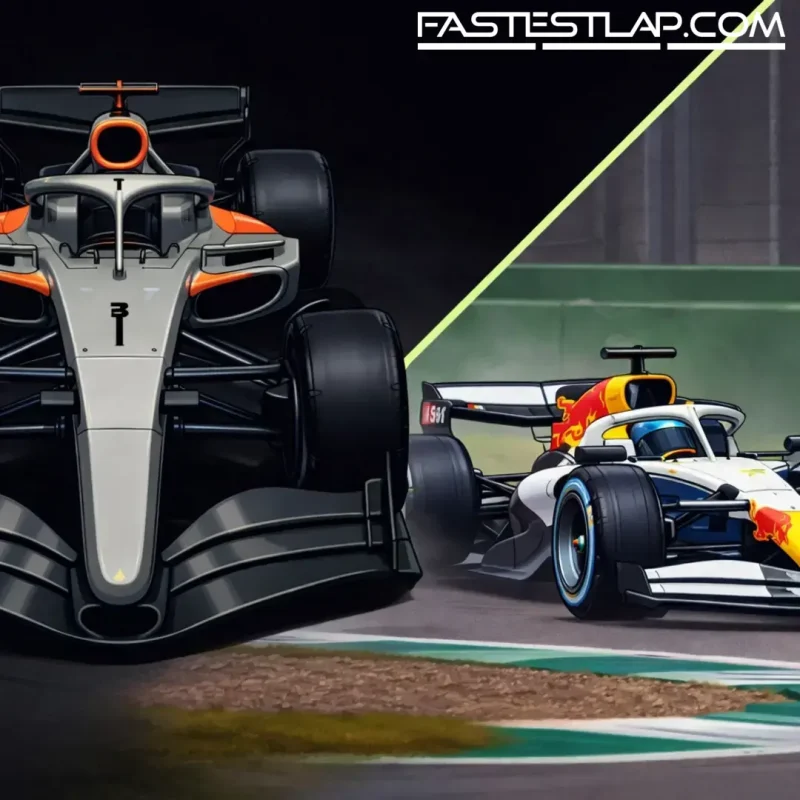
While Audi was doing the polished reveal, Racing Bulls were doing something more valuable: putting a new car on a track, even if only briefly. The VCARB03 rolled out at a wet Imola for a demo run, and the early photographs were enough to suggest the car is already diverging from the team’s launch imagery. That’s not unusual — renders are marketing tools, and they rarely capture the full story of a car that’s still evolving — but the fact there are “differences to pick up” this early is a quiet hint about how busy the development curve is going to be under the new rules.
It’s also a neat reminder that the 2026 arms race isn’t going to be won in a single unveiling moment. Teams are going to show you one thing in January and arrive with something meaningfully different once the serious mileage begins. Racing Bulls giving the paddock a glimpse of real hardware — in imperfect conditions, with imperfect photos — still tells you more than a studio set ever will.
The most significant “real” object revealed all day, though, might have been in Tokyo. Honda and Aston Martin pulled the covers off the RA626H, offering the first proper look any manufacturer has given the public of what a 2026-spec power unit looks like. Honda’s naming is as neat and purposeful as you’d expect, but what matters is the symbolism: for all the noise about the coming era, this was the first time we’ve actually seen the next-generation hardware in the flesh.
Honda is entering 2026 as Aston Martin’s sole power unit supplier, and the joint appearance underlined that this is more than a sticker partnership. Honda Racing boss Koji Watanabe also pointed to “room for interpretation” in the new rules — a loaded phrase in F1, because it’s exactly where competitive advantage tends to be found. Every regulation cycle talks about convergence; every regulation cycle rewards the people who read the same words and imagine something different.
That’s why the 2026 conversation keeps circling back to technical freedom in unexpected places. “Active aero” is about to become a weekly talking point rather than a niche rules footnote, and the sport is already positioning it as one of the defining characteristics of the new cars. How it’s implemented, how reliably it can be used, and how teams balance it against the rest of the package will shape the pecking order as much as any single downforce number.
And then there was Mercedes, delivering the sort of news that doesn’t come with a fancy stage or a hero shot — but can ripple through a season all the same. John Owen, the team’s director of car design and former chief designer, is set to step down in the coming months after almost two decades at Brackley, stretching back to the operation’s Honda days. He’ll go onto a period of gardening leave when he leaves.
Timing matters. A major technical regulation reset is exactly when continuity and institutional memory can be priceless — and exactly when new voices can also pay off if they help a team avoid walking confidently down the wrong path. Mercedes will promote from within, with engineering director Giacomo Tortora and deputy technical director Simone Resta set to oversee the technical group. That points to stability rather than upheaval, but it’s still a significant changing of the guard in a department that lives and dies by detail.
Taken together, it was the kind of day that pulls F1 out of winter abstraction. You had Audi defining the scale of its ambition in public, Racing Bulls showing that early-season optics don’t tell the full technical story, Honda and Aston Martin putting a first physical marker down on the 2026 engine era, and Mercedes quietly reshaping its technical leadership structure.
No lap times, no headlines about pace — just the more important stuff at this stage: direction, intent, and the first hints of where the cleverness might be hiding when 2026 really begins.