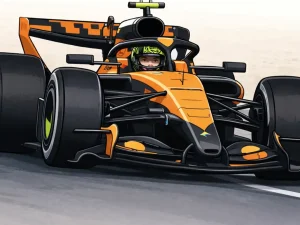
The 2026 season is barely three races old and already the paddock feels like it’s being pulled in two directions at once: a brand-new technical era that’s still finding its feet, and a silly-season undercurrent that’s starting to hum far earlier than teams would like.
Nothing captured that better than Martin Brundle admitting he was caught off guard by Jonathan Wheatley’s Audi exit. Brundle said he first got wind of it over the Australian Grand Prix weekend, yet even then didn’t see it coming — which, in itself, is telling. In a sport where the sharpest operators usually leave a paper trail of whispers months in advance, an experienced broadcaster and long-time paddock presence being surprised suggests this one moved quickly, or at least quietly.
Wheatley’s name has been circling Aston Martin for a while as the prime candidate to lead the team, and Audi confirmed his departure within 48 hours of that narrative accelerating. The timing matters. Audi’s still shaping its identity for this new cycle and senior personnel changes in the early months of a regulations reset land differently: you’re not just losing an executive, you’re potentially losing a set of processes, a philosophy, and the authority that keeps a growing organisation aligned when the results aren’t doing the messaging for you.
Aston Martin, meanwhile, has the opposite problem — plenty of ambition, plenty of spotlight, and a constant sense that the “project” needs to translate into something tangible on track. If you’re in that camp, the attraction of an established, hardened sporting director type is obvious. You don’t hire that profile for vibes; you hire it to turn weekends into points, and points into momentum.
That theme — authenticity versus artifice — popped up again with Aston Martin’s pointed little statement after announcing Lance Stroll’s GT3 debut. The team went out of its way to frame it as a driver who has “always enjoyed pure racing in all its forms”, which reads like more than a harmless bit of PR polish when you place it against the background noise around the 2026 rules.
Stroll has been among those critical of the new regulations, and he’s hardly alone. Max Verstappen has been the loudest voice, pushing back on what he sees as an increasingly manufactured style of racing baked into the formula. In that light, Stroll turning up at Paul Ricard for the opening round of the GT World Challenge Europe Endurance Cup on April 11 isn’t just a fun side quest — it’s also a statement of intent about what kind of driving experience scratches the itch right now.
The subplot, though, is that Stroll doing this in the middle of an F1 season immediately invites the paddock’s usual questions. Is it a release valve? A reset button? A subtle protest? Or simply a driver using a rare sliver of calendar space to do something he enjoys? Aston Martin clearly wants the last option to be the only one anyone considers.
Verstappen’s comments at Suzuka did little to damp down the wider concern. In reacting to Oliver Bearman’s huge 50G crash — which left Bearman with bruising to his knee — Verstappen effectively shrugged and said this is what happens when the 2026 cars drop into what he calls “mushroom mode”. The Mario Kart reference is funny until you get to the serious bit: he’s talking about speed differentials of 50 to 60 kilometres per hour on the straights, and the sort of closing speeds that turn small misjudgements into very big accidents.
It’s a grimly familiar tension. Every new regulation set brings a phase where drivers find the edges and occasionally go past them. What’s different here is Verstappen openly framing it as a structural feature — not an early-season learning curve, but something inherent to how these cars will behave when energy deployment and straight-line performance swing so dramatically. When a four-time champion describes the conditions for incidents as “inevitable”, the sport tends to listen, even if it doesn’t always act quickly.
While the front of the grid argues about the philosophy of racing, the midfield is living the consequences. Williams’ start to 2026 has been summed up neatly — and painfully — by Damon Hill calling it “a little bit disheartening”. This was supposed to be the payoff year. Grove sacrificed development of last season’s car to get ahead of the new era, and after three races the return is ninth in the constructors’ standings with two points.
That’s not catastrophe in April, but it’s the kind of under-delivery that hurts more because of the opportunity cost. When you choose the long game and the long game still bites, it leaves you with fewer levers to pull. The next few races matter less for what they do to Williams’ points tally and more for what they do to the team’s internal belief that the direction is right. Once that cracks, the season becomes a very long exercise in damage limitation.
At the other end of the emotional spectrum sits Cadillac, new to the grid and still absorbing what it means to be an F1 team in anger. After becoming the first new entrant since 2016, it currently sits 10th out of 11 teams in the constructors’ standings, with a best finish of 13th courtesy of Valtteri Bottas in China. On paper, that’s modest. In context, it’s not nothing.
New teams rarely arrive fully formed, and early competitiveness is often less about headline results than about operational competence: clean weekends, reliable systems, sensible development targets. The points will come later — if the foundations are sound. For now, Cadillac’s job is to look like it belongs here, even when the timing screens insist otherwise.
Put it all together and the first act of 2026 is shaping up as a season of competing narratives. Teams are still decoding the rules, drivers are still deciding whether they like what the rules are asking of them, and the market for top-level leadership is already shifting beneath everyone’s feet. The grid might be new, but the paddock’s old instincts are intact: if something feels unstable in April, people start planning for July.