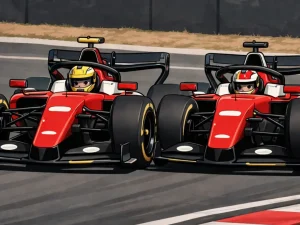
Lewis Hamilton’s first public laps in Ferrari’s new 2026 car at Fiorano came with a moment that, on social media at least, travelled faster than the SF-26 ever could on a 15km demo allowance.
A short clip from the banking around Ferrari’s private track showed the scarlet car rolling to a stop, followed by a small swarm of mechanics and a push back towards the garage. In late January, with everyone desperate for early tells on a brand-new rules cycle, it didn’t take much for the conspiracy engines to kick into life.
Ferrari, though, insists there was no drama at all. The stoppage was deliberate — “part of the plan” — with the team using a scripted interruption to manage mileage and run time inside the tight constraints of an officially registered demonstration run. Under the regulations for these promotional outings, teams are limited to 15 kilometres total. There’s no room for indulgence, and certainly no appetite for burning through that allowance idling in the pitlane.
Hamilton completed three laps before handing the SF-26 over to Charles Leclerc, who did two of his own. That’s your entire day, effectively: a handful of laps to make sure the thing starts, stops and talks nicely to the data systems, with everyone trying to look relaxed while internally scanning for the sort of gremlins that can waste a week in Barcelona or Bahrain.
If it feels faintly theatrical to stop the car on track on purpose, that’s because these launches are a carefully curated mix of genuine engineering need and show business. The audience is real — the tifosi were in place at 5am to grab whatever glimpse they could — but the useful work is brutally limited. When you’ve only got 15km, you don’t just “go for a few laps”; you hit pre-agreed boxes: systems checks, sensor validation, clutch bite, basic drivability. And sometimes you manufacture a scenario that lets you rehearse procedures without compromising the run plan.
Ferrari team principal Fred Vasseur was in no mood to dress it up as anything more than day one of a long job. His emphasis was telling: reliability first, learning second, performance later.
“I think we postponed as much as we can the demo day to have time to develop the car,” Vasseur said. “It means that it’s a long-term process… but the most important at the beginning is the reliability. The most important is to be able to do mileage and it’s why we are quite happy today because we didn’t have any issue.”
That last line matters more than the optics of a staged stoppage. The 2026 reset is exactly the sort of regulation change where early-season credibility is built on how quickly you can run, not how loudly you can talk. Everyone will turn up in testing with big ideas and very polished renders; the teams that get punished are the ones that can’t keep the car alive long enough to understand whether those ideas actually work.
Ferrari’s schedule reflects that mindset — and a quiet confidence that it can afford to play the longer game. The SF-26 will run next week at the first behind-closed-doors pre-season test in Barcelona, but Ferrari has already confirmed it won’t take part on Monday, opting instead for extra development time before using three of the remaining four available days. It’s a small decision with a big subtext: they’re prioritising bringing the right spec, not simply being seen running first.
Vasseur framed it in the same pragmatic terms. The demo day was pushed as late as possible, he said, to buy development time, and Barcelona will be about “maximum information” rather than lap times.
“In Barcelona the target will be to get the maximum of information on the car, the maximum of data,” Vasseur explained. “And then we’ll start the development from Bahrain onwards.”
That Bahrain reference is where Ferrari’s real pre-season begins. Two official tests follow after Barcelona, both in Bahrain: 11–13 February and 18–20 February. Those are the sessions where the paddock will start joining the dots — not just on Ferrari’s outright pace, but on how quickly it understands its own car, how stable the platform is across programmes, and whether the development curve looks like a straight line or a series of costly detours.
For Hamilton, the Fiorano day was never going to be about speed or statements. It was about the first physical handshake with Ferrari’s 2026 direction — the new ergonomics, the initial feel of the power delivery, the first read on how responsive the car is to what he asks of it. The clip of him stopped at the side of the track might have looked ominous to the untrained eye, but the more interesting takeaway is the opposite: Ferrari was organised enough to script the day, keep it clean, and walk away saying there were no issues worth discussing.
There will be plenty of time for Ferrari to be judged on the hard stuff soon enough. Barcelona will tell us how ready the SF-26 is to be worked, Bahrain will tell us how ready it is to be raced. Fiorano, in the end, was just Ferrari reminding everyone that in 2026, even the “problems” can be planned.