Honda doesn’t do theatre for the sake of it in Formula 1. So when it clears the decks for a standalone unveiling in Tokyo, you know it wants the paddock — and the wider industry — to understand what’s at stake.
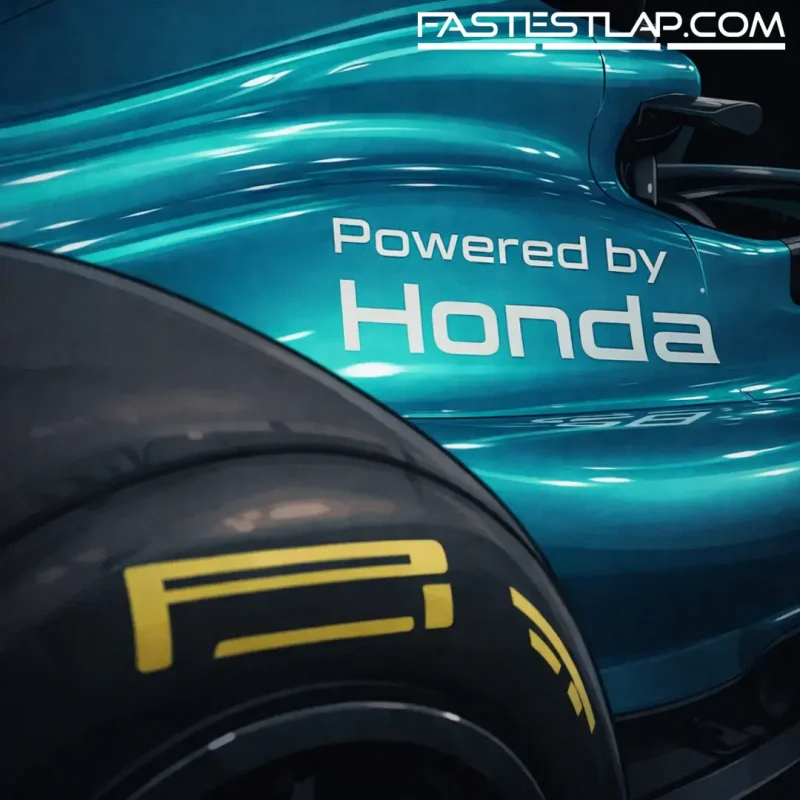
The headline is the RA626H, Honda’s first power unit built to F1’s 2026 regulations and the engine that will sit in the back of Aston Martin’s AMR26. But the subtext is sharper: this is Honda planting a flag in a new technical era where integration, resource discipline and electrical performance will decide who’s merely present and who’s properly competitive.
It’s also a very different kind of return to the one Honda effectively staged with Red Bull. Yes, Honda announced back in 2021 it was stepping away, then stayed involved on the fringes as Red Bull and its newly created Red Bull Powertrains continued to run Honda engines. That marriage delivered four Drivers’ titles from 2021 to 2024 and two Constructors’ Championships. But it was still, in practical terms, a hybrid arrangement — an elite team leveraging a known quantity while building its own capability.
With Aston Martin, Honda is committing to the full works-team logic again. And crucially, it’s doing so at the exact moment the rules reset offers genuine opportunity for a team with the budget and ambition to jump the queue.
Honda CEO Toshihiro Mibe’s message at the launch wasn’t coded. He framed the RA626H programme around the same themes Honda has been selling internally and externally: electrification, sustainability and relevance. Honda’s decision to take on “the new challenge” of F1 2026, he reiterated, is tied to the championship’s push to become a more sustainable series, aligning with Honda’s own direction towards carbon neutrality and providing a platform for electrification technologies.
That matters because the 2026 rulebook is designed to make that pitch real. The new generation of power units will run on sustainable fuel and adopt a 50/50 split between electric and combustion power. It’s a philosophical shift as much as a technical one: the electrical side is no longer an accessory; it’s half the performance story, half the energy management story, half the drivability story.
And then there’s the cost cap. Manufacturers might dress it up as a healthy constraint, but everyone in the engine game knows what it really is: a squeeze on iteration speed. You can’t brute-force your way out of a wrong turn with endless dyno hours and production runs. You have to pick your concepts, back them early, and execute cleanly.
“Formula 1 is evolving into a new generation motor sport,” Mibe said. “The cost cap system will pose strict limitation. With limited resources we must achieve a massive result.”
He didn’t call it a competition. He called it a battle — “a battle with ingenuity and technology refined to perfection.” That’s the tone of a manufacturer that knows the 2026 transition will expose weak links quickly: control software, energy deployment, thermal efficiency, packaging compromises, and the uncomfortable truth that the best power unit is the one that works as part of the whole car, not the one that wins a dyno beauty contest.
That’s where Aston Martin comes in — and why this partnership is so pivotal for both parties.
Aston Martin will be Honda’s only customer in 2026, effectively making the Silverstone outfit a works team. In an era where marginal gains increasingly come from the grey areas between departments, exclusivity isn’t just a nice badge — it’s leverage. The whole point is that the chassis and power unit can be designed as one integrated package from day one, rather than a series of negotiated compromises between supplier and customer.
Lawrence Stroll has been blunt about what he thinks that unlocks.
“It is going to be an incredibly important chapter in our history,” he said, calling the move to a Honda partnership and works-team status “pivotal” and “hugely” exciting. Stroll’s emphasis, though, wasn’t on branding or sentiment. It was on structure — the idea that Aston Martin is now set up to operate like a title contender should.
He pointed to the new leadership spine: managing technical partner Adrian Newey and chief strategy officer Andy Cowell. In Stroll’s view, that’s the final piece in a wider evolution that’s been years in the making — and the Honda deal is the hardware counterpart to that management reshuffle.
“Starting in 2026, we have entered a true works partnership with Honda meaning the chassis and the power unit are designed as one integrated package, a move that is crucial to our championship-winning aspirations,” Stroll said. “I am extremely confident we now have everything we need to achieve success.”
Confidence is cheap in January. The only kind that counts is the quiet sort you see in lap time, not press conferences. But the logic is coherent: if you’re going to take a swing at the biggest regulation change in years, you want the engine programme, the chassis concept, and the operational decision-making pulling in the same direction — under the same roof, or as close to it as possible.
The first real glimpse of what that looks like will come soon enough. Aston Martin’s AMR26 is scheduled to hit the track at Circuit de Catalunya in a behind-closed-doors test beginning 26 January and running for five days, with all teams permitted three days of running. The team’s official car launch is set for 9 February, just ahead of the second of three Bahrain pre-season tests, running 11–13 February, followed by another Bahrain outing on 18–20 February.
Then the talking stops. The 2026 season begins at the Australian Grand Prix on March 8.
Honda’s Tokyo launch didn’t promise miracles, and it didn’t need to. It was a statement of intent: that this isn’t a nostalgia act, and it isn’t a branding exercise. Honda is building a power unit for a rule set that will punish hesitation — and it’s chosen Aston Martin as the one team it’s willing to tie that bet to, completely.
In a year where everyone will claim they’ve “nailed” the new era, the most interesting detail might simply be this: Honda is treating 2026 like it’s supposed to hurt. That’s usually a sign a manufacturer believes it has a chance to win.