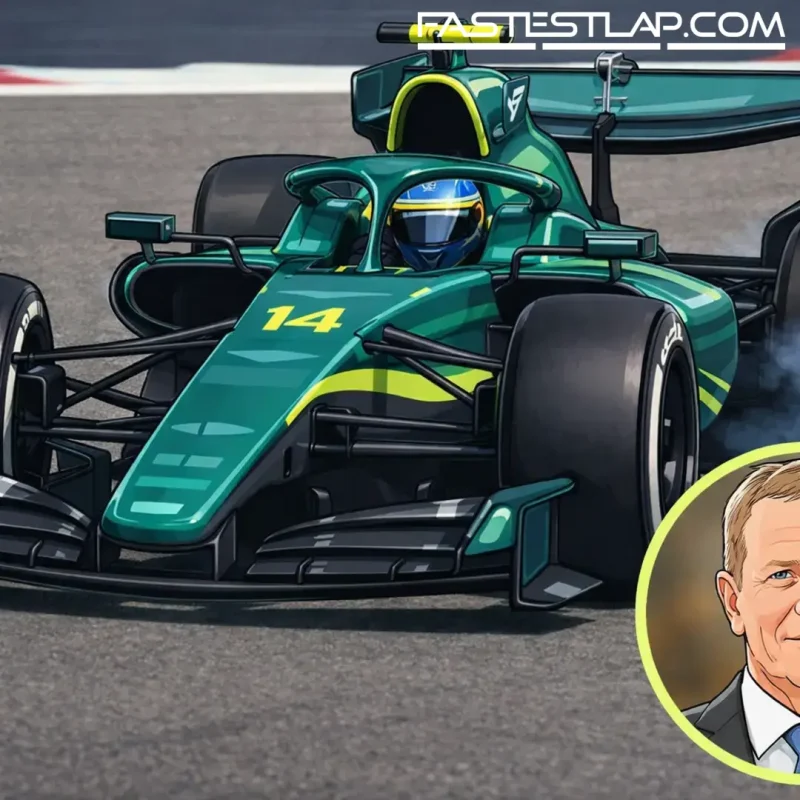
Aston Martin arrived at the new era talking like a team ready to lean on its shiny infrastructure and finally act like a front-runner. Two tests later, it’s mostly been learning how little time you’ve got when your entire technical programme depends on track mileage you can’t bank.
Martin Brundle didn’t bother dressing it up on Sky’s *The F1 Show* podcast, labelling the situation “dire trouble” as the paddock packs up and heads for Melbourne. His concern isn’t just that Aston Martin lost time in Barcelona and Bahrain — it’s what that lack of running does to a brand-new relationship with Honda at the exact moment every rival is hoovering up the kind of data that turns winter assumptions into workable race-weekend direction.
Aston Martin managed only 400 laps across the two pre-season outings, with reliability problems repeatedly taking the AMR26 off the circuit. The biggest hit came at the end of Bahrain, where battery issues and a shortage of Honda power unit spare parts effectively wiped out much of the final day and a half. That’s not simply a missed headline time or a lost long run; it’s the loss of correlation work, the tyre understanding, the baseline setup map — the boring stuff that makes the first flyaway feel like a continuation of testing rather than a blindfolded start.
Brundle’s wider point is the one that will worry Aston Martin most, because it suggests the problem goes beyond teething pains on a new engine. He reckons the link between what Aston Martin’s tools are telling it — windtunnel, CFD, the whole digital pipeline — and what the stopwatch says on track is “miles out”.
That’s the kind of phrase teams dread hearing this early, because it implies you’re not merely fixing parts, you’re questioning conclusions. If the car “didn’t exactly look stuck to the road when it was running,” as Brundle put it, then even the limited data Aston Martin does have may be contaminated by operating issues and stop-start programmes. In a season where everyone is still discovering what the regulations reward, you can’t afford to be unsure whether the aero platform is fundamentally sound.
Honda’s side of the story, as far as Brundle framed it, is equally uncomfortable. He referenced the manufacturer looking behind on “battery recovery – on the power recovery – and reliability”, and painted a picture of costs mounting quickly on the power unit side as parts and batteries get churned through. Honda has since identified “abnormal vibrations” as a trigger for the setbacks, with solutions being developed alongside Aston Martin — but vibrations are rarely a neat, single-switch fix, especially when packaging, installation and control strategies are still being refined in real time.
Even if the root cause is understood, the strategic hit is already baked in. Brundle highlighted the competitive arithmetic that often gets overlooked in glossy partnership launches: customer ecosystems matter. Mercedes has four teams running its package; Ferrari has three. That means oceans of parallel running, different installations, and multiple feedback loops generating data at scale. Audi is a one-team operation, but at least all its mileage goes into one central pot. Honda, right now, has only Aston Martin — and if Aston Martin isn’t circulating, Honda is effectively developing in the dark.
“Can you imagine, after nine days of testing, how much data Mercedes have,” Brundle said. It’s not just the quantity; it’s the variety. Different cars will stumble onto different solutions, and those learnings spread quickly inside an engine group. Aston Martin and Honda don’t have that luxury. Every lost hour hurts twice: once for performance, once for confidence.
That’s where the “snowball effect” becomes real. It’s not melodrama to say the season can start running away from you before you’ve even reached the first parc fermé. If Australia begins with more troubleshooting and compromised sessions, Aston Martin risks spending the opening flyaways simply trying to stabilise the baseline while others are already making performance upgrades with clean reference points.
None of this means Aston Martin is doomed, and Brundle was careful to acknowledge the obvious: the operation has serious resource and serious people. The team is still in the middle of bringing multiple big-ticket elements fully online — a new works power unit partner, a maturing factory set-up, windtunnel and simulator, and the arrival of Adrian Newey as a central figure in the technical direction. The paddock expectation has always been that “new everything” comes with a lag before it clicks.
The issue is that “it’s going to take some time,” as Brundle put it — and 2026 doesn’t offer much patience. The field’s been reset by the regulations, but the competitive behaviours haven’t changed: the teams that start clean tend to get into a rhythm of learning, upgrading and validating, while the teams that start messy end up using races as test sessions they can’t admit are test sessions.
Aston Martin will hope the vibration fix and battery reliability allow it to at least get through a Friday without firefighting. But Brundle’s alarm bell is about something more existential than a handful of broken components. If your correlation is off and your mileage is scarce, you’re not just behind on pace — you’re behind on understanding. And in modern F1, that’s the hardest deficit to claw back.