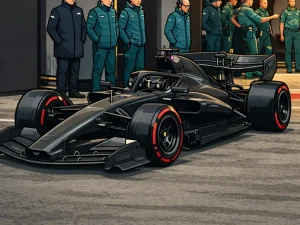
George Russell didn’t need a stopwatch to know which car had everyone craning their necks in Barcelona.
Mercedes left the Circuit de Barcelona-Catalunya shakedown looking organised and — crucially — reliable, with Russell a familiar name at the top of the unofficial timing screens as the W17 racked up big mileage. But the moment Aston Martin finally rolled its AMR26 out in the last hour of the fourth day, it changed the temperature in the paddock. Russell, still in Mercedes kit and shades, called it the standout of the week on sheer design presence — and he’s not treating it as mere aero theatre.
“I think the Aston Martin was probably the most standout in terms of the car design,” Russell said. “I think everybody was looking at that rear suspension and it obviously visually looks very impressive, but it’s not a competition of how sexy it is, it’s a competition of how fast it goes around the track.”
That’s the key point. The AMR26 hasn’t had the luxury of showing its hand through long runs, fuel-corrected comparisons or repeated set-up sweeps — not when it only appeared right at the end and posted the lowest mileage of the teams that ran in Spain. But even in this new era, where everyone’s fighting for the same broad aerodynamic outcomes, there are still rare moments when a car looks genuinely different. Russell’s comment about the rear suspension wasn’t tossed out casually; it was the kind of detail drivers tend to mention when the engineering story is obvious even at walking pace.
Aston Martin’s intrigue is amplified by the politics and personnel behind it. Adrian Newey’s influence is the unmissable subtext — the AMR26 carries the look of a team willing to gamble on distinctive architecture rather than a conservative first build. And in 2026, that’s not a styling exercise; it’s a signal of intent in a regulation reset where packaging, suspension geometry and the way teams manage the platform can define the entire aerodynamic concept.
Russell also pointed to the other half of Aston’s equation: Honda, now supplying Aston Martin as its factory partner. In a paddock that never forgets who delivered what in the previous cycle, Russell’s point was simple — you don’t write off a programme that combines Newey’s design nous with an engine manufacturer that has proven it can deliver at the top.
“And Honda, over the past few years with Red Bull, have had a very good engine beneath them, so we also know what they’re capable of,” he said. “So, that would be awesome to see, a big fight.”
There’s a notable layer to Russell’s assessment: it isn’t framed as fear, but as a warning against lazy pre-season assumptions. Mercedes’ shakedown went as smoothly as any team could ask for — Russell and Kimi Antonelli are widely reported to have logged around 500 laps between them — and that inevitably pulls the “pre-season favourite” tag back towards Brackley. Yet Russell was careful to keep the conversation broader, including Red Bull (now running its own in-house power unit for the first time), plus McLaren and Ferrari, as the likely core group at the front.
“I think at the moment, it does look like Red Bull, McLaren, Ferrari and ourselves are, let’s say, the four teams that are all quite close within one another,” he said. “But, you can’t discount what you’ve seen from Aston Martin, and what Adrian has done with that car. It’s looked pretty spectacular.”
What makes that line interesting is how it plays against the usual winter noise. In February, teams love to sell “encouraging signs” and “good correlation” while downplaying lap times. Drivers do it too — except when the eye test genuinely cuts through. Russell’s essentially saying: yes, Mercedes has banked the mileage and looks tidy, but if a rival has found a new way of generating performance with a distinct concept, the pecking order could shift quickly once everyone turns the wick up.
And Russell isn’t pretending Barcelona gives definitive answers anyway. He was blunt about where the real judgement starts.
“People always look towards the fastest car, and we’ll find that out in Melbourne,” he said. “And whoever that is, that will be the car that you wish to try and take inspiration from.”
That’s the other reality of a rules reset: copying isn’t a dirty word, it’s often the fastest route to recovery. If Aston Martin’s late reveal turns out to be more than a visual talking point — if the numbers in Bahrain and then Melbourne back it up — the rest of the grid will be studying every photograph and every on-board like it’s an exam paper.
Russell, for his part, sounds like someone who wants a proper fight rather than a season dominated by one concept. He even dipped into the nostalgia file, referencing the multi-team scraps of the early 2010s — not as a history lesson, but as a reminder of what a regulation change can produce when more than one organisation gets it right.
Official pre-season testing begins in Bahrain on 11-13 February, followed by another three-day block from 18-20 February. Then the sport heads to Melbourne for the season opener, the Australian Grand Prix, on 6-8 March — the first moment any of this starts to matter.
Until then, Mercedes can enjoy being the team that looked most comfortable in Spain. But Russell’s message was clear: don’t confuse early mileage with a settled hierarchy, and don’t dismiss the car that had the paddock staring — even if it only showed up for the last hour.