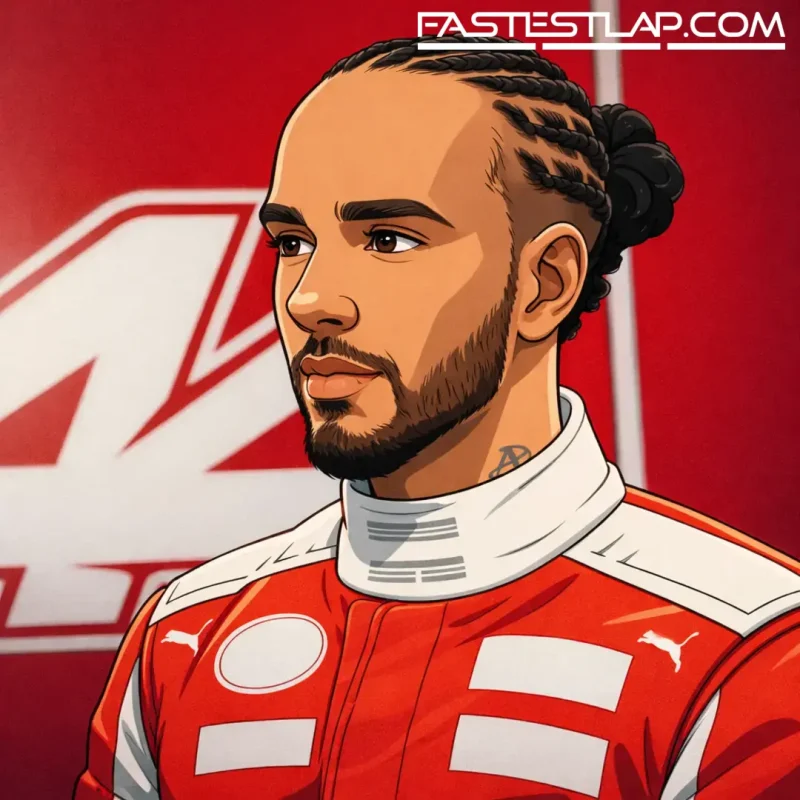
Lewis Hamilton doesn’t usually do melodrama in February. If something feels off, he’ll say it, but in the measured, almost clinical way that’s become his default as he’s moved deeper into the second act of his career.
So it landed with a thud in Bahrain when the Ferrari driver suggested Formula 1’s 2026 cars might demand lift-and-coast on a qualifying lap at the wrong kind of circuit — and that the odd-looking gear choices everyone’s noticed so far are less a quirk and more a symptom.
“We’re doing 600 metres lift and coast on a qualifying lap,” Hamilton said, pointing to Barcelona as the sort of place where the new energy picture could become a straightjacket rather than a weapon. “That’s not what racing is about.”
The paddock has had a month to chew on its first real taste of the new era after a behind-closed-doors shakedown at the Circuit de Barcelona-Catalunya. Bahrain’s three-day test this week, even with limited TV coverage, has been the first chance for the outside world to catch onboards and hear the new cars being driven properly — and one pattern has been obvious: drivers grabbing first and second gear in corners that, under the previous rules, were never anywhere near that low.
Hamilton’s explanation was blunt. The downshifts aren’t some experimental bravado or a “driver preference” story. They’re a response to a car that needs to hoover up more energy than the lap will naturally offer.
“The low gears that we have to go down into is just because we can’t recover enough battery power,” he said. “We can rev the engines very, very, very high so we’re going down to second and first in some places, just to try to recover that extra bit of power.”
It’s an unglamorous detail, but it gets right to the heart of what teams are wrestling with under the 2026 rules. With the MGU-H gone and the MGU-K’s output almost tripled to 350kW, the whole rhythm of a lap changes. The old hybrid era had its own management games, but recovery was more continuous and less dependent on manufacturing opportunities. Now, the car needs decisive moments of harvesting — and if a track doesn’t hand you big braking zones, you may end up creating them artificially through approach, gearing and driving style.
The knock-on effect, Hamilton suggested, is that the cars can feel edgy on entry. Those big steps between low ratios mean the car’s behaviour can change sharply when you drop into first, and the reward is energy rather than pure lap time.
“That definitely doesn’t help, because the steps between those ratios are quite high and so when you kick that down into first gear, it can snap,” he said.
He wasn’t dressing it up as a personal struggle, either. His read was that it’s simply what these cars do at the moment: low downforce, a lot of tyre slip, and the kind of instability that’s more “busy” than “spectacular”. Bahrain, with its heavier braking zones, has offered a friendlier environment than Barcelona — but still, the car hasn’t been making life easy.
“It’s very low downforce,” Hamilton added, noting that the conditions contributed too: a tailwind and plenty of lock-ups into Turn 10. “It’s the hardest getting through Turn 10 today than I think it’s ever been coming to this track… It was just a lot of sliding around on top of the tyres. It’s not spectacular.”
Hamilton’s comments also place him alongside Max Verstappen as another heavyweight voicing unease about what the rule set is pushing drivers towards. Verstappen has already branded the 2026 regulations “anti-racing”. Hamilton’s critique is narrower, but arguably more unsettling: if you’re asking drivers to back out of a qualifying lap hundreds of metres before the apex to make the numbers work, you’re changing the most elemental part of F1’s promise — that Saturday is a flat-out, no-excuses contest.
What makes it tricky is that this doesn’t sound like an issue that will be “fixed” with a setup tweak. It’s structural. And that’s where Hamilton’s other point matters: 2026 may be as much about who can drive the systems as who can drive the car.
Asked whether the fastest car could lose races simply by getting the energy story wrong, Hamilton didn’t pretend he had the answers yet — and that honesty was revealing in itself.
“I have no clue, mate. I have no idea. Really. I can’t even answer that question,” he said. “Energy management is going to be key. Which team is most on top of deployment and all that, and which drivers are on top of that — managing the controls, the feedback the driver is getting — those things are going to be crucial.”
There’s a quiet warning embedded in that. In a field where margins are already tight, the “best” package may not always be the one with the most grip or the most aero efficiency. It might be the one that lands closest to the sweet spot between harvesting and deploying, without forcing its driver into awkward compromises that wreck the lap.
For now, everyone is still gathering data and trying not to overreact to winter noise. But when a seven-time champion at Ferrari is openly talking about lift-and-coast qualifying laps and first-gear corner entries as the price of doing business, it’s hard to pretend this is just early-season grumbling.
The 2026 cars might yet come alive once teams learn how to exploit them. They usually do. The question is whether the sport likes what “alive” looks like this time — and whether the fans will accept that the fastest way around a lap might involve backing off long before the corner even starts.