Max Verstappen hasn’t said he’s quitting Formula 1. He’s just started talking like someone who’s tired of the whole place.
The four-time world champion is still contracted to Red Bull through the end of 2028, but the certainty that used to come with those long deals has evaporated in the first months of 2026. Verstappen’s public relationship with the sport’s new rules package has been combustible from the start, and his language has only sharpened as the season’s early frustrations have piled up.
He’s been one of the loudest critics of the new power-unit direction — the 50/50 split between combustion and electrical power — branding it “anti-racing” and reaching for the kind of metaphors that aren’t meant to be misunderstood. “Mario Kart”, “Mushroom Mode”, Formula E on “steroids”: Verstappen isn’t dressing up an engineering debate as a polite difference of opinion. He’s challenging the premise of the era.
And then came Japan, where he qualified 11th and sounded less angry than resigned.
“I don’t get upset about it. I don’t get disappointed or frustrated by it anymore with what’s going on,” he said. Pressed on what, exactly, he was weighing up, Verstappen’s answer was as blunt as it was loaded: “Life here.”
A day later he doubled down, shifting the conversation from technical gripes to the bigger question that tends to end careers: whether the paddock is still worth the cost.
“I’m thinking about everything inside this paddock… You just think about, is it worth it? Or do I enjoy being more at home with my family, seeing my friends more when you’re not enjoying your sport?”
That’s the bit rival teams listen to. Not the “anti-racing” soundbites, not the regulation rants — the admission that the joy is fading.
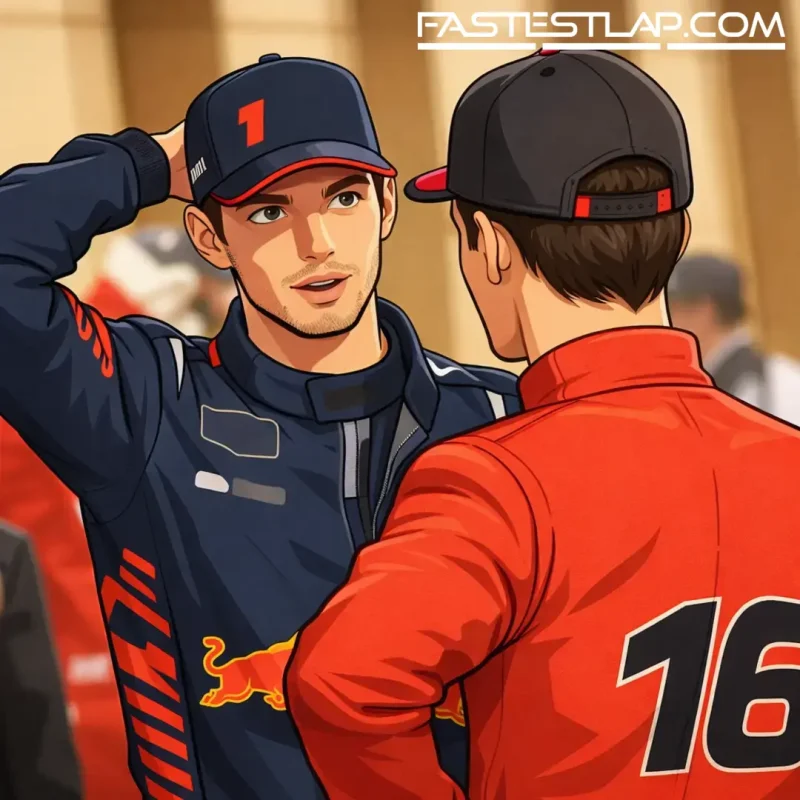
So the market does what it always does: it tries to solve the problem before the problem formally exists. If Verstappen walked away, who could Red Bull realistically put in that seat?
Red Bull’s historical instinct is to promote from within, but even by Milton Keynes standards, expecting the next Verstappen to be sitting neatly on the junior ladder is optimistic. Isack Hadjar has started his Red Bull stint brightly in the opening three races, and Arvid Lindblad has impressed at Racing Bulls, yet neither has done enough — yet — to make the idea of replacing the grid’s defining driver feel anything other than like an act of faith.
That’s why Charles Leclerc’s name keeps drifting into the conversation, even if it’s more about scarcity than a genuine plan. Leclerc is deep into his Ferrari career now, and while his pace has never been the question, his win count — eight, as he enters his eighth season with the team — is the kind of statistic that invites noise. His manager, Nicholas Todt, hinted last season that the situation couldn’t stay static forever if results didn’t follow. Leclerc pushed back, insisting his goal remains winning with Ferrari. The speculation didn’t stop; it rarely does when a driver of that calibre hasn’t had a title-capable run.
Ralf Schumacher, though, isn’t buying the Leclerc-to-Red-Bull theory — and his reasoning is less about driver fit than timing and stability.
Speaking on Sky Deutschland’s podcast, Schumacher argued that Red Bull, in the current shape of the project, isn’t an obvious destination for a driver trying to make the most of his prime years. In his view, Red Bull is in the middle of a long-term rebuild around the new era, beginning with its engine development programme — which Schumacher says has actually gone well — but wrapped in an atmosphere that looks unsettled from the outside.
He described the team as “a bit of a mess” and “chaotic”, and pointed to a lack of clear communication beyond the team’s walls. Schumacher also noted that Helmut Marko is no longer present as the sort of hard-edged figurehead who, for better or worse, used to provide a sense of direction and authority around Red Bull’s driver decisions.
Against that backdrop, Schumacher doesn’t see why Leclerc would jump from a Ferrari operation that, as he put it, is “just starting to function properly” into a Red Bull environment he views as still finding its feet in the new regulations.
There’s another layer to Schumacher’s argument, and it cuts to why Ferrari would likely fight hard to keep Leclerc even if the relationship ever became strained: succession planning.
Schumacher suggested Ferrari’s driver outlook is fairly clear under “normal” conditions, because Lewis Hamilton’s situation is “foreseeable” simply due to age. In other words, Ferrari needs continuity through the next handover, and that means anchoring the project with at least one top-line driver in his prime. In Schumacher’s mind, that driver is Leclerc — making it “not advisable” for Ferrari to even entertain the thought of letting him go.
It’s a refreshingly unsentimental take amid all the daydreaming. Yes, Verstappen’s unease has created a vacuum, and vacuums in F1 are always filled with rumours, hypothetical pairings, and agent-led whispers. But Schumacher’s point is that these moves don’t happen in isolation: the attractiveness of the destination matters, and so does the logic for the team that would be losing the driver.
None of this, of course, answers the central question: whether Verstappen is genuinely plotting an exit, or simply voicing what plenty of drivers mutter privately when a new era asks them to fall back in love with the sport from scratch.
What it does underline is that 2026 has introduced a new kind of tension at the front. Not a classic title fight tension — not yet — but something more brittle: a sense that the grid’s biggest star is negotiating with the sport itself, and isn’t certain he likes the terms.
If that negotiation turns into a goodbye, Red Bull’s replacement problem won’t be solved by plucking a big name from the paddock simply because it looks neat on paper. And if Schumacher’s right, Leclerc won’t be the answer anyway.