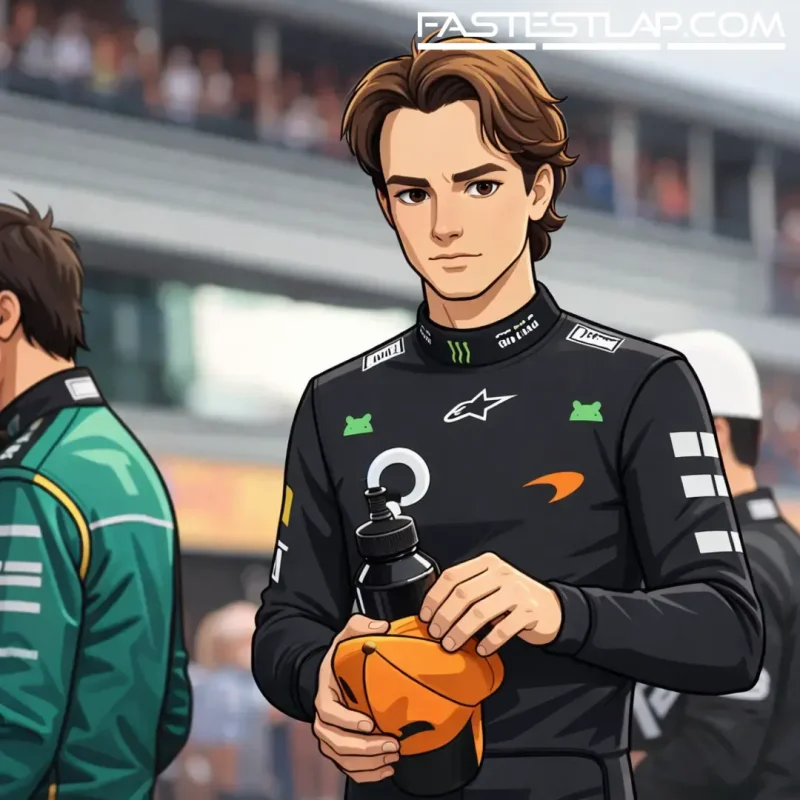
Oscar Piastri doesn’t usually do theatre in the media pen. Even when McLaren’s weekends have gone sideways, he tends to file it under “we’ll look at it” and move on. That’s what made his post-race verdict on Formula 1’s 2026 power units at Spa so striking: not just the language, but the irritation behind it.
“It sucks. I can’t really say it any other way than that,” Piastri said in Belgium, laying into a set of regulations that were supposed to sharpen the sport’s technical edge but, in his view, have instead taken too much agency away from the driver.
The core of the complaint isn’t new. The near-even split between internal combustion and electrical power has divided opinion up and down the pitlane, with drivers grumbling about inconsistent straight-line performance and the sensation that their lap is being shaped as much by software logic as by their right foot. Spa, with its long full-throttle stretches, merely put it under a harsh light.
What’s changed in 2026 is the extent to which the power unit “decides” where to deploy energy. The systems now have a self-learning element, calibrating deployment to maximise lap time — but not always in a way that feels intuitive from the cockpit. And that’s where Piastri’s frustration really lives: the idea that you can execute a lap cleanly, match your team-mate corner for corner, and still come out the other end staring at a deficit that looks more like an algorithmic shrug than a driving mistake.
“When you’ve got qualifying grids decided by computers behaving or misbehaving, it’s a pretty crap way of going racing,” he said.
That line has done the rounds in the paddock because it cuts to an uncomfortable truth. F1 has always been a contest of machinery as much as talent, and engineers have been “deciding” lap time since the first clever intake or suspension trick. But there’s a psychological difference between being outgunned by hardware you can understand, and being beaten by an opaque layer of energy management that can change its mood depending on what you did three corners earlier — or even on the out-lap.
Piastri pointed to exactly that sensitivity. With these engines, he suggested, seemingly minor variables can have disproportionate consequences.
“The engines are so complicated. They are sensitive to everything, and even things you do on an out-lap can dictate what happens,” he said. “It’s a very tricky way of going racing.”
Spa’s qualifying and race weekend only amplified the sense of randomness. Piastri referenced George Russell as another driver who’s had similar issues in recent rounds, and he was careful to broaden the net beyond any one supplier. This isn’t, he insisted, a Mercedes-specific headache — even if McLaren, as a customer team, is naturally more exposed when understanding and optimising the latest systems.
“It’s not just happening with the HPP teams… I think it’s happening with other engine manufacturers as well,” he said. “So, it’s not an us-specific problem.”
That matters, because it reframes the debate. If this was one manufacturer stumbling while others sailed on, the story would be simple: catch up, fix your calibration, do the work. If, instead, the field is wrestling with a regulation concept that produces the same kind of complaints regardless of badge, then it becomes a question of whether the rules have landed in the right place at all.
There’s already movement planned. The direction of travel for the next two seasons is to tilt the balance back towards the combustion engine. The split is set to move to roughly 58-42 in 2027 and then 60-40 in 2028, with fuel flow also increasing along the way. In theory, that should reduce the extent to which the lap is shaped by electrical deployment — or at least lower the stakes when the system doesn’t behave as expected.
Piastri isn’t convinced.
“The change in fuel flow and the less deployment are not going to fix those specific issues,” he said. “It’s to do with how the engine’s calibrated, how the engine learns.”
That’s the most revealing part of his critique, because it suggests the problem isn’t simply “too much battery” in the abstract. It’s the way these hybrid systems have been made to chase efficiency and performance through learning behaviour that can feel detached from what a driver is trying to do in real time. More fuel and less electrical contribution might soften the symptoms, but if the calibration philosophy stays the same — if the engine continues to make its own calls in ways that aren’t predictable lap-to-lap — then the fundamental frustration remains.
In a season where margins are tight and confidence is currency, that unpredictability is corrosive. Drivers don’t need every variable controlled; they need it readable. They can live with compromise. They struggle with the sense that they’re negotiating with the car rather than driving it.
Piastri also acknowledged the likely counterargument: this will improve as manufacturers learn. It’s early in a new era, and the first year of any major engine formula is rarely smooth. But even there, he didn’t mask the annoyance that this is a problem at all.
“Obviously, it will get better as all the manufacturers understand the engines more,” he said, “but the fact that it’s even a problem is pretty annoying for more than just myself.”
The subtext is hard to miss. F1 has sold the 2026 package on relevance and innovation. Drivers, meanwhile, are paid to stand in front of cameras and say the right things about progress. When one of the sport’s most measured voices openly labels the experience “crap”, it’s a sign the honeymoon period is already over — and that the next phase of this rule cycle won’t just be about who finds the most performance, but who can make it feel like racing again.