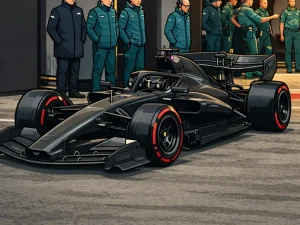
Haas has added another name to what’s quietly become one of the busier driver stables on the grid, confirming Jack Doohan as a reserve driver for the 2026 Formula 1 season.
For Doohan, it’s a clean, pragmatic move at a moment when the market has a habit of swallowing drivers whole. He turns up in 2026 with seven grands prix’ worth of experience, a season of learning the rhythm of a modern F1 weekend, and enough recent mileage in the paddock to be more than a ceremonial backup. Haas, meanwhile, continues to build depth around its race pairing of Esteban Ocon and Oliver Bearman, with Ryō Hirakawa also retained in a reserve role.
Doohan’s path back to this point has been anything but linear. He arrived on the F1 grid at the end of 2024 in Abu Dhabi, then returned in 2025 to complete six races for Alpine. That stint never really got the oxygen it needed: even before he’d properly started, he was surrounded by noise that he was a stopgap for Franco Colapinto, a signing pushed through by Flavio Briatore.
Results didn’t save him. Doohan left those six starts without a point, and Alpine eventually moved him aside — though it didn’t do much to settle the internal narrative, given Colapinto also failed to score. By the time winter rolled around, the talk of a possible Doohan return had been firmly shut down by Briatore, and Doohan ended up parting ways with the team altogether.
At that stage, he was looking at the sort of fork in the road plenty of young drivers fear: pivot away from F1 or keep loitering on the fringes and hope the right door opens. A Super Formula option was explored seriously enough for a mid-December test at Suzuka with Kondo Racing across three days, but he ultimately chose not to pursue that route and instead committed fully to staying in F1’s orbit.
Haas has now thrown him a rope — and, by its own standards, it’s a thoughtful fit. Komatsu has been open in the past about valuing drivers who can contribute in practical ways, not just look good in kit on a Friday. With 2026 bringing a new era of regulations, any team with limited margin for wasted weekends will want reserves who can step in and function immediately, rather than needing three days to remember which button does what.
“I’m thrilled to be joining TGR Haas F1 Team,” Doohan said. “It’s the ideal place to continue my Formula 1 career. I would like to thank the team for giving me the opportunity to grow and take on the great challenge of 2026 together. I’m eager to begin working with the team and collaborating on a successful season.”
Komatsu sounded equally bullish, framing Doohan not as a name to make up the numbers but as someone with the right background — and, crucially, the mindset required for a role that can be awkward for drivers who still see themselves as full-time racers.
“I’m personally very excited to have Jack join us on the team given the strength of his racing resume and of course his experience in being a reserve driver in Formula 1,” Komatsu said. “The dedication required to remain sharp and prepared to race while getting to know how the team works and so on, it’s challenging for any driver – especially one who’s obviously still very keen to race again at this level.
“I’ve enjoyed getting to know Jack and we’re looking forward to welcoming him into the team and benefiting from his contributions.”
The fine print is where it gets interesting. Haas hasn’t detailed what Doohan’s 2026 programme will actually look like, and there’s a notable limitation straight away: he won’t be used to satisfy the rule that mandates teams run a rookie in four FP1 sessions across the season (two per car). Doohan’s seven grands prix take him out of that eligibility bracket.
That doesn’t make him redundant — far from it — but it does shape the type of work he’s likely to do. If Haas wants him in a car, it’ll be through other avenues, such as Testing of Previous Car outings, which also opens the door for joint work with title sponsor Toyota. In a season where teams will be desperate to understand new machinery quickly, that sort of behind-the-scenes track time can be more valuable than the public-facing Friday cameos anyway.
And there’s a wider subtext here for Doohan. A reserve role can be a holding pen, but it can also be a platform if the team believes the driver is worth investing in. Haas’ current driver group — Ocon’s experience, Bearman’s trajectory, Hirakawa’s presence, now Doohan’s addition — reads like an organisation trying to protect itself from the chaos that 2026 could bring. If the new rules catch teams out, if reliability bites, if the calendar grind takes its usual toll, depth suddenly stops being a luxury.
Doohan won’t need telling that this is a serious chance to reframe his F1 story. His Alpine stint became defined by circumstance and gossip as much as anything he did on track. At Haas, the job is simpler: be visible, be useful, be ready. In the modern paddock, that’s often how careers quietly get restarted.