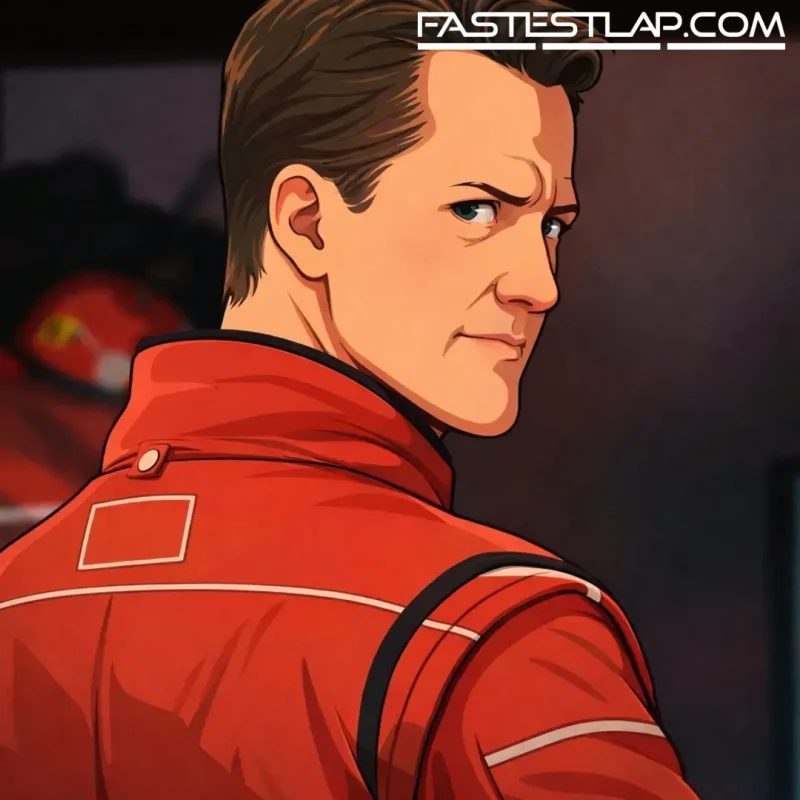
Jean Todt has never been one for dressing up the messy bits of Ferrari’s past, but his latest reflections on Michael Schumacher land with a slightly uncomfortable clarity: the most controversial moments of Schumacher’s career, he says, weren’t the product of some cold, calculating “win-at-all-costs” playbook. They were the opposite. They were emotion — and, in Todt’s words, when Schumacher did cross the line, he “did it badly”.
It’s a striking way to frame incidents that have been litigated for decades, particularly because Todt isn’t pretending they didn’t happen. He’s also not offering the usual soft-focus defence that everything looks different at 300kph. Instead, he’s arguing something more specific: Schumacher wasn’t a habitual cheat, but when the pressure cracked him, the mistake came with a self-inflicted invoice — and it was huge.
Speaking on the *High Performance* podcast, Todt went back to the moment that still stains the 1997 title fight: Jerez, the decider, and the collision with Jacques Villeneuve. Schumacher’s move attracted immediate condemnation and ultimately ended with him being disqualified from the championship.
“’97, we lost the Drivers’ Championship at the last race with his controversial overtaking to Villeneuve, where Michael unfortunately did a mistake,” Todt recalled. Then he sharpened it: “I mean, he crashed into him purposely. But he did it badly.”
That line matters. Todt isn’t excusing intent — he’s questioning the thinking. If Schumacher had truly been operating in some cynical, premeditated mode, Todt suggests, there were cleaner ways to tilt the outcome. Schumacher started on the front row alongside Villeneuve. If you wanted to play that kind of game, Todt argues, the opportunity was there from the start: a late brake, a first-corner squeeze — the kind of thing history has seen before in title showdowns.
Instead, Schumacher chose a desperate moment late in the race, when the situation was already slipping away. It wasn’t surgical; it was reactive. And it backfired immediately.
Todt’s broader point is less about the mechanics of the crash and more about what it reveals: the great champions often sell the idea that they’re made of granite, unaffected by the noise. Todt paints Schumacher as the opposite — someone powered by feeling, and occasionally trapped by it.
“That’s why when you judge somebody in action, you must be very indulgent,” Todt said. “It’s easier around the table to say, ‘You should do that, you should do that’, but when you are in the action, you must understand that your brain is reacting differently.”
You can read that as generous. You can also read it as brutally honest about how thin the margin is between control and impulse when the stakes are a championship.
Todt linked that same emotional snap to Schumacher’s other notorious flashpoint: Monaco qualifying in 2006, when Schumacher stopped his Ferrari at La Rascasse, preventing Fernando Alonso from improving. The stewards sent Schumacher to the back of the grid, while Alonso inherited pole.
Alonso went on to win the race; Schumacher recovered to fifth from a pit-lane start. By season’s end, Schumacher had missed out on the title to Alonso by 13 points — close enough that Monaco’s points swing inevitably became part of the narrative.
“In fact, Michael, an amazing guy, every time he lost control, he paid it very expensive,” Todt said. “So it cost him his championship as, incidentally, in 2006, Monte Carlo qualifying with Alonso, where he purposely span.
“He had to live in the back of the grid. It cost him the championship as well.”
What’s interesting is Todt’s insistence that, for all Schumacher’s reputation as a hard racer — and for all the mythology built around his relentlessness — he didn’t actually “know how to cheat”. Not because he was morally incapable, Todt implied, but because it wasn’t a trait that defined his approach.
“Michael did not know how to cheat,” Todt said. Then came the qualifier that will make plenty of readers raise an eyebrow: “He did it, from my knowing, twice. But he did it badly.”
In Todt’s telling, those two episodes were exceptions that prove the rule. They’re also a reminder of how Ferrari, under Todt, tended to operate when the outside world was screaming. He describes protecting Schumacher privately after Jerez, leaning into solidarity rather than public reprimand.
“I mean, honestly, ‘We are going to protect you. We are together’,” Todt said. “Human mistake. You must accept human error.”
That approach — circling the wagons, keeping the core tight — is practically a Todt-era Ferrari signature. He even suggested that setbacks revealed the group’s true strength: “Probably, the mistake demonstrated a very strong solidarity, because you see the strength of a group of people when things don’t go well. When all goes well, everybody’s friends.”
And if there’s a final layer to Todt’s comments, it’s the reminder that the Schumacher story was never simply about cold performance graphs and ruthless Sunday afternoons. Todt described Schumacher as “emotion” in total — the volatility as well as the generosity — citing Schumacher’s donation of “six or seven million” in aid to victims of the 2005 Asian tsunamis, a tragedy in which Schumacher lost one of his bodyguards.
It’s a complicated portrait, but not a sanitised one. Todt isn’t trying to rewrite Schumacher into a saint, nor is he reducing him to a villain. He’s saying what those close to the sharp edge of F1 often know but rarely admit so plainly: greatness isn’t the absence of weakness. Sometimes it’s learning to live with it — and sometimes, as Schumacher showed in 1997 and 2006, paying the full price when it wins the argument in your head.