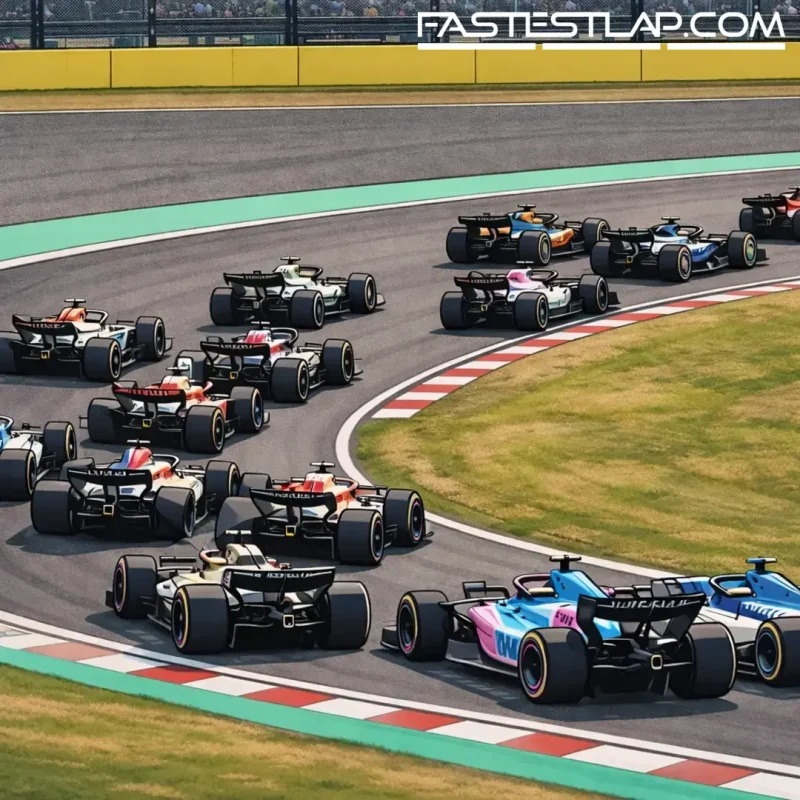
Suzuka has a habit of sharpening every argument in Formula 1. The track exposes weak aerodynamics, punishes tyre management and, as this early stretch of 2026 has shown, it also amplifies the paddock’s oldest obsession: whether the fastest team has simply built the best car, or found the neatest way to live in the margins of the rulebook.
That’s why the FIA’s incoming “hot” compression ratio test has landed with such bite. From June 1, the governing body will begin measuring compression at 130°C, a move designed to close off the loophole at the centre of the current chatter — namely, the suggestion that an engine could comply with the existing 16:1 ambient test yet effectively run a higher compression ratio once up to operating temperature.
Bernie Collins, now on Sky F1 after stints as a senior performance engineer at McLaren and strategy chief at Aston Martin, put her finger on the part that doesn’t quite add up: the temperature itself.
F1 engines, Collins argued on Sky’s *The F1 Show* podcast, don’t live anywhere near 130°C when they’re working hard. They live far hotter — in the 350–400°C ballpark by her estimate — which immediately raises a straightforward question. If the suspected trick (or “innovation”, depending on your sympathies) is tied to components behaving differently as they heat-soak, how much does a 130°C scrutineering point really tell you?
“The first thing to say is this isn’t new in F1,” Collins said, framing it less as scandal and more as the sport’s usual cat-and-mouse. Engineers read what the rules say — and, crucially, what they don’t — then build to the test. Change the test, and you change the game.
It’s a familiar rhythm. Collins pointed to last year’s rear wing clampdown, when the FIA modified the load test to better police flex. The principle is the same here: the scrutineering method becomes the battleground, not the black-and-white of legality. And once a technical story reaches that phase, the sport tends to stop talking about “is it legal?” and starts asking “who will it hurt when the FIA tightens the net?”
Mercedes is the name that keeps getting attached to this one, fairly or not. The allegation is that the Silver Arrows have been able to satisfy the cold test but gain something when hot — with the performance value argued everywhere from “hardly anything” to “several tenths”. The wide spread tells its own story: no one outside the dyno rooms really knows, and those inside aren’t talking.
What’s undeniable is the competitive backdrop. Mercedes has opened 2026 in bruising form, locking out the front row in Melbourne, Shanghai and Suzuka, and winning all three races. Ferrari has been close enough to be noticed, and McLaren’s recent uptick has added some weekend-to-weekend tension, but the results column still reads like a team in control.
In that context, June 1 isn’t just a technical date on a bulletin. It’s a narrative pivot the rest of the grid will cling to, because it offers a simple alternative explanation for what they’re seeing: maybe Mercedes hasn’t just nailed the car — maybe they’ve also been living in a grey zone that’s about to be painted over.
Collins, though, sounded a note of caution that the paddock could do with hearing more often. Even if the FIA’s new test is more representative than the old one, it may still be testing at the wrong point on the curve. Her point wasn’t that the FIA shouldn’t act — it was that the act has to match the reality of how these engines operate.
“We’re bringing in a test that tests how much they compress at 150 degrees,” Collins said, correcting herself mid-flow, “but I’d estimate the engines are something like 350, 400 degrees. So it’s a big, big difference.”
That gap matters because the entire premise of the crackdown is temperature dependence. If the suspected advantage is unlocked at real running temperatures, and the FIA is measuring at a level that’s merely “warm”, the sport could end up in a frustrating halfway house: a new test that looks tougher on paper but still doesn’t capture the behaviour it’s meant to police.
Mercedes, for its part, has insisted publicly that it won’t be affected. That’s exactly what you’d expect a team to say, regardless of whether it’s comfortable or concerned. The more interesting element is how little certainty there is about the knock-on effect across the field. Just as with the rear wing change, teams can be caught out by secondary consequences — a calibration tweak here, a reliability margin there, or an unintended shift in how aggressive you can be with maps over a stint.
And it’s not happening in a vacuum. Mercedes leads the Constructors’ standings by 45 points over Ferrari, and the drivers’ fight is already shaped by intra-team tension as much as inter-team rivalry: Kimi Antonelli is nine points up on George Russell. If June brings even a small swing in performance — or forces teams to run a more conservative operating window — it could change how Mercedes manages that pairing as much as how it fights Ferrari and McLaren.
For now, the compression ratio debate is doing what these debates always do in F1: it’s providing everyone who’s not winning with a reason to keep the faith. But Collins’ temperature point is the most useful detail to surface so far, because it cuts through the noise. This isn’t just about whether the FIA is “closing a loophole”. It’s about whether the sport is targeting the right problem, at the right temperature, in a championship that’s already starting to take shape.
June 1 will tell us something. The question is whether it’ll tell us the whole story.