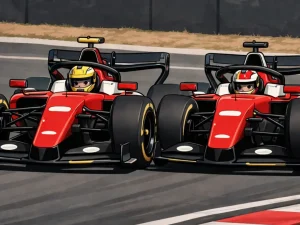
Lando Norris arrived in Melbourne with the No.1 on his McLaren and the kind of tight-lipped calm you usually see from drivers who know they’re about to be judged all over again.
He may be the reigning world champion — after edging Max Verstappen by just two points in 2025 — but Norris isn’t buying into the idea that McLaren now has to carry itself like the paddock’s new benchmark. In his mind, nothing about that changes the job description. The car’s different, the rules have been ripped up, and the pecking order is still a rumour until the lights go out.
Testing did little to settle anything. A skim of the timesheets suggested McLaren sat somewhere around third or fourth quickest, with Mercedes and Ferrari looking like the early pace-setters. Norris, though, wasn’t interested in the doom-and-gloom version of that story.
“I have good confidence in the team no matter what,” he said in Melbourne. “I don’t think we’re starting on the back foot. Even if you’re second, third or fourth quickest, I don’t think that’s on the back foot.
“I think that’s a very good position to start it.”
That’s the crux of McLaren’s current confidence: not that it expects to turn up and steamroller everyone, but that it’s learned how to move. The team spent the opening year of the ground-effect era scrapping around in the midfield, finishing sixth with a single podium, then clawed its way back to the front — beating Red Bull to the 2024 Constructors’ title and backing it up with Norris’ Drivers’ crown last year. For a group that had to rebuild its credibility the hard way, a winter of uncertainty isn’t a crisis. It’s familiar territory.
And 2026 is uncertainty, by design.
Formula 1 has hit reset with new technical regulations and a new generation of power units. The cars are smaller and lighter, active aerodynamics are part of the package, and the engines run on a 50/50 split between combustion and electrical power. In short: everyone’s learning again, and anyone claiming total clarity right now is either bluffing or selling something.
Norris’ point is that you don’t need to be the quickest in February to win in November — and McLaren has recent evidence to lean on. Even in seasons where it felt harder to make big in-year gains, he argued, the team has shown it can still find performance when it matters.
Where Norris sounds most convincing, though, is when he talks less about lap time and more about appetite. Titles can soften drivers; it’s not always obvious at first, but the edges round off, the pain of imperfection dulls. Norris insists it’s had the opposite effect.
“I’m still just as hungry,” he said. “I think it made me want it more, in a way. You get that feeling, the same as when you win one race, you want another one in a race. For me, it was the same feeling with the championship, that one is amazing, but then you definitely want to achieve two.”
It’s a revealing admission from someone who, for years, carried the weight of being F1’s “nearly” guy — fast enough to impress, candid enough to disarm, but always waiting for the full set of tools. Last year gave him the proof. Now comes the harder part: living inside that new identity without letting it change him.
Norris talks about “hunter mentality” in a way that sounds less like a slogan and more like a personal rule. He’s not especially interested in the hunted-versus-hunter framing, because once the visor goes down, he says it doesn’t exist.
“Honestly, I think when you get on track, you’re not either,” he said. “You just go out and get the most out of your car, and I get the most out of me.
“You certainly don’t think, ‘Oh, I’m the hunter now’, and something changes.”
What does matter is the culture that sits behind it: the refusal to feel comfortable, the insistence that a decent result still deserves interrogation, and the sense that McLaren’s rise wasn’t a fairy tale but a process — one that only works if the standards keep tightening.
“That’s also the best mentality for myself, is to set the bar up here and never be happy,” Norris said. “Still to complain about myself and not be too happy with myself until I’ve achieved what I know I’m capable of achieving.”
There’s a line in there that top-level drivers often avoid saying out loud: that he’d feel “embarrassed” if he ever turned up and didn’t want to win. It’s blunt, and it’s useful. Because the real risk for a champion in a regulation reset isn’t losing pace — it’s losing the edge that made the pace matter in the first place.
McLaren doesn’t look like it’s arrived in 2026 expecting an easy ride. If anything, Norris is framing this season as a test of discipline: accept that others may start ahead, trust the team’s capacity to develop, and keep his own standards high enough that he remains uncomfortable even when the results look fine.
The No.1 on the nose might suggest McLaren is now the reference point. Norris is treating it like a target on his back — not in the paranoid sense, but in the only way that works in Formula 1. Assume nothing carries over. Earn it again.