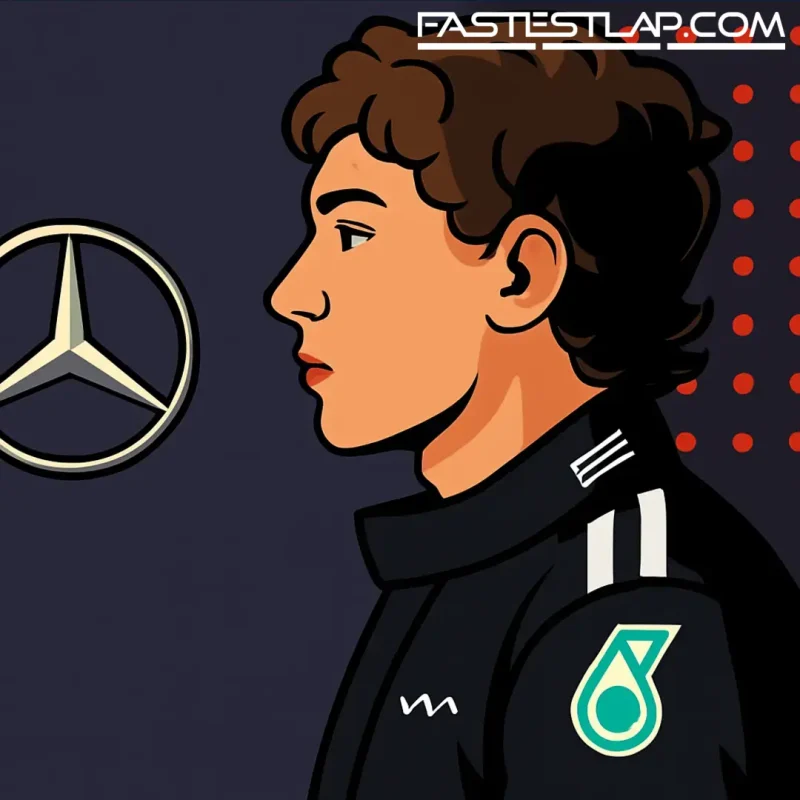
Charles Leclerc has offered a pointed bit of perspective to Kimi Antonelli after the Mercedes rookie was deluged with abuse online in the wake of his late-race error in Qatar — an incident some corners of social media twisted into a conspiracy.
Antonelli, 19 and in his first season with Mercedes, slipped up in the closing stages at Lusail and surrendered a key position to Lando Norris. That alone should’ve been the end of it. Instead, it was weaponised by bad-faith noise suggesting the Italian had done it deliberately to help Norris in the title fight, given McLaren’s Mercedes power unit. There’s no evidence of that, obviously, but the narrative was given oxygen by Helmut Marko’s post-race claim that the mistake looked intentional. Red Bull later apologised, calling the remarks “clearly incorrect,” with Marko’s standing inside the team understood to have taken another dent as a result.
Even before that, Max Verstappen’s race engineer Gianpiero Lambiase had implied something similar over the radio in the heat of battle, only to personally apologise to Mercedes after the flag. The online fallout, though, ran out of control. Antonelli blanked his profile picture and skipped his usual post-race notes, while Mercedes reported the scale of the abuse — including death threats — to the FIA.
Leclerc didn’t mince words in Abu Dhabi. “It’s unacceptable,” the Ferrari driver said. “Those people face no consequence for their words and their disrespect towards drivers. We’re all here trying to do our absolute best… sometimes mistakes happen. In that particular case, the hate was for absolutely nothing.”
Leclerc also recognised the rookie’s reality. “When you’re in your first or second year in F1, you sometimes look at social media… that makes it even more difficult. With experience you get used to it, but we shouldn’t have to get used to this. I hope one day it’s tackled properly.”
George Russell, Antonelli’s Mercedes teammate, echoed the sentiment and pushed the focus back where it belongs. “It’s pretty unacceptable what happened and the abuse online,” he said. “Mistakes were made by the Red Bull guys and they apologised. People make a mistake when they don’t have the full facts. But those thousands behind their keyboards have no excuse. Not just for F1 — society altogether.”
The FIA has ramped up its United Against Online Abuse initiative in recent seasons, a necessary step in a sport that can’t escape the sheer reach — and sometimes ugliness — of modern fandom. Drivers, teams, and the governing body are increasingly aligned on this: disagreement is healthy, harassment isn’t.
Haas rookie Oliver Bearman, who’s had his own taste of F1’s spotlight this year, didn’t sugarcoat his take. “Generally, it’s always the case that people behind the screen are horrible and they’re scum of the earth, really,” he said. “I don’t think they should be doing that type of stuff to someone.”
Bearman suggested part of why he’s avoided the worst of it is simply the environment. “That comes as part of being in a team like Haas rather than Mercedes. You’re a bit less in the limelight. You have the possibility to make mistakes and be less criticised for those… that criticism is an absolute joke. It shouldn’t be tolerated.”
Isack Hadjar — tipped for a big step up the grid in 2026 — was equally blunt. “People behind their keyboards are just idiots,” the Frenchman said. “They all know nothing about racing — never drove ever in their life — so that’s the only reason why they comment.”
Strip away the noise and you’re left with a teenager learning F1 at 300 km/h, the way everyone does: by pushing to the edge and sometimes tripping over it. Antonelli’s mistake in Qatar was the kind every driver makes at some point. The industrial-scale pile-on that followed? That’s the part this sport can’t keep normalising.
It’s heartening, at least, that the paddock closed ranks quickly. Red Bull corrected its own misstep. Rivals stepped up with empathy rather than point-scoring. And Mercedes, quietly and firmly, took the matter to the FIA.
None of that makes the abuse disappear. But it does send a clear message: there’s a hard line between passionate support and targeted harassment — and the drivers, for all the bravado and helmets and heroics, are still people. As Leclerc put it, they’re the same kids who grew up dreaming of this job, now doing it at the limit for our entertainment. Maybe the rest of us can operate with a limit, too.