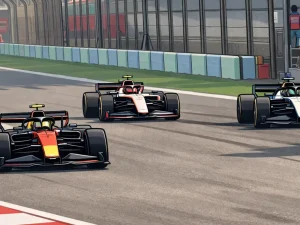
Charles Leclerc didn’t so much sign off Bahrain testing as put a thick underline under it. On the final evening in Sakhir, the Ferrari driver dragged the SF-26 through a handful of untidy moments and still ended up with the headline time: a 1:31.992 that nobody got close to on paper.
But the number that mattered most wasn’t the gap — nine tenths looks dramatic until you remember several of the usual suspects didn’t take a last-gasp qualifying swing at it. Lando Norris, Max Verstappen and George Russell all left a little ambiguity hanging in the air. What Leclerc did, though, was show Ferrari can produce a lap that looks properly sharp even when the car isn’t behaving like a metronome.
That’s the interesting part. Leclerc’s quickest runs came with visible effort: snaps and slides out of Turn 11, a lock-up and excursion into the Turn 1 run-off, and the sort of hand-waving frustration that tells you the lap time was there *despite* the car rather than because it was serenely planted. If this is Ferrari fast while still slightly spiky, the ceiling may be high — but the floor could still be uncomfortable on a bad weekend.
Mercedes’ day had a recovery mission feel from the start. Kimi Antonelli’s morning stoppage forced a reshuffle, leaving Russell to shoulder the late running in the W17. He was out within half an hour of the afternoon session beginning, and he spent as much time in traffic as he did on pure programme work — including an eye-catching moment when he tried to lean on Pierre Gasly into Turn 1, only for the Alpine to stand its ground through the chicane and out to Turn 4. Russell looked like he’d run out of energy as the move fizzled, a little teaser of how the new era might shape wheel-to-wheel fights when drivers can’t simply assume the power and deployment will always be there on demand.
Red Bull, meanwhile, continued to do Red Bull things: seemingly calm, methodical, and not especially interested in broadcasting its full hand. Verstappen cycled through different front wings and brake configurations and still popped in a 1:34.315 to go third at one point, later dipping into the 1:33s. He was Leclerc’s closest challenger for a spell, around seven tenths adrift, and when he lit up a purple first sector on a later push it hinted there was more performance available if the team wanted it.
McLaren’s evening was the opposite of theatrical. Norris didn’t even appear for the first part of the final session, delayed by a technical issue spotted over lunch. When he did finally roll out with just under two hours remaining, it was a short, stop-start rhythm: installation laps, back into the garage, then another brief run. He did get into the 1:33s and at one stage looked capable of threatening Ferrari, only to run wide at Turn 11 and abort a stronger lap. Late on, McLaren fitting C2s while Leclerc chased time on softer rubber suggested the priority had shifted from glory runs to understanding the car.
And then there was Aston Martin — the one team that will leave Bahrain feeling like testing left them behind. Lance Stroll completed just six laps all day, the result of Honda battery issues that had already flared up on Thursday and a lack of spare engine parts that effectively boxed them into “two laps at a time” micro-stints with long pauses to study data. The team confirmed their running was done after those six laps, turning the final afternoon into a spectators’ exercise while rivals piled mileage on.
Team ambassador Pedro de la Rosa insisted Aston Martin has “plenty of data” and a clear view of where the AMR26 needs work, which may well be true — modern sensors will tell you a lot even in short bursts — but there’s no getting around the optics. In a new regulation cycle, everyone wants laps, not just spreadsheets.
Back at Ferrari, the headline run arrived in the final chunk of the day. Leclerc improved steadily — 1:33.629, then 1:33.162 — before bolting on fresh C3s and later working with C4s, the car twitching enough to force him off a better lap at one stage. When it finally hooked up, he punched in a 1:32.297 with 40 minutes left, then ultimately settled on the 1:31.992 as the benchmark. Even a later attempt with another new set of C4s brought a purple final sector without a full-lap improvement, suggesting the lap was already near the limit of what Ferrari could extract in those conditions.
The paddock will naturally keep one eyebrow raised about comparisons. It’s 2026, the cars are fundamentally different, and the only clean thing about testing is that it never answers the question you want answered. Still, a useful reference point flashed through the timing screens: Carlos Sainz’s 1:29.348 from 2025, set on C3s, stands as a reminder of how much has changed with the end of the ground-effect era.
As the sun dropped and the usual end-of-test system checks took over, the pit wall attention drifted to practice starts — always a little window into confidence and mechanical bite. Leclerc again looked sharp off the line, launching from second in the queue and forcing Russell to defend into Turn 1. Yet even there, the sense was of convergence: Ferrari are clearly strong, but the rest are learning quickly.
Testing rarely hands you a definitive pecking order. What it did hand Ferrari was momentum — and Leclerc a small psychological win before the real points start. In a sport that runs on tiny margins and big narratives, finishing on top, even in February, never hurts.