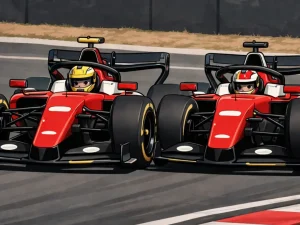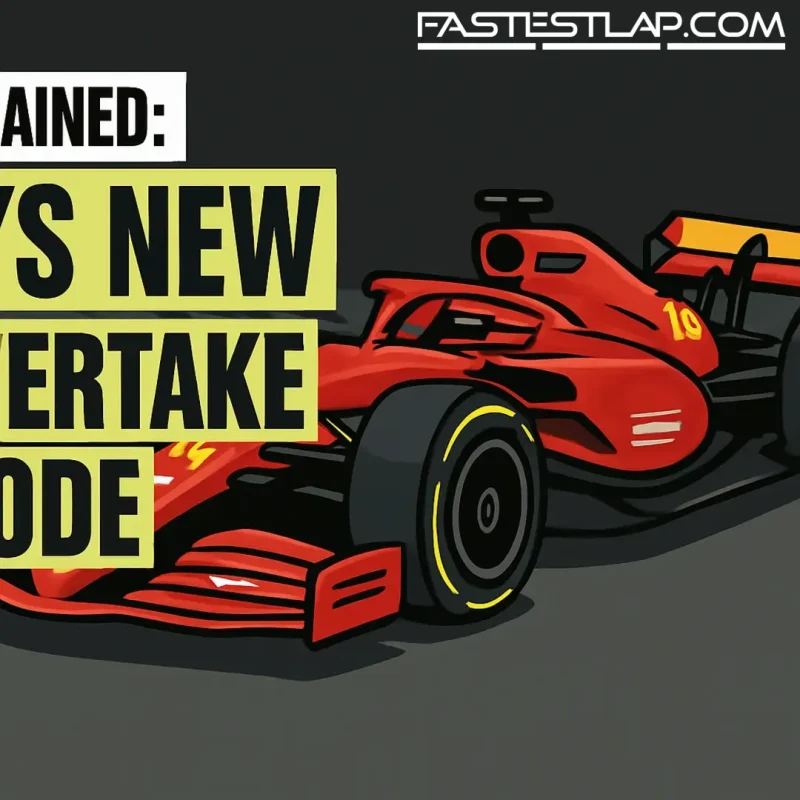
Explained: How F1’s 2026 ‘overtake mode’ replaces DRS — and why it will feel different
Say goodbye to the flap. From 2011 through 2025, DRS did exactly what it said on the label: trim drag, add speed, make passes simpler. In 2026, Formula 1 enters a new playbook. Active aero will keep everyone in low-drag trim down the straights, so the sport’s replacement for DRS isn’t about slicing air. It’s about electric shove.
The headline: an “overtake mode” baked into the 2026 power unit rules will give the attacking car access to extra electrical power from the ERS-K, while the car ahead stays on a leaner deployment map. It’s not push-to-pass in the IndyCar sense — it’s a tightly controlled power window, tied to car speed and specific activation zones, that should make the final metres of a pass more decisive without turning every straight into a motorway lane change.
What is it, in plain terms?
– The 2026 ERS-K can deliver up to 350 kW in total, but how much you’re allowed to deploy depends on your speed.
– In “standard” mode (everyone’s baseline), the maximum deployable power is pegged to speed using two maps:
– Below 340 km/h: max kW = 1800 − 5 × speed. That means you get the full 350 kW up to 290 km/h, then deployment starts tapering.
– From 340 to 345 km/h: max kW = 6900 − 20 × speed, falling to zero by 345 km/h.
– In “overtake” mode (only the attacker gets this), the car uses a more generous map:
– Max kW = 7100 − 20 × speed, and it remains active all the way to 355 km/h.
Put that into something you can feel trackside. At 338 km/h, a car in standard mode can use only 110 kW. If you’re the chaser with overtake mode enabled at the same speed, you can throw 340 kW at the rear wheels — almost the full ERS hit. Your deployment doesn’t begin to taper until roughly 337 km/h, and it lasts deeper into the straight, only reaching zero at 355 km/h.
No rear-wing trickery, just more electrical punch for the hunter and less for the hunted, particularly in the part of the straight where passes tend to stall out today.
The guardrails
– The FIA can dial back maximum ERS-K outputs at individual circuits if top speeds get spicy for the venue’s safety envelope. Any adjustment applies equally to standard and overtake modes.
– Energy management will matter. Drivers can harvest up to 8.5 MJ per lap; the rules allow an extra 0.5 MJ on a lap where a driver uses overtake mode. In other words, that bigger deployment window comes with a slightly bigger battery budget — but only on that lap.
When can drivers use it?
Like DRS, overtake mode will live inside detection and activation zones, with the details sent to teams at least four weeks before each event. Key points:
– There’s still a detection gap, but it isn’t fixed to one second. The FIA will set the threshold per track.
– No use on Lap 1; it becomes available after the race leader crosses the detection line for the first time.
– After a Safety Car, it’s re-enabled when the whole field has passed the detection line.
– The Race Director can disable it for visibility, grip, or any safety concern.
– It’s available in practice and qualifying. If it’s disabled mid-qualifying, it stays off for the rest of that segment.
– If the car’s automated notification fails, a team can request permission to operate it manually — but it’s on them to police legal use.
What it means for racing
The most common complaint about DRS was that it sometimes turned art into admin: get within a second, press a button, breeze past. The 2026 layout tries to fix the “breeze” bit. Because everyone’s running low-drag down the straights as part of the base aero concept, there’s no “sail past with the wing open” advantage anymore. The pass comes from the attacker carrying more electrical power for longer — especially in the upper-speed phase where downforce isn’t your limiting factor and raw grunt sets the table.
On paper, this should:
– Reward battery management and harvesting strategy. You can’t spam the button without planning your state of charge.
– Make the defending job more nuanced. You can still place your car and fight on entry and exit, but you won’t be able to match the attacker’s top-end deployment when they’re in range.
– Shift racecraft emphasis back to exit speed and timing the launch — get the drive, then use the extra ERS window to finish the move, not just to arrive alongside.
There’s also an element of the unknown. DRS zones benefitted from 15 seasons of data. Overtake-mode zones start with a blank sheet, and the FIA will have to tune them round by round. Expect some races in early 2026 to feature tweaks across the weekend as the sport finds the sweet spot between “no chance” and “drive-by.”
The verdict
Call it a recalibration rather than a revolution. F1 isn’t ditching assistance; it’s changing the kind. The overtake mode hands the attacker real, usable power where it counts while asking drivers and engineers to think harder about energy as a weapon. If it lands as intended, we’ll see fewer perfunctory passes — and more moves that start with guile and end with electricity.